In 2026, more than 900 million people are estimated to be regularly using generative artificial intelligence—computer systems capable of creating human-like text, images, audio, video, and other original content.1 AI is becoming integrated into nearly every aspect of daily life. Health care is no exception.
Across mental health care, cancer care, and the intersection of these disciplines, psycho-oncology, AI is rapidly emerging as a tool to support patient education, clinical decision-making, communication, symptom management, and psychosocial care.
As these technologies continue to evolve, they present unprecedented opportunities to improve access to comprehensive, personalized care while simultaneously introducing important ethical challenges surrounding fairness, accountability, transparency, privacy, and patient safety.2-7
Among the populations most likely to engage with emerging AI technologies are the more than 2.1 million adolescent and young adult, or AYA, survivors of cancer in the United States. AYAs face unique psychological, social, and treatment-related challenges that often require personalized, long-term support. As adolescent and young adults are some of the earliest adopters of emerging digital technologies, ensuring that AI-based tools are developed, recommended, and implemented ethically is essential to providing safe and equitable psycho-oncological care for this specific population.8-17
Ethical AI and mental health ethics have often developed along separate paths, but with new integrations come the new challenge of sharing the same goal: Providing safe, equitable, trustworthy, and patient-centered care.
The purpose of this editorial is to present a collaborative ethical framework that combines principles of ethical AI development with professional mental health ethics to guide the design, implementation, and use of AI technologies in psycho-oncology.
Figure 1: A Collaborative Ethical Framework for AI In Physho-Oncology
Although our framework (Figure 1), is presented in the context of adolescent and young adult survivors of cancer, within psycho-oncology, its guiding principles may serve as a foundation for the ethical development and implementation of AI technologies across other patient populations and healthcare settings as AI continues to transform clinical care.
AI developers are guided by principles such as fairness, transparency, accountability, privacy, and security, while mental health professionals follow ethical standards including justice, integrity, fidelity and responsibility, respect for people’s rights and dignity, and beneficence and nonmaleficence.
Together, these complementary principles provide a strong ethical foundation for integrating AI into psycho-oncological care.18,19 (Figure 1)
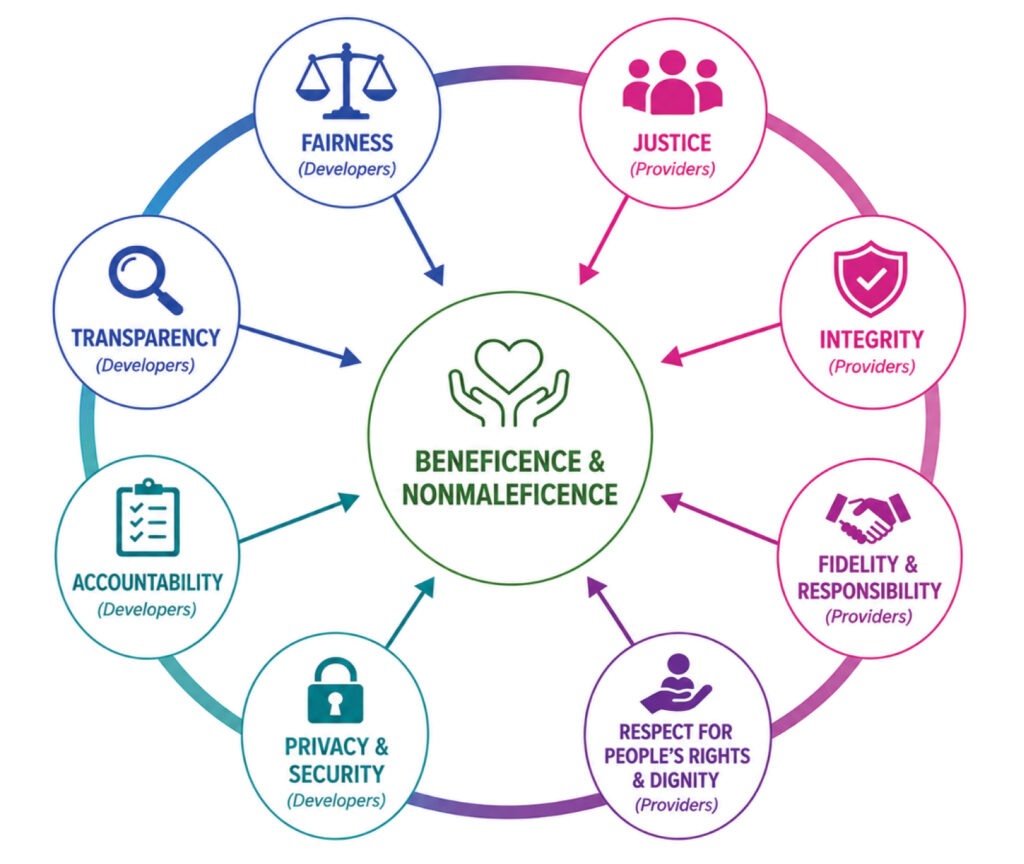
Achieving this goal requires collaboration between the individuals who build AI technologies and the mental health providers who recommend and use them. Ethical guidance is therefore needed for both developers and mental health providers.
Fairness & justice
Fairness in AI and the mental health principle of justice share a common goal: Ensuring that every patient has an equitable opportunity to benefit from AI-enabled care. Ethical AI should perform consistently across the diverse populations it is intended to serve, while mental health providers have an ethical obligation to ensure that all patients receive fair, inclusive, and appropriate care.
Together, these complementary principles help reduce disparities and promote equitable psycho-oncological care for adolescent and young adult survivors of cancer.8-17
Developers play a critical role by designing AI systems using diverse, representative datasets and continuously evaluating them for bias and discrimination. Clinicians complement this work by determining whether AI tools have been appropriately developed and validated for the patients they serve and by recognizing barriers, such as technology or tool bias/discrimination, language, cost, internet access, or digital literacy that may limit equitable use.
Together, fairness and justice remind us that ethical AI is not simply about building accurate technologies, it is about ensuring those technologies improve care for all patients they intend to serve. 18,19
Transparency & integrity
Transparency in AI and the mental health principle of integrity share a common goal: ensuring that AI technologies are honest, understandable, and worthy of patient trust. Developers promote transparency by documenting how AI systems are built, including their evidence base, intended populations, and known limitations. This information enables clinicians to critically evaluate whether a technology is appropriate for their patients and supports honest conversations about what AI can and cannot do.18-21
Developers should build AI using trustworthy evidence, while continually evaluating performance and openly reporting limitations. Mental health providers should understand this evidence before incorporating AI into care, recognize when human judgment remains essential, and communicate strengths and limitations clearly with patients.
Together, transparency and integrity ensure that trust is built not simply because AI provides an answer, but because developers create technologies that can be understood and mental health providers help patients understand when those technologies should and should not be trusted.
Accountability & fidelity and responsibility
Accountability in AI and the mental health principles of fidelity and responsibility share a common goal: ensuring that responsibility for patient care always remains with people, not technology.
Developers should incorporate safeguards, monitor performance, and build systems that recognize situations requiring human intervention. Mental health providers should understand these safeguards, recognize their limitations, and ensure patients receive appropriate clinical care whenever AI reaches the limits of its intended role. 18,19,22-25
Recommending an AI technology carries the same ethical obligation as recommending any other clinical resource. Developers remain responsible for monitoring and improving AI after deployment, while clinicians remain responsible for deciding when and how it should be used.
Together, accountability and fidelity remind us that while AI may enhance psycho-oncological care, ethical responsibility always remains with the developers who create these technologies and the mental health providers who incorporate them into patient care.
Privacy, security, and respect for people’s rights and dignity
Privacy, security, and respect for people’s rights and dignity share a common goal: protecting patients’ personal information, autonomy, and right to make informed decisions about their care.
Developers should build AI technologies that minimize data collection, implement strong cybersecurity protections, and clearly communicate how information is collected, stored, and used. Mental health providers complement these efforts by understanding these protections and helping patients make informed decisions about using AI.18, 19, 26-28
Respect for patient dignity extends beyond protecting information, it also protects autonomy. Developers should design inclusive, understandable technologies that avoid unnecessary data collection, while mental health providers should ensure AI remains a choice rather than a requirement for care.
Together, these principles remind us that ethical AI is defined not by the amount of information it can collect, but by how responsibly it protects patients’ information, autonomy, and trust.
Beneficence and nonmaleficence: The shared ethical goal
Although fairness, transparency, accountability, privacy, and their corresponding mental health principles each address different aspects of ethical AI, they ultimately share an objective: Beneficence and nonmaleficence, the ethical obligation to maximize benefit, while minimizing harm for patients.
These principles collectively guide the ethical development, implementation, and use of AI technologies in psycho-oncology, particularly for AYA survivors of cancer.8-17f
As AI continues to transform health care, the question is no longer whether these technologies will become part of psycho-oncological care, but how they will be integrated responsibly.
Although this framework was developed for adolescent and young adult survivors of cancer, its guiding principles may inform the ethical development and implementation of AI across other patient populations and healthcare settings.
As AI continues to evolve, ensuring innovation remains grounded in shared, collaborative ethical responsibility will be essential to realizing its greatest promise, not replacing human care, but strengthening our ability to deliver it.
References
- Malik A. ChatGPT reaches 900M weekly active users. TechCrunch. Published February 27, 2026. Accessed August 13, 2026.
- Foote K. A brief history of generative AI. DATAVERSITY. Published September 10, 2025. Accessed June 3, 2026. https://www.dataversity.net/articles/a-brief-history-of-generative-ai/
- Dediu H. Teen survey update: what happens when teens grow up? Asymco. Published February 16, 2026. Accessed June 3, 2026. https://asymco.com/2026/02/16/teen-survey-update-what-happens-when-teens-grow-up/
- Li J, Zhang L, Yu Z, Bao Z, Li D, Wang L. The impact of AI on modern oncology from early detection to personalized cancer treatment. NPJ Precis Oncol. 2026;10:69. doi:10.1038/s41698-026-01276-6
- White BM, Aitken GL, Zink JA, Kheirkhah Rahimabad P, Kumsa FA, Hashtarkhani S, et al. Empathic AI for patient-centered cancer care: a scoping review of patient navigation, support, and clinical practice. JMIR Cancer. 2026;12:e82336.
- Torous J, Blease C. Generative artificial intelligence in mental health care: potential benefits and current challenges. World Psychiatry. 2024;23(1):1-2. doi:10.1002/wps.21148.
- Zhang Q, Zhang R, Xiong Y, Sui Y, Tong C, Lin FH. Generative AI mental health chatbots as therapeutic tools: systematic review and meta-analysis of their role in reducing mental health issues. J Med Internet Res. 2025;27:e78238. doi:10.2196/78238.
- Cheung A, Haas O, Majid S, et al. Artificial intelligence in psycho-oncology: opportunities, challenges, and future directions. PsychoOncology. 2025;34(3):e70052. doi:10.1002/pon.70052.
- Tai E, Buchanan N, Townsend J, Fairley T, Moore A, Richardson LC. Health status of adolescent and young adult cancer survivors. Cancer. 2012;118(19):4884-4891. doi:10.1002/cncr.27445.
- McCarthy MC, McNeil R, Drew S, Dunt D, Kosola S, Orme L, et al. Psychological distress and posttraumatic stress symptoms in adolescents and young adults with cancer and their parents. J Adolesc Young Adult Oncol. 2016;5(4):322-329. doi:10.1089/jayao.2016.0015.
- Yan A, Howden K, Mahar AL, et al. Experiences of adolescent and young adult cancer survivors during the COVID-19 pandemic. J Cancer Surviv. 2023;17(2):370-383. doi:10.1007/s11764-021-01158-9.
- Saris LMH, Vlooswijk C, Kaal SEJ, Nuver J, Bijlsma RM, van der Hulle T, et al. A negative body image among adolescent and young adult (AYA) cancer survivors: results from the population-based SURVAYA study. Cancers (Basel). 2022;14(21):5243. doi:10.3390/cancers14215243.
- Kim B, White K, Patterson P. Understanding the experiences of adolescents and young adults with cancer: a meta-synthesis. Eur J Oncol Nurs. 2016;24:39-53. doi:10.1016/j.ejon.2016.06.002.
- Vogels EA, Gelles-Watnick R, Massarat N. Teens, Social Media and Technology 2022. Pew Research Center; August 10, 2022. Accessed June 3, 2026. https://www.pewresearch.org/internet/2022/08/10/teens-social-media-and-technology-2022/
- Guadagno JA, Tezanos AGV, Flores M, et al. Mobile phone interventions to improve medication adherence among adolescents and young adults: systematic review and meta-analysis. JMIR Mhealth Uhealth. 2017;5(5):e66. doi:10.2196/mhealth.7798.
- Kennedy B, Yam E, Kikuchi E, Pula I, Fuentes J. AI in Americans’ Lives: Awareness, Experiences and Attitudes. Pew Research Center. Published September 17, 2025. Accessed June 3, 2026. https://www.pewresearch.org/science/2025/09/17/ai-in-americans-lives-awareness-experiences-and-attitudes/
- McBain RK, Cantor J, Kofner A, et al. Use of generative AI for mental health advice among US adolescents and young adults. JAMA Netw Open. 2025;8(11):e2542281. doi:10.1001/jamanetworkopen.2025.42281.
- American Psychological Association. Ethical Principles of Psychologists and Code of Conduct. American Psychological Association. Updated January 1, 2017. Accessed June 3, 2026. https://www.apa.org/ethics/code/ethics-code-2017.pdf
- Impink M. Building a responsible AI framework: 5 key principles for organizations. Harvard Professional & Executive Development Blog. Published June 26, 2025. Accessed June 3, 2026.
- OpenAI. Overview of OpenAI crawlers. OpenAI Developers. Accessed June 3, 2026. https://developers.openai.com/api/docs/bots
- Leffer L. Your personal information is probably being used to train generative AI models. Sci Am. Published October 19, 2023. Accessed June 3, 2026. https://www.scientificamerican.com/article/your-personal-information-is-probably-being-used-to-train-generative-ai-models/
- Duffy C. Character.AI and Google agree to settle lawsuits over teen mental health harms and suicides. CNN Business. Published January 7, 2026. Accessed June 3, 2026. https://www.cnn.com/2026/01/07/business/character-ai-google-settle-teen-suicide-lawsuit.
- Ruwitch J. A new lawsuit blames ChatGPT for a murder-suicide. NPR. Published December 12, 2025. Accessed June 3, 2026. https://www.npr.org/2025/12/12/nx-s1-5642599/a-new-lawsuit-blames-chatgpt-for-a-murder-suicide.
- De Freitas J, Oğuz Uğuralp Z, Uğuralp AK. Emotional Manipulation by AI Companions. Harvard Business School Working Paper No. 26-005. Harvard Business School; August 2025. Revised October 2025.
- Fukami T. Enhancing healthcare accountability for administrators: fostering transparency for patient safety and quality enhancement. Cureus. 2024;16(8):e66007. doi:10.7759/cureus.66007.
- Ponemon Institute. Cost of a Data Breach Report 2025: The AI Oversight Gap. IBM Security; 2025. Accessed June 3, 2026. https://www.ibm.com/reports/data-breach
- Ghazal LV, Johnston H, Dodd E, Casillas J, Lightfoot AF, Quinn GP, et al. A needs assessment approach for adolescent and young adult sexual and gender diverse cancer survivors. Int J Environ Res Public Health. 2024;21(4):424. doi:10.3390/ijerph21040424.
- Barnett M, McDonnell G, DeRosa A, Schuler T, Philip E, Peterson L, et al. Psychosocial outcomes and interventions among cancer survivors diagnosed during adolescence and young adulthood (AYA): a systematic review. J Cancer Surviv. 2016;10(5):814-831. doi:10.1007/s11764-016-0527-6.