My high school experience revolved around constantly worrying about my four younger siblings and mom amidst our normal condition—instability.
Being unhoused meant sleeping in our car.
Our small car provided sleeping quarters for seven people, myself and six others. We slept pressed tightly against each other, our bags of clothes, and the walls of the vehicle.
At nights, in the dark parking lots of closed businesses, my body stayed awake, cautious of who or what may be out there. My upright position and the hot air fueled the anxiety, leading up to all-nighters that began with my waking up with a jolt at, give or take 1 a.m., and looking out the car window.
Often, I gave up my share of meals—combo deals from Wendy’s or Little Caesar’s—so that the small amount could stretch longer for my siblings. Food or no food, I was going to feel hungry regardless.
I spent some nights outside, with my family’s belongings stuffed in garbage bags and suitcases, moving from one part of the city to another after each denial for a room. I stood, frustrated and tired, wondering whether we would ever find a place that would be willing to take in all of us.
On occasion, my family and I stayed with my aunt and uncle who lived an hour away from my school district. Across my siblings and me, our grade levels spanned elementary, middle, and high school.
To make a single round trip, I arrived at my high school extremely early and left extremely late. The school—Berkmar High, in Lilburn, GA—provided what I desperately wanted, the time to focus on my emerging academic passions, plus sturdy shelter against the elements.
School closed, books opened. Day in, day out. Shed some tears and blotch my notes. Shake it off and move on. That rhythm became familiar, keeping me going much like the rhythm of my heartbeat.
Meanwhile, my home life remained chaotic, as each day we had to choose between food, shelter, or gas. Having all three was outside our price range. Even with the large amount of downtime I had before school officially started, these concerns crowded in the forefront of my mind.
I tried my best to maximize my productivity, never knowing what my home life might fling at me later that afternoon. School closed, books opened—day in, day out. Shed some tears, blotch my notes, shake it off, move on. This rhythm became familiar, keeping me pushing ahead, like the rhythm of my heartbeat.
Today, I am an MD-PhD student at Washington University School of Medicine in St. Louis, also known as WashU Medicine, rooted by training at Case Western Reserve University and Vanderbilt University. I’ve seen these institutions referred to as the “New Ivies.” I prefer the image of an “Oak,” because that’s the role these places played in my life—stable, sturdy, mightily reaching upward. Attending these Oak League universities, I developed my scientific mind and career aspirations, remaining persistent in my goals and persevering with the strength of an oak tree.
My main interest is cancer.
What I just gave you is a rough outline of what happened, how I covered the distance from Point A to Point B, from childhood to the Oak League.
The rest is nuanced, the things that happened backstage. There’s always much more happening behind the scenes.
When you grow up the way I did, you never know when and how much to share about your background. Even as I write this, I’m hesitant. Am I telling more than I should? Will this turn around and bite me? But I repeat to myself that if my story can make one person more open-minded or help someone push through adversity, then I’ll keep recounting my hardships and my journey.
I’m a Black man who struggled with homelessness in the past. My family is still homeless, with secondary effects of homelessness still profoundly impacting our lives. However, the community I developed in each aspect of my life kept pushing me forward, keeping doors open while life was trying to close them.
These good people helped me see beyond that fogged-up car’s window from my past. Thanks to them, gradually, I came to see the world as an open place.
My high school struggles culminated in being salutatorian and receiving the Questbridge full-ride scholarship to attend Vanderbilt University.
Undergrad came with luxuries that included three meals a day and certainty that I would be sleeping horizontally, in an actual bed, with sheets, a pillow, and a blanket, night after night.
Meanwhile, my family’s situation did not change.
In class, I found my mind drifting off from lecture to images of my family lugging bags, heavy bags, in the sun, with nowhere to go. That’s when I took it upon myself to take as many jobs as I could. At one point, I was a host in a sushi restaurant, a tutor, and a math learning assistant.
Before I knew it, in addition to my math and biochemistry double major and time in the lab, I was working near the weekly max of 19 hours for full-time students. This schedule caused sleepless nights and encouraged a monotonous disposition, as my grades suffered and I withdrew from my peers.
I was too tired to do my very best at school and be social. But I was sending home as much as $200 on a good week, and in some cases I would overdraw my bank account by $500 because the amount I made working just wasn’t enough.
My mom, noticing with each call how her son’s voice was sounding unfamiliar, gave me the most important advice I heard during this period: Never become a product of your circumstances.
At that moment, I brushed it off, moved on.
But over time, I gained an appreciation for those words. Bit by bit, I found myself arriving early to my obligations with newfound energy. I was seating regulars at the restaurant, engaging with them as they talked about their day, or hearing from students I tutored as they shared their test results with me. Their emotions were infectious, and they brought meaning to my jobs.
I had only heard my mom’s words before. Now, I was listening to them. I would not become a product of my circumstances. Never.
For the first time, I shared the story of my background with my closest college friends. Even though I shook and stuttered getting the words out, they responded with a hug and an invitation to play video games.
All the emotional support I received pushed me to continue striving in my classes while also giving me a fresh burst of energy to keep up with my intense schedule. I was able to immerse myself in my STEM courses, and seeing the intersection of health and science made something click for me.
Sure, my background demonstrates that life is unfair, but illness represents a different type of unfair. Who gets sick and why? Who has limited access to health resources and why?
Sometime during high school, I accepted this unfairness in life, but now I sought to challenge it. I wanted to take the responsibility of both deeply understanding diseases and improving the health of those around me: to give back by helping people recover, to return to the world, to life.
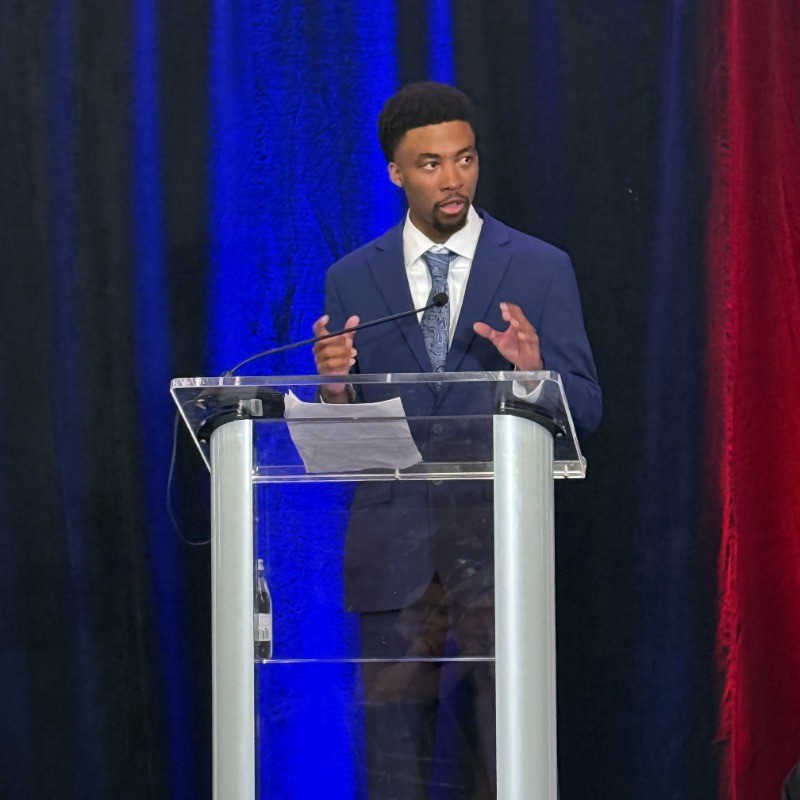
American Cancer Society Medal of Honor ceremony.
Even with my insane schedule, I managed to spend time in the lab. There, I investigated the proteins of the brain-eating amoeba which causes a rare but deadly brain infection. Throughout my research project, I learned how limited treatment options for this disease were. That’s when I realized how the laboratory work was aimed to address this issue, and how I could join the fight to combat poorly characterized diseases, to fill in critical gaps in healthcare through rigorous, reproducible research.
I shifted career ambitions to see if there was a job that involved both basic research and clinical medicine. Not just a role that allowed me to do both, but something that fully integrated the two on a daily basis and that’s when I discovered it; my true career aspiration.
By graduation from Vanderbilt, I was clear that I wanted to become a physician-scientist and train in a dual MD and PhD degree-granting program. However, I lacked the lab experience and skills required to achieve that goal compared to my peers who didn’t need to work to provide for their families.
With my efforts devoted to making money and sending it to my family, I missed out on learning how to communicate through speech and writing, and how to drive a research project independently. I realized that these were not things you pick up through perseverance, natural smarts, and resourcefulness.
I knew that I could do better if I just had more time, support, instruction, and mentorship.
Fortunately, the American Cancer Society-funded postbaccalaureate program at the Case Comprehensive Cancer Center provided the perfect opportunity to catch up.
The Center for Innovation in Cancer Research Training at ACS, led by Dr. Ellie Daniels, strives to create a pool of talented trainees with skills needed to excel in cancer research and—yes—revolutionize the field.
ACS funds 31 post-baccalaureate programs across the U.S., providing mentored research training, career development, and social support to facilitate the successful transition to graduate or professional school.
The basis of my research project in the program at Case aimed to investigate lung cancer cell interactions under different environmental conditions through a mathematical and ecological lens.
I loved it!
I spent time troubleshooting experiments, presenting my research at conferences, and engaging with researchers at other institutions. Most importantly, I received incredible mentorship from my PI, Dr. Jacob Scott, a radiation oncologist at the Cleveland Clinic, who served as my role model for the physician-scientist path.
While making clinical rounds with him, I experienced how appreciative patients with a recent cancer diagnosis were with his bedside manner. Their facial expressions conveyed a sense of relief as he listened to their concerns and explained treatment options.
Afterwards, he brought me to another section of the hospital, where I witnessed his collaboration with colleagues to develop a radiation treatment plan. The procedure was only possible with the input he received from the dosimetrists, who direct where the radiation goes, and medical physicists, who ensured the accuracy of the radiation machine.
In the lab, I saw students go into his office and come out eager to work on the next steps for their project.
One day, a patient stopped by and toured the facility.
As he spoke about his experience with cancer, he showed us a scar on his leg where a tumor was resected, tearing up in the process. He looked around the lab, inquiring about our cell culture work and math theories on the whiteboard, and thanked us for the work we perform.
Seeing the patient connect benchwork to real human stakes, I understood the significance of the research my peers and I conducted under Dr. Scott’s guidance. Moreover, the physician-scientist role became clear.
When a patient presents with an illness with no treatment in the clinic, research can push against that, leading to a discovery that improves that patient’s life and the lives of others with a similar condition. That core purpose is what I strive to achieve.
I knew I was on the right path.
Along with my experience in Dr. Scott’s lab, the ACS Case CCC postbaccalaureate program director and assistant director, Drs. Ruth Keri and Damian Junk, have dedicated themselves to making the program rigorous and impactful.
At Case, I took graduate cancer biology courses, engaged in oncology shadowing, and attended workshops to obtain new skills. The final requirement was a research manuscript and presentation, after which I was awarded with my Case Western Reserve University graduate certificate in cancer studies.
Throughout the whole program, Drs. Keri and Junk were available to guide all the fellows and answer questions about our future career pathway. No matter what topic I had in mind, I could simply walk into their office and sit down to talk about it. Because of them, I became familiar with techniques to make grant applications concise and compelling, common difficulties that faculty researchers experience, and factors in scientific literature that strengthen or weaken its claims.
Next, I had to overcome my weakness with oral presentation.
My first time speaking before my peers and the directors, I stumbled over my words and failed to convey my presentation’s key points.
Public speaking is a talent, of course, but it’s also a skill that can be developed.
I lacked public speaking experience, and I grew scared of all the eyes focused upon me, never quite sure if what I had to say was being heard, or judged. I spoke with so little confidence that if my sentences were transcribed, most of them would end in question marks as opposed to periods.
Since then, I’ve worked toward distilling the “why” and “how” of my research with feedback from Drs. Keri and Junk, ensuring the audience understands the takeaway from my presentations: Not a fact, figure, or workflow, but rather the image of a person now with the opportunity to improve their disease course. As I continued honing this skill, my confidence naturally increased as well and I could say my words with conviction. I could now give a compelling talk.
This growth led to ACS inviting me to be the featured post-baccalaureate who spoke at their Medal of Honor ceremony in honor of the award recipient Dr. Tyler Jacks. Speaking beneath a crystal-dripping chandelier at the Willard Hotel, with Dr. Jacks as well as NCI Director Anthony Letai and former NCI Directors Ned Sharpless and Kimryn Rathmell in attendance was terrifying.
Sure, my background demonstrates that life is unfair, but illness represents a different type of unfair. Who gets sick and why? Who has limited access to health resources and why?
My goal was to survive. The applause from national leaders in cancer research and policy was a bonus. Being able to talk about the struggles of my family—and to thank the many friends and mentors—was the greatest reward I could imagine.
I also realized the importance of post-bacc programs from this experience. Just like me, there are people from different but also challenging backgrounds who need to be lifted up so that their perspectives can be incorporated into science and medicine.
My friends who were also in the ACS Case CCC postbacc program showed me this firsthand and I know that this trend will enrich patient care and research innovation.
Because of the support from ACS and the training at Case CCC, I’m more aware of what my career training pathway will entail, and I am determined to succeed.
I’m incredibly grateful to have that opportunity combined with a network of individuals across different career stages who will continue to support me.
My next steps?
I applied to multiple MD-PhD programs, received five acceptances, and ultimately chose WashU Medicine. The program is one of the largest and most respected in the country with friendly, down-to-earth faculty supporting the trainees and a curriculum that integrates three-week-long immersive clinical experiences throughout the classroom learning phase of medical school.
The main draw for me was everything I saw about the institution at each stage of the application process from interviewing to visiting the campus at their second-look weekend.
All my time spent with WashU Medicine assured me that the guidance, support, and training Vanderbilt and Case Western gave me to thrive despite adversity were also available there.
I humbly acknowledge the enormity of challenges in this next stage of my journey, and, of course, I know that victory is never a sure thing, but as my mentor Dr. Scott reminds me, “things never get easier, you become better at handling harder tasks.”
With that bit of wisdom in mind, I’m incredibly excited for my journey through medical and graduate school with my peers and the support of the WashU Medicine faculty. At each step in my life, the community around me was crucial in helping me stay on track to reach my career goals.
I will invest back in the community through robust research and clinical care to find cures for some of the most complex diseases. I will also pay it forward to help the next generation of students who also face adversity but have so much to give to medicine and research.
Recently, I found something Dr. Robert Winn, director of Fox Chase Cancer Center who years ago made a journey that was in many ways similar to mine, said in a podcast about the importance of diversity being that, “you are bringing different life experiences, which then can ultimately lead to a richer conversation and a more robust way of moving forward.”
This is especially important when insight travels from the lab to the clinic and back to the lab, and then again to the clinic.
Each background comes with a perspective that can uncover what may be invisible to others. As a physician, I’ll draw on the lessons from my past to find trends or answers that otherwise would go unnoticed to improve patient outcomes and trust in medicine.
I want to engage with colleagues who can leverage their own life events to reveal what I may miss when treating patients. By working together like this, we can make healthcare more robust for everyone.
All of us have our worries. I still lose sleep, worrying about my family. When I can, I send money to support them.
From sleeping in the car to failing an assay in the lab to overcoming the impostor syndrome, everything in my life has built me up to this point.
Today, I can finally reassure myself with one phrase, “I’ve got this!”