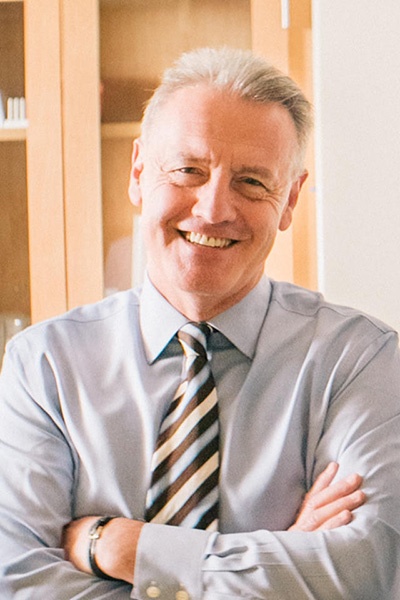
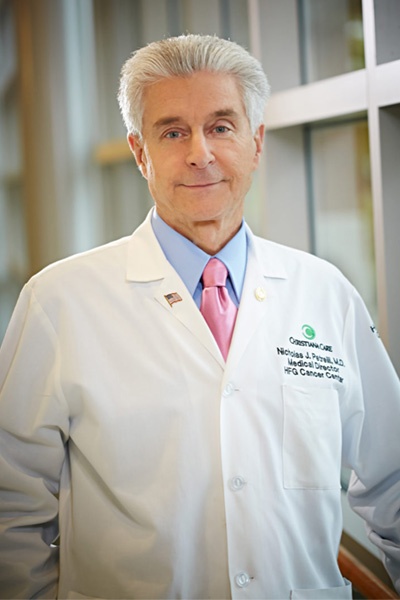
Leadership is changing at The Wistar Institute and the Helen F. Graham Cancer Center & Research Institute in the months to come—but the leaders of the two institutions say that this will have little if any effect on the clinical-research collaboration that they have spent the past 15years building (The Cancer Letter, July 12, 2019).
The partnership is equal parts Wistar, a research powerhouse that has the NCI Basic Science Center designation, and ChristianaCare’s Graham Center, a hybrid academic and community center that operated an NCI Community Oncology Research Program site.
At various points, the two institutions have been hoping that they could become an NCI-designated consortium, but during that time, the NCI requirements for consortium designation have become increasingly difficult to meet.
Dario C. Altieri, president and CEO of Wistar, director of the Ellen and Ronald Caplan Cancer Center, and Robert and Penny Fox Distinguished Professor, prepares to step down from his executive jobs by the end of the year(The Cancer Letter, Jan. 30, 2026). A bit more than a year ago, his Delaware counterpart—Nicholas J. Petrelli—retired from his leadership position in 2024 after 22 years as Bank of America Endowed Medical Director of the Helen F. Graham Cancer Center and Research Institute at ChristianaCare.
Petrelli remains in his job as director of the Cawley Center for Translational Cancer Research.
But Altieri and Petrelli are convinced that they have hardwired the scientific collaboration of their institutions. That collaboration has produced dozens of joint publications on melanoma, ovarian, head and neck, and brain cancers. The two centers share an external advisory board and institutional review board. They have also developed a de-identified patient database and a transporting team that lugs specimens back and forth on I-95 between Philadelphia and Newark, DE.
Petrelli and Altieri appeared together on The Directors, a monthly series which focuses on the problems that keep directors of cancer centers up at night.
This episode is available exclusively on The Cancer Letter Podcast—on Spotify, Apple Podcasts, and YouTube.
Altieri and Petrelli say they have nurtured a steady old-growth that can stand to weather the transition, no matter “who is sitting in the director’s chair.”
“There is a full level of integration that goes back 15 years. It’s not something that we just came up with overnight. It was built,” Altieri said in a conversation with The Cancer Letter. “Sure, there will be changes at Wistar, there will be another person sitting in this chair, but it would be absolutely foolish to abandon something that has been so successful.”
Altieri says building the Wistar-Christiana partnership was a unique experience in his career as a cancer director.
Before Wistar, Altieri worked at two matrix cancer centers for about 16 years.
“I got to tell you that doing the kind of collaborative translation research that Wistar and the Graham Center do together was very, very hard in those places,” said Altieri. “This [partnership] sounds easy to do, but in my past experience, in my past life, before coming to Wistar and before working with Nick, I could never get it done.”
Petrelli said one of the biggest benefits of the partnership has been avoiding the molasses effect of dealing with academic bureaucracy.
“We’ve eliminated red tape in this partnership,” Petrelli said in a conversation with The Cancer Letter. “I don’t have to tell you what it’s like dealing with major university programs in terms of getting things done in an expedited way.”
Petrelli recalls a scientist—Andrew Kossenkov—needing 100 more patients to fully validate the results of a study, which cost around $8,500.
“I called Dario,” said Petrelli. “I didn’t have to submit paperwork. I didn’t have to get approval from five or six people. I explained the situation and his answer was, ‘Nick, for $8,500, sounds like a great ROI.’ So, that’s the kind of partnership here. And I think eliminating that red tape has allowed us in 15 years to really do a lot.”
NCI’s standards for consortia
Starting in 2021, NCI set forth its current criteria for designation of consortium cancer centers. The current NCI Program Announcement, or PAR, reads:
A consortium partner with clinical activities must:
- Hold at least $2.5 million in direct cost NIH-funded research project grants that are classified as cancer research by NIH’s Research, Condition, and Disease Categorization (RCDC), held by a minimum of 10 PD/PIs. These grants cannot be counted as part of the Center until the consortium arrangement is approved by NCI, following acceptance of the arrangement by the NCI’s Cancer Centers Study Section (A) as part of their overall review of the P30 CCSG application.
A consortium partner without clinical activity must:
- Satisfy the requirements listed above, not including clinic-related activities, and hold at least $1.0 million in direct cost NIH-funded research project grants that are classified as cancer research by NIH’s Research, Condition, and Disease Categorization (RCDC), held by a minimum of 5 PD/PIs. These grants cannot be counted as part of the Center until the research partnership arrangement is approved by NCI, following acceptance of the arrangement by the NCI’s Cancer Centers Study Section (A) as part of their overall review of the P30 CCSG application.
Before the existing requirements were instituted in 2017, NCI required a minimum of seven R01-equivalent grants held by five independent PIs. In essence, this defined a consortium member as needing to meet the equivalent of a fully developed research program.
Altieri said he finds this rule reductive.
“Why box us in?” he said. “Why put us in a box that says you have to have that in order to have the recognition? We’re different organizations, different entities. Can there be more flexibility about it?”
We’ve eliminated red tape in this partnership. I don’t have to tell you what it’s like dealing with major university programs in terms of getting things done in an expedited way.
Nicholas J. Petrelli
“Is it really a problem? I mean, come on, [the Graham Center does] something else. They’re taking care of patients, patients want to receive care close to home, their outcomes are exceptional. Do you really want to box them to have five R01s and three funded investigators? We do that. We’re plenty of investigators with more than one grant each. Plenty.”
Petrelli said it’s unlikely that the rule will go away any time soon. He recalled a trip the pair took to NCI a few years ago:
“I turned around to Dario and I said, ‘Dario, don’t you think hell would freeze over before the NCI centers would change the criteria for a community cancer center to have a partnership like this with NCI designation?’ I mean, that might still be true today,” Petrelli said.
The leaders of the Graham Center “haven’t given up” on the idea of earning NCI designation as a consortium, said Petrelli.
“The new medical director at the Graham Center—Thomas Schwaab, who came from Roswell Park just like I did—he envisions in the future perhaps meeting those criteria,” said Petrelli (The Cancer Letter, Sept. 13, 2024).
“I think that would be very difficult in the present era,” Petrelli said. “What happens is we apply for NIH grants. We get them here and there. We also applied through foundations. But now because of what’s happening in Washington, everybody’s applying to foundations. So, the window is even tighter than it was a year ago.”
Petrelli and Altieri said that the strain on scientific funding from the federal government is one of the top issues keeping them up at night.
“I’m a long-term cancer center director. I thought I had seen them all, but obviously I have not,” said Altieri.
“We need to be very careful at how we spend the money,” he continued. “We’re a resource-constrained institution like most universities. Don’t think that just because somebody has $10 billion in endowment, they are protected or safer, or they can draw from the war chest and everybody’s happy. That’s not the way it happens.”
Nonetheless, the two centers seem to have a strategy in place to earn the designation: Building up the population health research program at ChristianaCare through “joint faculty recruitment and joint fundraising.”
“That is a way to expand the R01 pool of research funding, not so much in terms of laboratory contribution, but in terms of population health sciences,” Altieri said.
The cancer centers are in the process of onboarding two fellows dedicated to population health science (The Cancer Letter, Jan. 12, 2024). The partners have also launched a population health study on treating triple-negative breast cancer in Delaware.
“This [has] been our answer to building up the science further at the Graham Center,” Altieri said. “There is still a lot of work to be done in Delaware in terms of health disparities, underserved communities—maybe now is a bad word and we can’t say it, but that’s the reality. These people have very little and therefore are exposed to enormous risks for cancer. And so, that’s the direction that we’ve been going through.”
Petrelli clarified that becoming an NCI designated consortium is not his highest priority.
“I’m going to cut my throat here, but it’s not [about] a label. It’s what we do,” Petrelli said.
Explore previous episodes of The Directors.
Some highlights:
The magic of cutting red tape
The examples Petrelli and Altieri mentioned of how the partnership cut red tape are countless. Many logistical issues, which elsewhere may need the sign-offs of multiple department heads, seem to be solved with a simple phone call, according to how the two characterized the relationship.
Said Altieri:
Petrelli talked about taking down the barriers and cutting the red tape.
One time we had an issue: We wanted to develop a streamlined process for sample analysis all the way to clinical trials. Nick picked up the phone and said, ‘ChristianaCare and the Graham Center would be the IRB of record,’ Period, done.”
Another example:
We had a program in pancreatic cancer. One of the most difficult diagnoses to this day, nothing works. We don’t really understand it. I called Nick and said, “Hey, Nick, can we do an exploratory study in some of your [pancreatic ductal adenocarcinoma patients]?” And now, I have a freezer that is full of samples from these individuals, and we can do a lot of things. We have a paper together with Nick in collaboration about the first part of the study, a completely new pathway that we hope will eventually lead to something new in terms of treatment.
So, this sounds easy to do, but in my past experience, in my past life, before coming to Wistar and before working with Nick, I could never get it done.
Creating a model
When the partnership first formed in2011, the hope was that the Wistar and Graham Center partnership could grow to be a model replicated at other basic science and community clinical centers.
“We started bouncing ideas together, fundraising together, opening early-stage, first-in-human clinical trials together,” said Altieri. “The idea was: Could this be a model for how a basic center and community center can really join forces? Outside of any designation from the NCI, I think still our model remains really a great vehicle for innovation, for bringing new things, new ideas to the forefront of both laboratory research, as well as the clinic.”
Why box us in? Why put us in a box that says you have to have that in order to have the recognition? We’re different organizations, different entities. Can there be more flexibility about it?
Dario C. Altieri
Petrelli says a key component of their partnership is that each institution stays in its own lane.
“We don’t compete with each other, that’s the bottom line,” Petrelli said. “We have a basic research center and a clinical entity.”
On top of that, leadership has instituted structural elements that intend to break down silos between staff on both sides.
“The whole idea here is to make this partnership grow into new areas, continue to educate the scientists on the clinical problems the physicians face at the bedside, which is what all the Grand Rounds are all about,” Petrelli said. “They’re done virtually, monthly. The scientists are there. They understand the problems the patients go through. They understand treatment resistance in certain tumors. So, that’s what this is all about.”
The point: connecting basic science and clinical care
One idea has served as the current beneath the partnership, steering the ship towards a common goal: basic science research and clinical care need each other.
Basic science research is wasted if it only ever lives in a sterilized lab.
“Even a basic center is expected, rightfully so, to have a translational output, to have a disease relevant output,” Altieri said. “It’s not enough to study genes, pathways, and signals and say, ‘Hey, this might be important in cancer.’ What we have to do is to show that it is important in cancer and make a tangible advance.”
At the same time, clinicians share their on-the-ground knowledge of patients with researchers—a key to fueling advances that could save their patients and future patients who walk through their doors.
“There is one thing that Nick said to me 15 years ago, and I still remember. It’s imprinted in my hippocampus and it was something very, very true,” Altieri said. “He said to me, ‘Look, we’re not here to be tissue providers. Our physicians are not here to give you samples and then go home. We are here to be engaged.’
“That captures really the essence of the partnership. Clinicians and scientists are on equal basis. They’re both important, they both contribute.”
Listen to the full episode on Spotify, Apple Podcasts, and YouTube.
A transcript of the podcast is available below:
Paul Goldberg: Well, Dr. Altieri, Dr. Petrelli, thank you so much for finding the time to appear on The Directors, a monthly podcast of The Cancer Letter. And one thing about The Directors is that the first question is always the same: What is keeping you up at night as you run your institutions?
I guess Dr. Altieri, let’s just go alphabetically.
Dario Altieri: Yeah, let’s go alphabetical. Paul, thank you for having us. Thank you for having me on the program.
What keeps me up at night, gee, where should I start?
I’m a long-term cancer center director. I thought I had seen them all, but obviously I have not. This is a very challenging time, and it’s a challenging time for biomedical research in general. It’s a challenging time for cancer research. And so, there are a number of facets to the story.
Education and training of the next generation of scientists, whether it’s going to be enough funding coming from federal funding agencies, our academic institutions adapting to the new climate. And more importantly, are we, as doctors and scientists, doing a good enough job in restoring American trust in research and cancer research.
So, did I answer the question? I think it’s quite a long line of things.
PG: You’re staying up at night. I don’t know why you’re staying up at night. It’s your question to answer. Dr. Petrilli?
Nicholas Petrilli: So, ditto to what Dr. Altieri said, Paul, but I want to take it a little bit down the road. He mentioned concern about the next generation of scientists.
And so, there’s a domino effect here. The scientists are responsible for discovering new biomarkers, new treatments, new genetic profiling, and that leads to clinical trials. And we know that the gold standard in cancer care and clinical trials. And so, added on to the future of the next generation of scientists is what’s going to happen to our clinical trials program. And we talked about this before.
The majority of patients are treated at community cancer centers, not at the NCI designated centers. So, programs like NCORP, the National Cancer Community Oncology Program, what happens to that if funding is not where it should be? And then, subsequently, at the end of that road are the patients.
The patients end up suffering from that.
So, Dario and I talk about this all the time. And I’m sure other directors talk about it also, but that to me is a major issue here.
PG: I guess I should put my cards on the table. The reason I invited the two of you has to do with a plan the two of you had come up with some years ago to combine your organizations with Nick bringing in patients and Dario, of course, running this powerhouse of research.
And between the two of you, you have what might be considered the cancer center and you were trying to get [joint] designation at one point. Where is this now?
And by the way, Dario, I know you’re retiring at the end of the year. And Nick, you’re still at the cancer center, but your position has changed somewhat.
NP: Right. Well, I can start. I mean, I still think that our partnership, which is 15 years old this year, is still the only one between an NCI clinical trials funded program, a community cancer center, and an NCI basic research center.
Now, I will say, and Dario and I discussed this a little bit, that despite my stepping down as medical director of the Graham Center and overseeing the research component, and despite Dario stepping down, when I talk to Dario scientists, they are full blown behind this type of partnership.
You’ve seen us before, what we offer. Dario and his team offer us worldwide scientists, and we offer the patients, not only patients, but patients statewide.
There are not many cancer centers that can say they have programs statewide. One of our programs that Dario has supported is in triple-negative breast cancer for which Delaware is number one in incidence.
We’re trying to find that out in collaboration with the scientists at Wistar.
So, this is another major concern for us.
And I don’t know, Dario may know. I know that Northwell was trying to pull this off, but I don’t know of another NCI basic research center that certainly has had the commitment that we have had together over 15 years.
DA: And I want to jump in and add something to what Nick had said. If you turn the clock back to 2011, which is really when I visited Nick in Delaware, the idea was, how do we break the ceiling?
How do we get out of the box of what an NCI-designated the basic center should do or is expected to do, and a community cancer center that has a dominant role in the community and that sees 70% of the oncology patients in Delaware, how do we engineer a level of innovation that hasn’t been done before?
And that is outside of guidelines, requirements coming from the NCI or any other funding agency. And, Paul, let me just say, our cancer centers cannot be more different; right?
I mean, we’re a basic research center. We are one of those seven endangered species of NCI-designated research center.
Nick runs a fantastic clinical operation of a community cancer center. So, if you look at us from the outside, we cannot really be more different. And yet, we found an enormous area of convergence. We found an enormous area of synergy and complementarity where our scientists are eager to learn from next clinicians, are eager to listen to the joint seminar series of the Grand Rounds that the clinicians at the Graham Center host, are eager to really understand whether the pathway, their favorite gene, their favorite signaling mechanism that they’re studying are actually important for the patients and are actually important for the treatment.
So, one thing led to another, and we built this from the ground up, as it should, it was not top down, it was really bottom up, and we started publishing together, we started bouncing ideas together, fundraising together, opening early-stage, first-in-human clinical trials together.
The idea was, can this be somewhat formalized?
Could this be a model for how a basic center and community center can really join forces? And outside of any designation from the NCI, I think still our model remains really a great vehicle for innovation, for bringing new things, new ideas to the forefront of both laboratory research, as well as the clinic.
NP: You know what, there was a time, Paul, where Dario and I visited the NCI and did presentations on this partnership, and we talked a lot about it, and I may be cutting my own throat here since, as Dario knows, we’ve applied to the AACI—and by the way, we got through the preliminary application, Dario—but we discussed that…
What’s important here is the science and the clinical endpoints and not any label that we get; right?
That’s the real key here. Yes, we’d like to be designated with Wistar in some capacity, perhaps a new capacity, but who knows, the way things are right now.
But to us, it was really—look, let’s just keep moving forward, let’s get advice from the EAB, let’s get through our Cancer Center Support Grants, let’s see what’s said, and let’s take it from there. And as you know, Wistar got an “Exceptional” score, again, on their five-year CCSG.
That report and the external advisory report always calls out the Graham Center as an important part of this partnership, so we’re achieving what we want to achieve short of that designation as a partnership.
PG: Now that there’s going to be a change at Wistar, and, well, there’s really no change as far as your role, Nick, because you’re still the center director, even though you’re not physician-in-chief. Does this mean that the vision is in danger, or is it going to persist because of the structures you have built already?
DA: Let me just start, and Nick can offer his own perspective.
I think that the vision is not only going to stay the same, it is going to further expand. I think that this has been, and I’m not saying this to be a cheerleader, but I think that this has been an incredibly successful partnership all around.
Paul, if you were to read the comments before the site visit team or our summary statement, Nick and I did together four CCSG renewals—four.
Three full renewals and one merit extension. And every time the reviewers, invariably, five years, after five years, after two years, after five years, invariably praised the partnership as an incredible mechanism, an incredible vehicle of how collaboration should really be envisioned.
So, sure, there will be changes at Wistar, there will be another person sitting in this chair, but it would be absolutely foolish to abandon something that has been so successful nationally, nationally, recognized by all these reviewers time after time.
And I would tell you, Paul, the Graham Center at ChristianaCare is really the only cancer center with which we start as a codified institutional agreement. We collaborate with scientists and occasionally with clinicians and other centers, but the Graham Center is the only one where we have a piece of paper that says the Wister Institute and the Graham Center will do X. And the X is are all the things that I mentioned a moment ago.
NP: Yes. And I think I totally agree with Dario, Paul. Let me give you one example, because Dario said we’ve been through four of these.
I used to have brown hair when we started.
The issue here is we’ve eliminated red tape in this partnership. I don’t have to tell you what it’s like dealing with major university programs in terms of getting things done in an expedited way. So, Wistar scientists have worked for several years now on a blood gene profile to detect lung cancer in an early stage.
And Dr. Kosenkov, who is the lead scientist, is validating all this data. And he called me and the team together, our thoracic team, and said, “We need several more patients to really validate this.” And I said, “All right, this is fine. We can get a hundred patients for you, split it into benign and malignant.”
I said, “How much is it going to cost?”
And he said, “Well, about $8,500.” $8,500. That’s it.
I called Dario. I didn’t have to submit paperwork; right? I didn’t have to get approval from five, six people, right? I explained the situation. He knew about it, and his answer was, “Nick, for 8,500 bucks, sounds like a great ROI, right? Great ROI.”
So, that’s the kind of partnership here. And I think eliminating that red tape has allowed us in 15 years to really, really do a lot.
PG: It’s interesting that this kind of an arrangement, there are people talking about making this kind of an arrangement. The basic science center can no longer sit there with genius scientists sitting there and staging thought experiments and in vitro studies. You’ve got to get samples, you got to get patients. Is that happening throughout the basic science centers as far as you know? Or how do others do it? I mean, I know only one other place that’s thinking what you’re thinking.
DA: Yes, I can’t speak for them, Paul. I do know that what you said is absolutely correct.
Even a basic center is expected, rightfully so, to have a translational output, to have a disease relevant output. It’s not enough to study genes, pathways, and signals and say, “Hey, this might be important in cancer.”
What we have to do is to show that it is important in cancer and make it a tangible advance. So from what I know of a couple of the other centers, of the other basic centers, they are one-offs. They are collaborations with one scientist to another. What we have with Nick is, again, at the institutional level.
And I think there is one thing that Nick has said to me 15 years ago, and I still remember… It’s imprinted in my hippocampus and it was something very, very true. He said to me, “Look, we’re not here to be tissue providers. Our physicians are not here to give you samples and then go home. We are here to be engaged.”
And I don’t know if Nick sees it the same way, but from my perspective, that captures really the essence of the partnership, the essence of the bottom-up partnership where clinicians and scientists are on equal basis.
They’re both important, they both contribute, and they are both at the table.
And let me add something, I hope I’m not going to get myself in trouble. Before coming to Wistar, I was at matrix cancer centers, two different ones, very different ones. And Paul, I got to tell you—and I spent many years, altogether, 16 years in these other two entities and institutions. Paul, I got to tell you that doing the kind of collaborative translation research that Wistar and the Graham Center do together was very, very hard in those places, despite the fact that they could not have been more different in terms of institutional culture and the institutional impact.
So, Nick talked about taking down the barriers and cutting the red tape. One time we had an issue, we wanted to develop a streamlined process for sample analysis all the way to clinical trials.
And Nick picked up the phone and said, “ChristianaCare and the Graham Center would be the IRB of record. Period. Done.”
Right? Remember that, Nick?
NP: Oh, I do. Actually, at each of the EABs, I always put that in, one unified IRB.
It’s interesting to think that this would have been difficult to do at a standard matrix cancer center. I’ve never heard you say that you can actually do this kind of thing easier between these two institutions than you can do it within a single matrix cancer center.
DA: I’ll put it in writing, just don’t quote me.
PG: I’m going to have to quote you.
DA: I know, I know, I know. I know. I was just making a joke, but it’s been consistently my experience.
And to this day, to this day, I run what I hope to be still a competitive lab, internationally competitive. We had a program in pancreatic cancer. One of the most difficult diagnoses to this day, nothing works. We don’t really understand it. I called Nick and said, “Hey, Nick, can we do an exploratory study in some of your PDAC patients?”
And now, I have a freezer that is full of samples from these individuals, and we can do a lot of things.
And then, we have a paper together with Nick in collaboration about the first part of the study, a completely new pathway that we hope will eventually lead to something new in terms of treatment.
So, this sounds easy to do, but in my past experience, in my past life, before coming to Wister and before working with Nick, I could never get it done.
NP: And Paul, before I get into trouble, everything that Dario talked about, surgical specimens, all IRB-approved protocols, all patient consent, all patients information de-identified through a system that the scientists get into at any time they want and get de-identified information on the tissue samples that have been sent up.
And we have a transporting team that can get up to Wistar on I-95, the day that the specimen is taken.
DA: These two organizations are different. They have different missions. We certainly have a mission of 67% of the budget of the Wister Institute comes from the American taxpayer in the form of grants and contracts. Fine, this is us.
But for Nick’s program, that’s different. And so why box us in, putting us in a box that says you have to have that in order to have the recognition? We’re different organizations, different entities. Can there be more flexibility about it? So, I can’t resist, Paul, because I’m getting old and I announced already my [retirement as center director]…
But Nick and I travel often to the NCI to talk about it. And a few years ago, the person is no longer there… A few years ago, we presented the partnership, we presented the accomplishments, we presented the infrastructure, and what’s more important, there was an all out institutional commitment to get it done and continue to get it done.
And the questions that we got was—from this unnamed source—the question that we got in Washington was, “Well, is Wistar going to become a Clinical Center then?”
No, we’re not going to become a Clinical Center!
We don’t want to become a clinical center. We want to collaborate with clinical centers. We want to create a framework whereby you don’t have to be here 20 years to develop a person-to-person relationship with your favorite clinician.
Whereby, if I recruit a new assistant professor out of Iowa or Illinois, that person comes to Philadelphia, doesn’t know anybody, he can still pick up the phone and call people like Christiana and say, “Hey, I’m studying triple negative breast cancer. Can we do something together?”
That’s the idea. That’s the idea.
NP: We don’t compete with each other, Paul. That’s the bottom line. Our two institutions don’t compete. We have a basic research center and a clinical entity.
Now, the new medical director at the Graham Center, Thomas Schwab, who’s an MD, PhD, who came from Roswell Park, just like I did, he envisions in the future perhaps meeting those criteria. Whether that happens or not, I think about that in the present era, and that would be very difficult in the present era, because what’s happened is we apply for NIH grants.
We get them here and there. We also applied through foundations; right? But now, because of what’s happening in Washington, everybody’s applying to foundations; right? So, the window is even tighter than it was a year ago.
So, we haven’t given up that idea, but again, the whole idea here is to make this partnership grow into new areas, continue to educate the scientists on the clinical problems the physicians face at the bedside, which is what all the Grand Rounds are all about.
They’re done virtually, monthly. The scientists are there. They understand the problems the patients go through. They understand treatment resistance in certain tumors. So that’s what this is all about.
Again, I’m going to cut my throat here, but it’s not a label. It’s what we do.
I’ll say this, and this really will…
PG: Oh my god, I’m so… drum roll.
NP: One of the trips to the NCI years ago, Dario and I were coming back on the train and that individual that Dario mentioned, who remained nameless, said, “Well, we would have to change the criteria. We would have to get the NCI-designated centers to change the criteria.” So I’m thinking, “Oh, okay. All right. All right.”
So on the way back, I turned around to Dario and I said, “Dario, don’t you think hell would freeze over before the NCI centers would change the criteria for a community cancer center to have a partnership like this with NCI designation?” I mean, that might still be true today.
PG: We don’t know. Well, I guess the three-and-five rule comes from… It doesn’t come from the National Cancer Act and it doesn’t come out of the scriptures. It’s not something that was given to Moses on Mount Sinai, was it?
DA: It was not. To the best of my knowledge, it was not.
And ultimately, Paul, this is a great conversation because it’s also a broader conversation, right? I mean, cancer centers evolve. They have to. They have to evolve. It doesn’t matter whether you’re a basic center, comprehensive, whatever, you need to evolve. The science is evolving, the way we treat patients is evolving, the structure of clinical trials is evolving, the partnerships with the private sector to support those trials is evolving.
And so, at some point, there has to be a conversation, and I don’t know whether I’m going to see it in my own lifetime, obviously, but there has to be a conversation as to what does it really mean now to be an NCI-designated Cancer Center? Is it a badge of what exactly? Research funding, research excellence, outstanding clinical care, all of the above, population studies, all of the above. What is it really? What is it that matters?
What I know is that there are outstanding clinical programs and research programs that will never be NCI-designated. And I know—without offending anybody—and I know some NCI-designated cancer centers are fairly mediocre in terms of impact in what they do.
So which one is it? Which side is up? How do we want… It’s not exclusionary. The idea is that NCI-designated cancer center cannot really be built as a club with exclusionary criteria saying, “No, no, you’re out. ” I think things evolve and I think there has to be perhaps more flexibility, more thought as to what it really means to have an NCI-designated cancer center, and what should the reach of that center be?
PG: It’s an interesting idea. Just thinking out loud, why can’t you move three of your investigators with five grants to Delaware?
I’m not making a suggestion, mind you. I’m just asking why not.
DA: Nick would tell you that we have considered this, and he also would tell you that he has a fully equipped laboratory unit and suite at the Graham Center, so it is a possibility.
PG: That solves a problem.
DA: We’ve gone a different way, Paul. We’ve gone a different way, and Nick can be far more articulate than I am.
You heard him talking about triple-negative breast cancer, and what he hasn’t told you is that he personally and the Graham Center have been the driver of reducing mortality and health disparities related to colorectal cancer in the state of Delaware.
They did it single-handedly as the most impactful and important institutions to do that. He can show you the survival curves of people with colorectal cancer before and after they got to work on that.
What we have done was to work together to build together a population science program, based at the Graham Center, through joint faculty recruitment and joint fundraising. So that is the direction we’ve been going.
There is still a lot of work to be done in Delaware in terms of health disparities, underserved communities, maybe now is a bad word and we can’t say it, but that’s the reality. These people have very little and therefore are exposed to enormous risks for cancer. And so that’s the direction that we’ve been going through. Nick, hasn’t this been our answer to building up the science further at The Graham Center?
NP: Yes. And that was actually, Paul, Dario’s idea. The issue was, Let’s develop a population health fellowship, population health and science fellowship.
We recruited an individual from the Cancer Control and Prevention Department at the NIH who started last April. And the deal was we’ll eventually get a second fellow. The Graham Center will pay for the first one. And as the program evolves, Wistar will pay for the second. That was decided in about 25 minutes, Paul. 25 minutes.
DA: It’s all accurate, Paul. It’s all accurate. And these are faculty, Paul. We call it fellowship because they are early-stage entry level individuals. But in essence, they have all the latitude and privileges of full-fledged faculty members. They can apply for any type of grant and they are on an academic track. So, why not? Could this be a mechanism to exploit an enormous strength at the Graham Center, make an even broader impact in the community? And at the same time, build highly competitive research programs.
PG: So, community outreach and engagement is a part of that, right?
DA: Yeah, but not for us, Paul. The basic centers don’t have a COE component in the CCSG.
PG: But Nick needs it if you are to continue with this integration, right?
NP: Well, there’s the no competition and there’s the match that matches us together. Wistar can’t do that, but we can do it and we can do it statewide. We’re a state with three counties, a million people. The colorectal program was done statewide. The triple negative breast cancer program is spreading statewide.
PG: So you could actually build a pretty great department. It takes a lot more than a couple of faculty members though to build a good population sciences component, or does it?
DA: It does. It does. But there is a very strong infrastructure already in place. There is a lot of knowledge, right? Consider what we talked about before, that the work that the Graham Center had done when it comes to lung cancer and when it comes to colorectal cancer is already a very strong institutional memory and a very strong institutional commitment. We want to be part of it and support it. That is a way to expand the R01 pool of research funding, not so much in terms of laboratory contribution, but in terms of population health sciences.
PG: So, are you planning to recruit some more people?
Absolutely. As Nick indicated, the next Caspar Wistar fellow would be based at the Graham Center and will be funded through Wistar’s funds.
NP: Yes. Paul, I think your statement—you have to build a big program. I don’t think that’s the case. What you need are quality people who are willing to put their nose to the grindstone and work. Not a generation of… It’s a privilege and a right, but a generation of responsibilities. So, I don’t think we need a big program in population health and science to accomplish what we want to accomplish between Wistar and the Graham Center in the state of Delaware.
And we’ve already received not only funding from Wistar, but funding from the state. So the state, one of our scientists, Dr. Scott Siegel, who runs this program, has received state funding and NIH funding for this. So, I don’t think we need a lot of people. We just need hard workers who are willing to take the time, put their nose to the grindstone.
PG: Does each of you have an EAB or… Nick, do you have one?
NP: No, we participate in the EAB with Wistar. I used to have an external advisory board when I first got to the Graham Center to help, but right now I don’t have an external advisory board. No.
PG: So you have the same EAB?
NP: Yes. Just like the same IRB.
DA: And Nick presents at the annual EAB meeting, just like any research leader of the Wistar Cancer Center. Nick is the associate director for translational research at the center. So there’s full alignment, full integration between the structure of the two cancer centers.
PG: And there’s no way to change that. I can hear what you’re saying because there’s no reason to.
DA: No. No, there isn’t.
NP: There’s no reason.
DA: And let me also say that our scientists are cross-appointed at the Graham Center. The clinicians are affiliate members of our center. So, there is a full level of integration. Again, Paul, that goes back 15 years.
And it’s not something that we just came up with overnight. I mean, it was truly built and was built that way with a lot of intention because we wanted this to be, regardless of who’s sitting in the director’s chair, we wanted this to continue to grow and make the level of impact that the partnership has generated—statewide impact.
NP: Along with joint publications and joint grants.
DA: Sure. Sure.
PG: And you are getting joint grants?
NP: Yep.
DA: We do.
NP: And joint publications.
PG: Well, it must be a very difficult time to try to build a program like a population science program at a time when your chances of getting an R01 grant are somewhat better than your chances of winning the Delaware State Lottery. I don’t know about the Pennsylvania State Lottery.
DA: Well, it is a challenging time, and no question about it. We are committed. We want to do it. I am sure that Nick mentors his junior colleagues in saying that there is a level of commitment, there is one unwavering, and that ultimately there will be a turning point.
And, Paul, I don’t know where the turning point is or what will happen, but I will say that I am really hopeful that the 2026 HHS billl, was the result of strong bipartisan support for research, was the result of strong belief that American preeminence in research can only be achieved through public funding, which is transparent, which is accountable, and that creates the level of innovation that this country has always been known for, where you let people do their thing, right?
You let these scientists follow their own curiosity, ask the questions that they wanted to ask because that is the moment in which you really generate advances.
So, I’m hopeful that that is a sign that despite everything that is happening in the society, despite this notion that there is a very low level of trust of the American people in science and scientists and clinicians, despite everything that we hear in the news, that there is a path forward to restore that trust and to drive publicly funded research is really the only engine that can generate the type of achievements and progress that we all hope for.
NP: I can’t add to that. I mean, this country’s been through a lot. We’re going to celebrate 250 years, celebrate greatly in Philadelphia and across the country.
We made it through the ’60s. I mean, sure, it’s tough times, but I’ve seen even in the present day, people coming together and peacefully opposing things that should not be done. So we’ll get through this. We’ll get through this. We will.
And I think we’ll be better for it, but we’ll get through it. We’ve been talking about how hard it’s been, but I tell people who I mentor, if it was easy, anybody could do it. So we just have to keep moving forward and struggle and we’ll get through it.
PG: How do you keep your troops from losing hope? How does one do this? Do you use institutional funds to support people? What’s the strategy?
DA: Again, for basic centers like ours, the challenges are enormous. Remember, we don’t have access to clinical revenues. We don’t really have access to tuition relief because we don’t give degrees. We’re a laboratory-based organization. We train students, we train postdocs, but we don’t give degrees ourselves. These are not our students. They get their degree somewhere else.
So I would like to describe Wistar as a resource. We need to be careful with the resources. We’re a resource constrained institution. Like most universities though, Paul, don’t think that just because somebody has $10 billion in endowment, they are protected or safer, or they can draw from the war chest and everybody’s happy. That’s not the way it happens. So we need to be very careful at how we spend the money, but at the same time, as Nick just said, we need to keep moving forward.
And so at Wistar, we continue a very aggressive growth, strategic growth. It was part of our strategic plan. I wanted to achieve two other milestones before I announced my own stepping down. We opened a new cancer-focused Center for Advanced Therapeutics. Nick is on the external advisory board of that center because the idea is that these are scientists and the new ones that we’re going to recruit need to have an understanding of what new therapies truly mean in the trenches. And for people that are experiencing funding gaps, we support them as we should, as we should.
We can’t cut them out just because the NCI as a funding pay line—well, when it used to be published—was 4%. Because if you think about that, it’s very discouraging, right? 4%. Would you advise your children to follow a career that has a 96% chance of failure? I mean, that’s what it is. So you can’t think like that. We cannot think like that.
PG: No, no. But it’s… How long do you think the system can maintain itself and not start crumbling at this point?
NP: Well, hopefully another three years only.
PG: Yeah. But do you have the resources to stick around? You probably do.
And it’s not like… I didn’t see a real catastrophe at the cancer centers because when I actually call people and say, or on The Directors, when I say, “Is there a specific program that you have lost as a result of what the Trump administration has done, or DOGE?” And the answer has been not a whole ton.
DA: Not really.
NP: Well, you reported, Paul, that those cancer center directors are supporting those investigators until we get over what we’re in. You reported that in The Cancer Letter.
PG: So it must be true.
NP: Yeah, just like what Dario’s doing at Wistar.
PG: Well, it’s really an interesting conversation. Is there anything we’ve missed, anything, any encouraging words?
NP: Onward and upward.
DA: It was a great discussion, Paul. And thank you for having us. I just want to say that working with Nick has not just been a privilege, but it’s been a lot of fun.
And, obviously, this comes from the fact that we both have Italian genes and therefore you can’t go wrong with that, but apart from the silliness, we had a lot of fun doing it. We had a lot of fun building it.
And with every milestone, whether this is new programs, pilot projects, joint funding, leadership of the CCSG, one renewal after the other, always with exceptional rating, it meant something, I think, for both of us and for our organizations.
NP: Well, Paul, I can end by saying that in a professional career that we’re both in, all of us are in, you develop colleagues over many years, but there’s a handful of people that really turn out to be friends that you can confide in and you feel good talking to you.
And you also see the humor sometimes in difficult times. And that’s the role that Dario has played with me. He’s become not only a colleague, but a true friend in the most Italian sense of the word, a true friend. And so, I will always remember that until I’m in a pine box.
DA: Same here.
PG: Well, I mean, you both built something that will endure and you’re still working together and will continue to work together. So pine box is not a…
DA: It’s not in the plan.
PG: It’s not in the plan. No pine boxes. Well, thank you both so much.
DA: Thank you, Paul.
NP: Thank you, Paul.