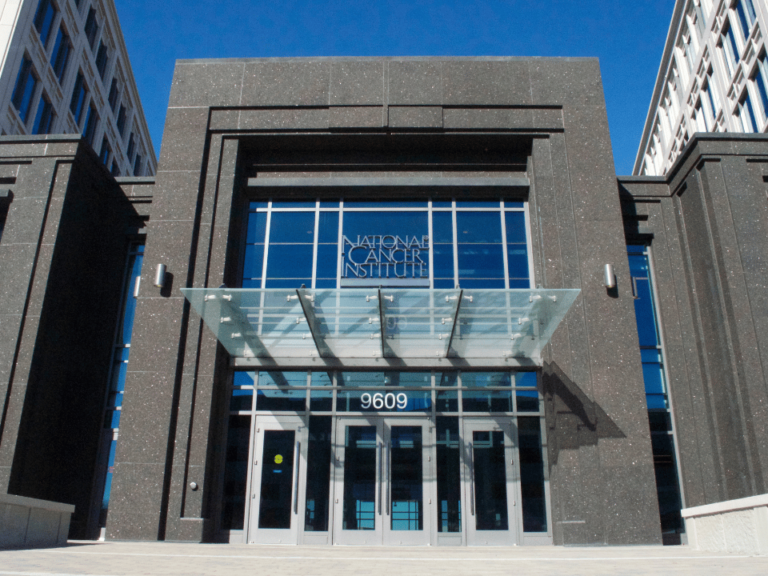
If a Mount Rushmore of Epidemiology were to exist, Joseph F. Fraumeni Jr. would be etched into the face of the mountain, former NCI Director Ned Sharpless once told Stephen J. Chanock.
Chiseled into the mountain alongside this “gentle giant,” as Fraumeni was affectionately referred to, would be the likenesses of other legends of epidemiology past—Sir Richard Doll, Richard Peto, Florence Nightingale, and John Snow.
To cheer up the grieving staff of the NCI Division of Cancer Epidemiology and Genetics, which Fraumeni founded and directed for decades, Sharpless generated an AI image of what Mount Rushmore of Epidemiology might look like.
In this vision, John Snow, a 19th century physician made famous by tracing the source of cholera outbreaks in London, was replaced with Jon Snow, a protagonist of the “Game of Thrones” series.
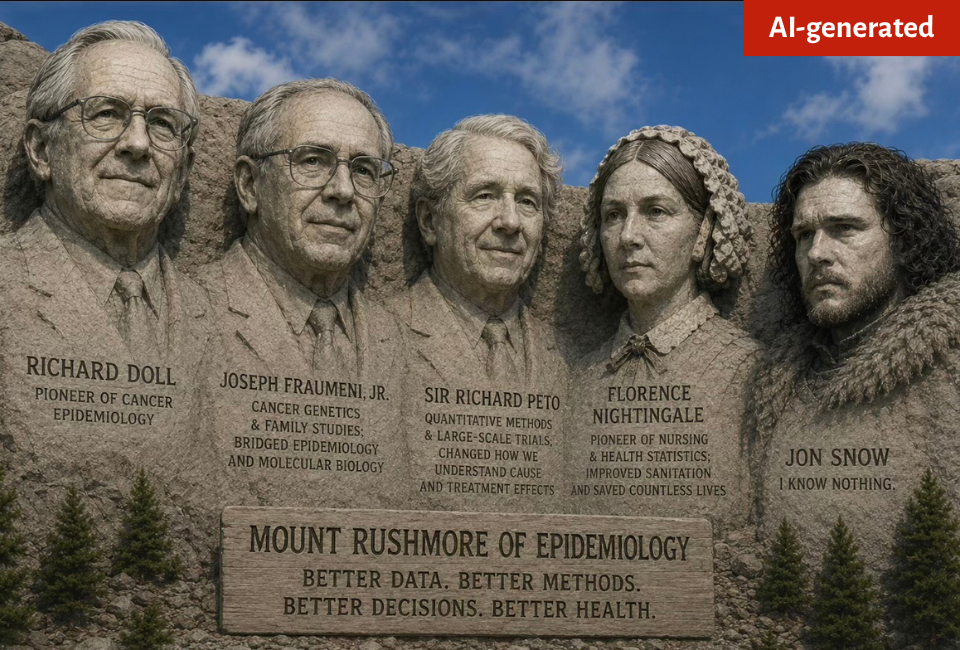
Source: Ned Sharpless
It may be an appropriate time to commission such an alpine sculptureto memorialize the enormity of their life’s work.
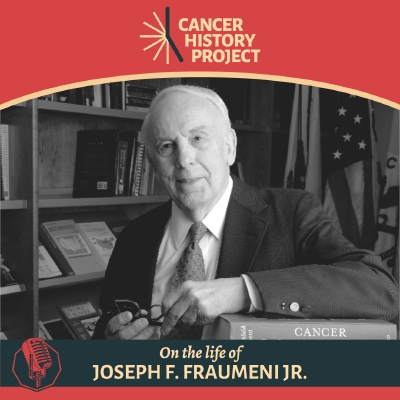
Fraumeni died on June 22 (The Cancer Letter, June 26, 2026). He was 93.
For Fraumeni, being peerless meant having to raise his peers.
Of the hundreds of scientists Fraumeni mentored, perhaps one of the closest was Stephen J. Chanock, his successor as director of the NCI Division of Cancer Epidemiology and Genetics, who worked with Fraumeni for 25 years.
Otis Brawley, co-editor of the Cancer History Project and the Bloomberg Distinguished Professor of Oncology and Epidemiology at Sidney Kimmel Comprehensive Cancer Center at Johns Hopkins University, interviewed Chanock on the most recent episode of the Cancer History Project podcast.
The Cancer History Project Podcast is sponsored by City of Hope, the American Society of Clinical Oncology, the Sidney Kimmel Comprehensive Cancer Center at Johns Hopkins, and the University of Texas MD Anderson Cancer Center.
This episode is available on Spotify, Apple Podcasts, and YouTube.

Brawley and Chanock looked back on Fraumeni’s 50-year long career. His contributions to science included co-discovering the Li-Fraumeni syndrome and developing cancer maps, which visualize cancer rate data from every county in the U.S. His work served as a backbone for other major discoveries, such as the two-hit hypothesis by Alfred Knudson and BRCA genes.
“By adding molecular biology to classical genetics, he basically invented molecular epidemiology. He also trained a generation of cancer epidemiologists through his multi-decade leadership at NCI,” Sharpless said.
Fraumeni developed theories around how cancer works and tested them.
“The mission statement of DCEG has been to understand the etiology of cancer through epidemiology and genetics as a means to prevention or early intervention,” Chanock said. “That’s really the wisdom of Joe Fraumeni who lived that, and really developed the tools, the capabilities, and the workforce to pursue that.”
As a result, Fraumeni established a vision of cancer’s genetic susceptibility. His observations about diethylstilbestrol raised “a very revolutionary idea” that early exposures could result in precancerous conditions and develop into cancers decades later. The cancer maps added a new attention to cancer caused by environmental exposures.
“These patterns were very important, which led to understandings about what was going on post-World War II and [how] certain occupations are associated with select cancers,” Chanock said. “This led to the birth of a whole set of cohorts and case control studies to look at asbestos, smelters, occupational hazards and smokeless tobacco use in the South.”
The goal was always to help patients, many of whom had no options at the start of Fraumeni’s career.
“What Joe was envisioning was the more we understand, the more we can be honest and explain to our patients who develop cancer or may develop cancer, what we could be done to prevent or decrease that risk,” Chanock said.
“I was trained as a pediatric oncologist,” Chanock said. “There was not a single circumstance where we, sadly, diagnosed a child with cancer, and the mother and her father wouldn’t say, ‘Why did this happen? What is going on? I don’t understand.’ And then they would spend a tremendous amount of emotional and spiritual energy trying to figure out what’s the cause of this? What did they do? What were they exposed to? Why is this in the family or whatever?”
A mission to help patients was part of Fraumeni’s fundamental ethos: “The noblest motive is the public good.”
“Joe really lived that,” Chanock said. “He indeed was a true public servant and patriot… This was a man who—it was not about him It was about what he could do to advance what he thought was the important mission of the National Cancer Institute.”
The golden touch
Fraumeni’s ultimate talent, Chanock and Brawley concur, was his ability to ask questions.
“I remember him saying, ‘Don’t ask the fashionable questions. Ask the hard questions,’” Brawley said.
I mean, this is somebody who had a golden touch with respect to asking questions. He had this very curious mind that, thankfully for the rest of the world, he set it on epidemiology.
Stephen J. Chanock
“I mean, this is somebody who had a golden touch with respect to asking questions,” Chanock said. “He had this very curious mind that, thankfully for the rest of the world, he set it on epidemiology.”
“When I would go see him over the last couple years, he always wanted to know, ‘What’s new in genetics? What new tools are there? What’s it going to change? How are we going to be able to apply this? When can we do this in large populations so we can better understand parts of the genome that we haven’t interrogated with genome-wide association studies?’ His mind was always going to the places where we hadn’t been successful yet, and how can we be successful in those places,” Chanock said.
Asking questions was in his true nature as a human being, and didn’t stop until the very end.
“Three weeks before he passed away, I went to see him [at the hospital],” Chanock said. “He was quite physically ill, but mentally with it. I walked in the room and then he said, ‘Well, how’s it going with figuring out the relationship between genetic susceptibility to thyroid and kidney cancer? There’s something about those two cancers that’s connected. Figure it out, Chanock.’
“Here he was, 93 years old, very infirm, just recovering from an aspiration pneumonia and he’s asking me about that. I talked to him for a little bit and he smiled and said, ‘Good, just keep up the good work.’ That was the next to last thing he said before I left.”
A mentor to many
This gift of question asking played a big role in what some consider one of his greatest accomplishments: his mentorship of young investigators.
“I think Joe Fraumeni would actually say his greatest contribution was all of those people that he brought into epidemiology,” Brawley said.
Many are oncological giants of their own now (Mitch Gail, Peggy Tucker, Bob Hoover, Bill Blot, and Deborah Silverman, to name a few).
“He was a remarkable mentor who saw things in people long before others would,” Chanock said. “He encouraged people on the basis of their innate abilities, not on the basis of either their pedigrees, or their sex, or their race, or their ethnicity. He saw where they were really good scientists, and his view was you bet on the good people. You don’t bet on people because they are something. Had he worked at the racehorses, he would have been a very rich man.”
Among the many strengths Fraumeni brought as a mentor, editing was one of his strongest, Chanock said.
“He was an amazing editor,” Chanock said. “It was a privilege to work with him. You would get your paper back with many suggested edits. I would say 99 out of 100 times, he was spot on. It was rewritten in a much clearer and better way.”
“Peter Boyle referred to this paper he had gotten back as having been ‘Fraumenied,’” Brawley added. “He turned it into a verb.”
What underlied this good editing was a certain mindset: “You have to appreciate what your biases are at every step,” Chanock recalled Fraumeni saying. Sometimes you need to “get around them or think outside the box.”
There was this marvelous capacity to be a casting director, so to speak. His movie is a true blockbuster. If you were to make a movie of what he did in epidemiology, it would win lots of Oscars and he’d have all these marvelous supporting actors and actresses who’ve gone on to marvelous careers.
Stephen J. Chanock
The giants Fraumeni collected around him went on to further the mission of the Division of Cancer Epidemiology and Genetics.
“There was this marvelous capacity to be a casting director, so to speak,” Chanock said. “His movie is a true blockbuster. If you were to make a movie of what he did in epidemiology, it would win lots of Oscars, and he’d have all these marvelous supporting actors and actresses who’ve gone on to marvelous careers.”
Fraumeni’s focus was on other people—whether that be fellow scientists.
“I think he felt that the world was really best as a ‘co-laboratory,’ not a laboratory,” Chanock said. “Working in teams.”
Or whether that be for the good of humanity.
“I think he taught a lot of people: ‘What we do is never for your individual glory. I’m not interested in getting the brass ring. It’s what you do for others,’” Chanock said.
Notably missing from Fraumeni’s office were his many awards—the Mott Award, the Snow Award, nor the General Motors Cancer.
Instead, there was a mantra that he lived by.
“There was this Kanji, the Japanese calligraphy, on the wall that read, ‘When you drink the water, don’t forget who dug the well,’” Chanock said. “This was something that he would remind people of. We are all parts of a longer trajectory and don’t forget who came before you. He would say, ‘We have to know who’s going to come next and be sure there is a next because most of these questions are difficult and take a long time to answer.’”
Read more on the Cancer History Project. This interview is available on Spotify, Apple Podcasts, and YouTube.
The Cancer History Project is a free, collaborative archive of oncology history that aims to engage the scientific community and the general public in a dialogue on progress in cancer research and discovery.
This project is made possible with the support of our sponsors: City of Hope, the American Society of Clinical Oncology, the Sidney Kimmel Comprehensive Cancer Center at Johns Hopkins, the University of Texas MD Anderson Cancer Center, UK Markey Cancer Center, the National Comprehensive Cancer Network, and the Mark Foundation for Cancer Research.
The Cancer History Project is an initiative of The Cancer Letter, and is backed by over 60 partners, spanning academic cancer centers, government agencies, advocacy groups, professional societies, and more.
Interested in learning more about the history of oncology? Subscribe to our monthly podcast on Spotify or Apple Podcasts.