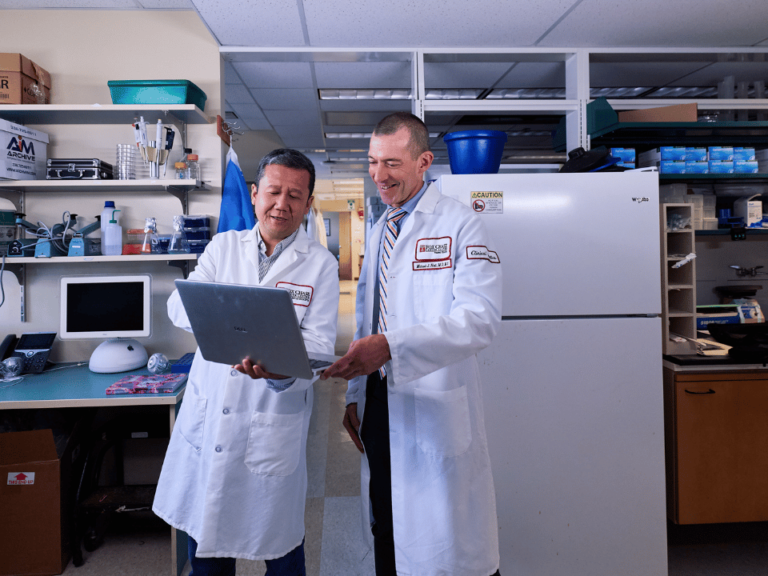
Jaye Gardiner awarded $225,000 Black in Cancer postdoctoral fellowship for pancreatic cancer research

Share on facebook
Share on twitter
Share on linkedin
Share on email
Share on print

Jaye Gardiner, a postdoctoral researcher at Fox Chase Cancer Center, has received the inaugural Black in Cancer postdoctoral fellowship, which will provide $75,000 annually for three years to support her research into pancreatic ductal adenocarcinoma.

To access this subscriber-only content please log in or subscribe.

If your institution has a site license, log in with IP-login or register for a sponsored account.*
*Not all site licenses are enrolled in sponsored accounts.

Login Subscribe

Table of Contents

YOU MAY BE INTERESTED IN

Scientists at Oregon Health & Science University have developed a technique using an electronic jolt and nanoparticles to reveal the telltale signal of an insidious form of cancer. The technique offers a new way to detect early signs of pancreatic cancer—a particularly deadly type of cancer because it isn’t detected until it’s progressed to later stages that are difficult to treat effectively. The new method would involve a simple blood draw among people who are considered higher risk due to family history or other factors.
FDA has approved an Investigational Device Exemption supplement to its U.S. multi-center pancreatic cancer pilot study, known as IMPACT (Intratumoral Pancreatic Alpha Combination Trial), evaluating the safety, feasibility, and efficacy of Alpha DaRT in combination with chemotherapy for patients with newly diagnosed unresectable locally advanced or metastatic pancreatic adenocarcinoma.
The long-awaited results from the RASolute 302 trial—a phase III clinical trial evaluating daraxonrasib, a RAS inhibitor, for the treatment of patients with previously treated, metastatic pancreatic ductal adenocarcinoma—have been read out. 
At a lecture at Yale Cancer Center recently, Robert A. Winn brandished a copy of a 32-year old booklet titled “Cancer at a Crossroads: A Report to Congress for the Nation,” using it as a show-and-tell prop in arguing that America’s cancer program is once again at a crossroads and therefore in urgent need of strategic thinking (The Cancer Letter, April 10, 2026).
Patients with pancreatic cancer who received the experimental drug elraglusib, alongside standard chemotherapy, were twice as likely to be alive after one year of treatment, compared to those receiving chemotherapy alone, according to the results of a randomized phase II clinical trial conducted by researchers at Northwestern University. The drug also reduced the risk of death by 38%.

Never miss an issue!

Get alerts for our award-winning coverage in your inbox.

Login