ASCO 2019 through art

Share on facebook
Share on twitter
Share on linkedin
Share on email
Share on print

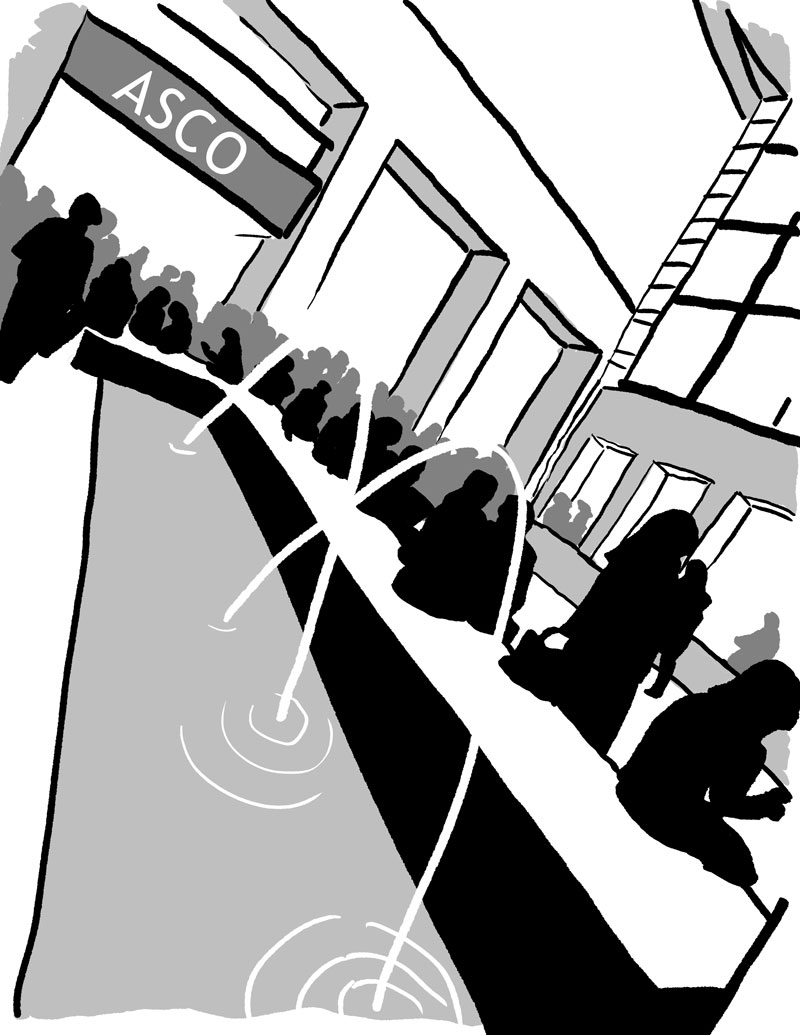
This year, we decided to approach the annual meeting of the American Society of Clinical Oncology in a completely new way: through illustrations.

Our illustrator Katie Goldberg offered to go out into the crowded hallways and capture the images of ASCO 2019.

I have never thought of ASCO as fodder for art. When 40,000 people who share interests convene in one spot, they create a culture. When they meet for just a few days, they create an ephemeral culture.

Abstracts, photos, and videos capture that culture, but an artist can see something else: the energy of interactions, scenes you might simply rush past.

Katie and I agreed on the parameters of the assignment. Her goal wasn’t to capture images of important people as they delivered lectures or rushed by. Instead, she was to roam the halls, capturing something only an artist can see—the spirit of the gathering, its visual language, its motion.

We’ve interspersed her art throughout the pages of the our PDF issue, which you can download here, or scroll down to see the full gallery.

1 lead image
4 genentech cookies
5 pazdur
7 asco posters
9 overall shot
3 asco tv
2 asco fountain
6 checkpoints3
8 child-care
10 daily-news
11 pres-address
Paul Goldberg
Editor & Publisher
Table of Contents

YOU MAY BE INTERESTED IN

When our hematological malignancy testing pilot project began in Eldoret, Kenya, there seemed to be a mismatch in relation to progress in healthcare. The region, like much of sub-Saharan Africa, had been focusing on combatting infectious diseases such as HIV and malaria—which was much-needed—yet cancer care was under-resourced. 
Artificial intelligence is rapidly transforming biomedical research and healthcare. Large language models, foundation models, and AI agents are increasingly being deployed to assist with data interpretation, literature review, clinical decision support, and translational research. 
In modern oncology, important insights from clinical trials often emerge years after initial publication. As new therapies extend survival and transition more patients into long-term remissions, clinicians and researchers are increasingly looking beyond initial response rates to understand durability, long-term safety, and even the possibility of a cure. 
Paul Goldberg
Editor & Publisher

Never miss an issue!

Get alerts for our award-winning coverage in your inbox.

Login