Neeha Zaidi, MD, is turning the tables on pancreatic cancer. Mutations to a gene called KRAS—a cancer driver common to almost all pancreatic cancers—are now a target for prevention and treatment.
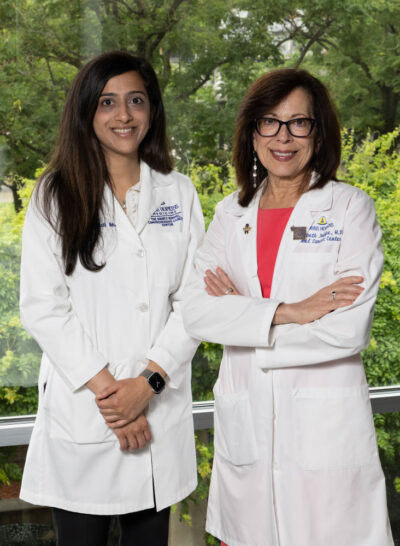
Dr. Zaidi, an immunotherapy and pancreatic cancer expert, is studying KRAS mutation-targeted vaccines to harness the power of the immune system against this aggressive cancer. One of the most exciting aspects is its potential to stop cancer from ever developing in patients at high risk for pancreatic cancer.
“KRAS is an early mutation in pancreatic cancer. It occurs at least a decade before cancer develops, so this is a huge opportunity for interception and intervention,” Zaidi said.
The vaccine uses peptides—protein fragments from the mutated KRAS gene—to send signals to the immune system. In one of the most recent clinical trials, patients who had pancreatic cancer surgery received the vaccine in combination with drugs known as immune checkpoint inhibitors with the aim of killing off any remaining cancer cells and keeping the cancer from coming back.
Immune checkpoints are the natural on and off switches of the immune system, but cancer cells often exploit these controls to turn immune cells away. Using checkpoint inhibitors in combination with the vaccine allows the immune cells the vaccine brings to the cancer to complete its job of killing cancer cells.
The new studies are built upon the pancreatic cancer platforms developed by internationally renowned pancreatic cancer and cancer immunology expert Elizabeth Jaffee, MD, deputy director of the Kimmel Cancer Center, co-director of the Skip Viragh Center for Pancreas Cancer Clinical Research and Patient Care, and the Dana and “Cubby” Broccoli Professor of Oncology.
Origin story
Dr. Jaffee began her pioneering work at the laboratory bench in the 1980s. Her pancreatic cancer vaccine was designed to supercharge the immune system, causing immune cells to seek out and kill cancer cells, including hunting down and cleaning up surviving cancer cells or newly appearing cancer cells anywhere in the body. The first version of the vaccine was called GVAX.
After a decade of laboratory discovery, clinical trials of this first-of-its-kind vaccine began in the early 1990s. Although it was first tested in kidney cancer in 1992, its greatest success was in pancreatic cancer.
Dr. Jaffee created the pancreatic cancer-specific version of the vaccine in her laboratory and also led the first patient studies, even opening a GMP (Good Manufacturing Practice) facility at the Kimmel Cancer Center to produce the vaccine for clinical studies.
With few treatments for advanced pancreatic cancer, the vaccine attracted worldwide attention. News reports of the vaccine led to over 1,000 calls to the Kimmel Cancer Center, which was the only place doing this kind of research at the time. Patients with pancreatic cancer were desperate to receive the promising new treatment.
There were amazing success stories. Kathy, one of the first patients to receive the vaccine, saw a response after two doses. Twenty-six years later, she remains cancer-free and credits Jaffee’s work with giving her the time to see her grandchildren grow up.
Kathy, now 76, had one grandchild at the time of her diagnosis. Her pancreatic cancer spread and could not be cured with surgery.
“I didn’t think I’d live to see her grow up,” said Kathy.
Since then, she has welcomed three more grandchildren. Years later, Kathy still gets emotional when she thinks about her cancer battle.
She said she is grateful for Dr. Jaffee’s research and the wonderful care she received from her oncologist, Dan Laheru, MD, who co-directs the Skip Viragh Center for Pancreatic Cancer Clinical Research and Patient care, and her nurse Beth Onners, MSN.
“They are wonderful, top notch,” said Kathy.
Kathy was part of the first study of the vaccine in 60 patients. Almost all of the patients survived one year, and about two-thirds were alive after two years. A few, like Kathy, had long-lasting responses.
Just getting started
Dr. Jaffee was just getting started. She continued her research with the goal of making the vaccine work in more patients and to keep it working for a longer time.
Cancer is complicated, and after three decades of research, Dr. Jaffee recognized that the immune system was equally complicated. To advance therapeutic cancer vaccines, she had to be an expert in both.
The primary problem is that as many as 80% of cancers do not attract the attention of the immune system, Dr. Jaffee said. As a result, the cancer-fighting immune T cells—the foot soldiers of the immune system—do not show up. This is particularly true in pancreatic cancer, she said.
In GVAX, Dr. Jaffee used a molecule called GM-CSF to lure immune cells to pancreatic cancer. Later vaccine iterations used the bacterium listeria to draw the attention of immune cells.
Another early attempt explored a drug that blocked the protein mesothelin, which was found by Dr. Jaffee’s collaborator, Dung Le, MD, to play a role in advancing the growth and spread of pancreatic cancer cells.
As cancer genetic discoveries were made, including the discovery of the genetic blueprint of pancreatic cancer by Ludwig Center investigators Bert Vogelstein, MD, Kenneth Kinzler, PhD, and their team, Dr. Jaffee began using the new genetic information to improve the vaccine. The genetic discoveries revealed gene mutations common to pancreatic cancer, but also showed that mutations often varied from patient to patient.
Armed with new information, Dr. Jaffee and collaborators began developing personalized vaccines that used peptides—a table of contents of sorts displayed on the cell surface to reveal the internal structure of a cell—to prime the immune system to recognize cancer.
The ultimate goal was to create an “off-the-shelf” approach that would work in most patients and could be a more economical option to the personalized vaccines specific to each individual patient’s cancer.
KRAS emerges
One mutation quickly emerged as an optimal target: KRAS. Since KRAS mutations are present in upward of 90% of pancreatic cancers, it was the perfect choice.
One vaccine—using peptides from the mutated KRAS gene—could be the perfect formula to work in almost every patient.
In 2017, Dr. Zaidi started to work with Dr. Jaffee to bring the KRAS vaccine to patients. The first study in 12 patients showed that the vaccine was safe and that it significantly increased the cancer-fighting immune T cells in the blood of patients.
“The vaccine was doing what we wanted it to,” said Dr. Zaidi. “It was safe, and it was generating a robust immune response.”
In the following years, Drs. Zaidi and Jaffee collaborated on clinical trials of the KRAS vaccine in a variety of scenarios.
As in the early vaccine work, researchers explored obstacles to the vaccine’s effectiveness. Ongoing research revealed that the immune system did not just tolerate cancer cells because they were versions of normal cells, but that cancer cells actually hijacked the natural on and off switches of the immune system to shut down an immune response to cancer.
The KRAS vaccine could attract immune cells to the cancer, but the cancer cells would hit the off switch and send them away.
Another advance in cancer immunology research, however, paved the way for removing this obstacle.
Checkpoint inhibitors
The immune system’s on/off switches are immune checkpoints that serve an important purpose. They turn on the immune system when a foreign invader is sensed, or an injury occurs, and shut it down when the invader is neutralized, or the body is healed. Cancer cells, because they are of our own cells, have access to all of the natural processes and mechanisms normal cells have, and they use immune checkpoints to shut down the immune response being generated by the KRAS vaccine.
However, in the Kimmel Cancer Center’s Bloomberg~Kimmel Institute for Cancer Immunotherapy, for which Dr. Jaffee is the associate director, researchers were identifying the immune checkpoints and testing drugs, known as checkpoint inhibitors, that reignited the immune response that cancer cells shut down.
In 2020, Dr. Zaidi first tested a vaccine that targeted six of the most common KRAS mutations in combination with two immune checkpoint inhibitors. The combination was given to patients who had surgery to remove as much of their cancer as possible.
One of the best features of using the immune system as a medicine is that it has the potential to work against all cancers, early and advanced. In patients with pancreatic cancer that cannot be cured with surgery because it has spread outside of the pancreas, the vaccine/checkpoint inhibitor combination brings new hope.
A new study of the KRAS vaccine in combination with two checkpoint inhibitors—known as Bal-Bot for the two drugs used: “Bal” balstilimab and “Bot” for botensilimab—is ongoing in collaboration with Nilo Azad, MD.
With dramatic response in patients who already had cancer, Drs. Jaffe, Zaidi, and collaborators wondered if it could also prevent pancreatic cancer from developing.
Prevention
Working with Michael Goggins, MD, a gastroenterologist specializing in pancreatic cancer and markers of high risk, Dr. Zaidi began a study of the vaccine in 20 patients with predisposition, including BRCA mutations, a gene alteration known to increase the risk of developing pancreatic cancer.
The results were promising. The vaccine was safe and generated significant immune responses in 90% of participants, with cancer-fighting T cells remaining detectable for up to two years. None developed pancreatic cancer during the study’s follow-up period, although larger studies with longer follow-up are needed to determine whether the vaccine can prevent the disease.
To see these vaccines working so well has been a dream of mine since the beginning. Now it is becoming a reality. It’s really miraculous.
Elizabeth Jaffee
Another prevention study is aimed at patients with IPMNs, intraductal papillary mucinous neoplasms, or pancreatic cysts. In some patients, these growths may become pancreatic cancer. In studies of precancers that appear to be transitioning to cancer, researchers found that immune T cells decreased in numbers the closer an IPMN was to becoming cancer.
Dr. Zaidi is giving the vaccine to 10 patients with IPMNs to see if it can keep T cells engaged and prevent them from transitioning to pancreatic cancers. In laboratory models, the vaccine slowed the growth of these precancers. Her clinical trial will help determine whether the vaccine can produce similar effects in people.
Some IPMNs create such a high risk for pancreatic cancer that they are surgically removed. Zaidi is studying whether giving these patients the KRAS vaccine before surgery will provide clues to how the vaccine is working.
With tissue removed at surgery, Dr. Zaidi said, they could see if immune cells got into the tissue and if there was any immune system suppressing activity that might keep the vaccine from doing its job to prevent the cancer. In that case, other immunotherapies, such as checkpoint inhibitors, might be required to hold the cancer at bay.
“We are doing a lot of work in early detection and prevention,” said Dr. Zaidi.
Dr. Jaffee, who has spearheaded the evolution of the vaccine from its first iteration for patients with advanced pancreatic cancers, is eagerly anticipating the findings from the latest gene-targeted versions that have shown the promise to prevent pancreatic cancer from developing.
Bringing hope
As Drs. Jaffee, Zaidi, and their colleagues continue to harness the immense power of the immune system, these therapies are bringing unprecedented hope to patients. Cancers that would have most certainly killed are now being reined in by the immune system. It was what Dr. Jaffee hoped for when she began her research at the Johns Hopkins Kimmel Cancer Center in the 1980s.
Currently, however, her optimism is tempered by the threat of cuts to federal research grants. She said it is the only thing standing in the way of future cures for patients with pancreatic cancer and other types of cancer. Already, just 8% of studies get funded by the National Cancer Institute. Any further cuts would devastate research and the vital progress being made against cancer, she said.
“To see these vaccines working so well has been a dream of mine since the beginning,” said Dr. Jaffee, who has dedicated her career to finding cures for this deadly cancer. “Now it is becoming a reality. It’s really miraculous.”