On Oct. 19, FDA granted an accelerated approval to dostarlimab-gxly (Jemperli) for the treatment of patients with previously untreated stage 2 or stage 3 rectal cancer that is mismatch repair deficient or microsatellite instability–high, as determined by an FDA-authorized test.
This episode is available on Spotify, Apple Podcasts, and Youtube.
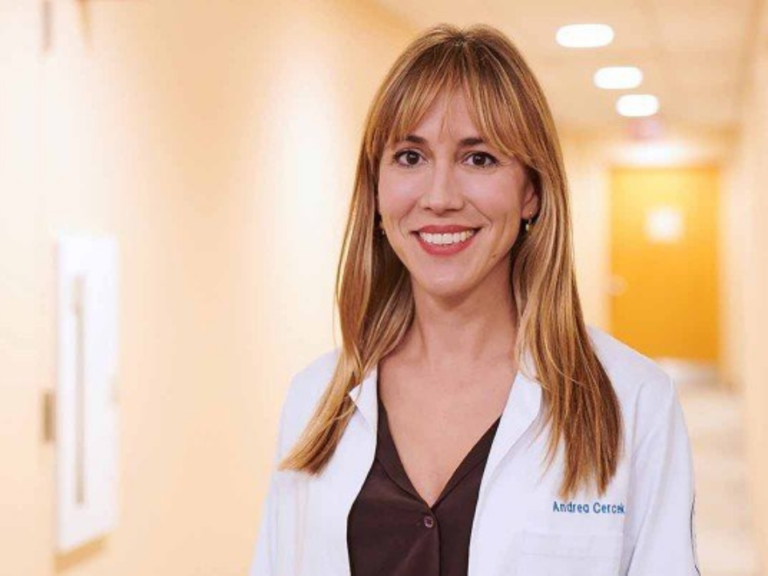
In this episode of The Cancer Letter Podcast, Andrea Cercek, PI for AZUR-1 and section head of colorectal cancer at Memorial Sloan Kettering Cancer Center, appears as a special guest to discuss the results of the study, which was the global registrational trial that supported dostarlimab’s accelerated approval.
Dostarlimab is sponsored by GlaxoSmithKline.
The FDA approval could allow some patients to avoid chemotherapy, radiation, and surgery—treatments that can have devastating consequences for bowel, urinary, and sexual function, as well as fertility.
For anxious patients concerned about forgoing the potentially curative standard of care treatment, Cercek offers reassurance and context.
“I think the key thing here is that the patients are in follow-up,” Cercek said. “It’s not that we say, ‘Okay, see you later. You’re good. We don’t need to see you again.’ No, it’s very strict—every four months, evaluations with MRIs, with flexible sigmoidoscopies, monitoring of symptoms if any symptoms return, and that we could always intervene at that point and still offer curative treatment.
“And I think we did in fact see that in the patients in AZUR-1 where they didn’t have complete responses that then went on to standard of care, not just surgery, but as I mentioned, radiation or chemotherapy first because there is some ability to decide on which regimen you start with. The large majority of those patients did phenomenally well. And in fact, 93% of the entire population is disease-free.
“So, that just tells you that there is this ability to actually intervene with standard of care if needed.”
Stories mentioned in this podcast include:
- NCI’s new CCSG is the result of “thousands of hours” of listening, negotiations, surprises New NOFO aims to shrink applications by 40% – The Cancer Letter
- NCAB ad hoc working group seeks to define its role as it approves eight reissue concepts “We could do a lot more than be another committee to check the RFAs before they go to the next level.” – The Cancer Letter
- MSK’s Andrea Cercek: Oncology faces learning curve as dostarlimab challenges dMMR rectal cancer standard of care
- Facing stage 4 cholangiocarcinoma, Keaton Herzer moved mountains to take off-label therapy, get a transplant
- Dostarlimab becomes first FDA-approved immunotherapy for locally advanced rectal cancer
- Kelly Spill opted for dostarlimab trial, avoiding rectal cancer treatment that would leave her infertile
This episode was transcribed using transcription services. It has been reviewed by our editorial staff, but the transcript may be imperfect.
The following is a transcript of this week’s In the Headlines, a weekly series on The Cancer Letter Podcast:
Jacquelyn Cobb: This week on the Cancer Letter Podcast…
Andrea Cercek: What’s important to note is that this was a registrational global study, which was single arm study in a curative setting and with a relatively novel endpoint of clinical complete response that was sustained for 12 months. So patients received six months of dostarlimab. They were evaluated. If the tumor was completely gone, they would enter this observational period for 12 months before they were evaluable for the primary endpoint. And because it was a registration on a global study, it was designed a bit more conservatively with this novel endpoint. So there was an investigator assessment. So each investigator that was treating the patients could determine if this was a clinical complete response and then if the patients met the CCR12 endpoint. And it was the investigators that decided on treatment. In other words, the investigator had the assessment, patient went on to follow up, they met a CCR12, they were continued just in follow up.
Or if they didn’t make that clinical complete response and the tumor was still there, the investigators decided on standard of care.
Paul Goldberg: You’re listening to the Cancer Letter podcast. The Cancer Letter is a weekly independent magazine covering oncology since 1973. I’m your host, Paul Goldberg, editor and publisher of The Cancer Letter.
Jacquelyn Cobb: And I’m your host, Jacqueline Cobb, managing editor of The Cancer Letter. We’ll be bringing you the latest stories, groundbreaking research, and critical conversations shaping oncology.
Paul Goldberg: So let’s get going.
Jacquelyn Cobb: Hi Paul, how are you?
Paul Goldberg: Hi Jacqueline. How are you?
Jacquelyn Cobb: I’m doing good. Thank you for being flexible with me on timing this morning. I was running a little late today. My coffee order was running late. It’s not a very good excuse.
Paul Goldberg: Having you on a podcast without enough caffeination would be really boring.
Jacquelyn Cobb: It’d be much worse, yes. It’s worth the three minutes I’m late.
Paul Goldberg: At least I’m caffeinated.
Jacquelyn Cobb: Yes, yes. I know I should have it in my cancer letter mug, but didn’t have time. Didn’t have time. That’s worth the action.
Paul Goldberg: You don’t have time to pour your coffee into the… How long does that take?
Jacquelyn Cobb: 10 seconds? I don’t know. Anyway, too literal here this morning. I’m going to take us through last week’s headlines very briefly because today we are going to hear directly from Dr. Andrea Circic. I had an interview with her last week for the story that I wrote about her basically giving more context to the AZURE-1 trial results that were basically used by FDA to justify accelerated approval for dostarlimab for the treatment of locally advanced DMMR rectal cancer patients. So that’s a whole story. It’s an exciting clinical advance is sort of the idea of the story, but her explanation of it, not to put myself down, is just a little bit more succinct and clear, I think, or at least a nice additive to the story that I ended up writing yesterday. So that’s what we’re going to have for the meat of today’s podcast. But before we go into that –
Paul Goldberg: If that’s the meat, what are we doing?
Jacquelyn Cobb: I know, what’s the potatoes?
Paul Goldberg: What’s the bone?
Jacquelyn Cobb: But we will be going through the rest of the issue briefly just to give readers or listeners a walkthrough of last week’s headlines. And the cover story is pretty interesting. I, full transparency, haven’t read it yet. I’m so sorry, Paul. I was doing the other stories of the issue and that’s on my homework today to do, but I definitely did. I was around it enough to understand what the meaning is and it’s that NCI’s new CCSG applications are going to be simpler, smaller, more streamlined. And so I’ll let you talk more about it now, Paul, but that’s the gist.
Paul Goldberg: Yeah, it was the meat of the AACI meeting. That was very much the most important story in cancer centers. How does NCI designate and re-designate cancer centers? The way I see it, and I hope I’m not wrong, is the rules kind of grew. Cancer centers are fundamental to the National Cancer Act of 1971. That’s a big chunk of that. Cancer centers are fundamental now to cancer care around the United States and the world really, because research is worldwide. So how they’re designated, it’s a very interesting story because I think it kind of grew organically into whatever it was. And then Kim Rathmell brought together a workshop in 2024 in September and had Emeritus Cancer Center directors run it. And then NCI listened. Now Kim Rathmell is no longer the NCI director, but as she moved on and Tony LaTai wanted to continue this whole process of redoing cancer centers and what it takes and how do you make it rational?
It’s interesting because people become experts in the process. People know how to manipulate the process. People know how to write so you won’t get a no, but then nobody looks at the process and the rationale for the process. And that’s what NCI has done, which is not the classic bureaucratic behavior at all. The classic bureaucratic behavior is to have the middle level bureaucrats frustrate the work of the highest level bureaucrats. That’s classic. That’s not what happened here.
Jacquelyn Cobb: No.
Paul Goldberg: Because Krzysztof Ptak, who’s head of the office of the cancer centers, as soon as he became acting a couple of years ago, started really working this, spending thousands and thousands of hours on this. And then there’s also a very interesting event occurred when early in the administration, all of the grant review was moved to the Center for Scientific Review at NH. Now, this is kind of controversial, very controversial, because suddenly there was this question of what happens with the site visit. And so last year there was a lot of discussion of the site visit and what its future is. And as it stands right now, the cancer centers are not scored based on the site visit. And the site visit became kind of a big event. People show up from all over and there is this group of reviewers and the center brings out its dog and pony shows and some of them are beautifully produced.
And so it’s kind of Lion King, that’s the joke that caught on last year at AACI, the Lion King level of production. And sometimes you would have a Politico or she is completely clueless sitting there, but giving importance to the proceedings and this goes on. Or you could have, this is the worst part, you could have members of the site visit group who are really posturing and trying to show their own expertise and importance and getting into just all kinds of not terribly interesting discussions and everybody listens. So what they replaced it with is kind of interesting, which is a small group, seven center directors and one associate cancer center director. So they show up for four hours, half a day and they hang out at the cancer center and they get a little presentation from the center director and a bunch of other presentations.
There is a question and answer, everything gets done fast. And it’s interesting because Kim Rathmell said some really interesting stuff about it, which was as director to director, you can learn a whole lot by just figuring out what is happening. And each of the cancer centers is of course different, but this is a really well compressed thing. It’s not scored, but it goes to NCAB.
So I guess from what I could tell, everybody seems to be pretty happy with this. And it’s interesting that last year the big surprise was that everybody was really pretty happy with the CSR review as well, with how well it was done. So suddenly here we are. Everybody seems to be somewhat… We’ll see what’s in the actual NOFO. What we have is Krzysztof Ptak’s slides, which are available to any cancer letter reader for a nominal price of zero dollars and zero cents. It’s worth looking at. I mean they’re nice slides and basically they’re promising that 40% of the bulk of the CCSG application has gone away. Now there’s also an addition of initiation of clinical trials and how to make them start faster. All of that is in there. But the conversations I’ve had on and off the record, I mean there’s no reason to really quote people on that, but most people were basically telling me that, yeah, it would be really nice to eventually to get the scored part, to get the Central Scientific Review part back into NCI, but the procedure, fine.
Maybe there’s some that will occur eventually because cancer centers are different, they’re special, but things are working and they never didn’t work. It was interesting because how they did it, they had to… Right now, cancer center directors were telling me that they were writing the renewal applications to essentially a NOFO that hasn’t been published. So poor Krzysztof had to guide that. Poor Krzysztof is a very happy guy. He had to basically guide everyone through it, but it’s an interesting way of funding cancer centers and it’s better than the previous way it seems. And it really does not represent governing bio cause or fiat, which is exactly the same thing. So it’s not from top down, it’s from the bottom up.
Jacquelyn Cobb: Well, that’s what I was going to ask, Paul, is the headline is, but it’s results of the new CCSG is the result of thousands of hours of listening negotiation and surprises is I feel like such a good…
Paul Goldberg: But the surprise is what this administration did, which is move everything to Center for Scientific Review. But that worked too.
Jacquelyn Cobb: I know.
Paul Goldberg: Yeah. There’s really no reason to complain very much.
Jacquelyn Cobb: Yeah. It was a moment of, I think, concern and trepidation when it happened because we didn’t know what was going to happen, but now that we have the feedback and that it’s working…
Paul Goldberg: Yeah. Which is kind of not as… Yeah, it’s also an interesting time to be a journalist because we talk so much about things that don’t work. This actually works. Gee.
Jacquelyn Cobb: Yeah.
Paul Goldberg: Isn’t
Jacquelyn Cobb: That great?
Paul Goldberg: I know. Yeah, which also leads to something else because this went from administration to administration and it kind of shows you that this can work in a nonpartisan fashion.
Jacquelyn Cobb: Yes.
Paul Goldberg: And it never really comes up or shouldn’t come up. It does come up, but it shouldn’t. That’s kind of the best thing about the National Cancer Program is sometimes it gets nonpartisan.
Jacquelyn Cobb: I know. And nowadays, especially for listeners, this is going to come out tomorrow, but we’re recording this on election day, so very present.
Paul Goldberg: Yeah, but it’s all very important because really fundamentally the National Cancer Program is highly political because I mean, think about it, the NCI director is a presidential appointee. There is a president’s cancer panel which bypasses NIH, which goes directly to the president. And NCAB directors are members rather are named by the White House. And this is also really the first time in history of mankind that the country declared war on a disease. So yeah, it’s really political. It doesn’t have to operate badly just because it’s political?
Jacquelyn Cobb: No. No, clearly not.
Paul Goldberg: Sometimes it has. I mean, we were there to cover some real just catastrophes, bumper car concessions, but this is fine. It’s working.
Jacquelyn Cobb: Yeah.
Paul Goldberg: Yeah.
Jacquelyn Cobb: Interesting. And I mean, I don’t know if it’s necessarily… Again, I’m not the most educated on this, but I feel like the fact that it was sort of from the ground up or the fact that they really listened to what the people who are actually going to be applying to these grants wanted a need, specifically about the site visits, just because I know that that was such a big conversation. There were a lot of people who were concerned that you were going to lose out on important information related to the grants and blah, blah, blah. But NCI heard all of those concerns and has come up with something that, like you’re saying, seems to be getting quite good feedback.
Paul Goldberg: Yeah, and adapted to field conditions, which is what this administration did with the transfer of CCSG to the Center for Scientific Review, which is fine. Someday it might go back or not, and everybody will be just fine. Thank you very much. Assuming that the NCI directors stay competent because we really could have gotten some real doozies. I know. We did not.
Jacquelyn Cobb: I know all of this is contingent on the fact that Letai is…
Paul Goldberg: That there’s a lot depends on the NCI director. And in this case, I mean, Latai really did take on that project and just kept it going and gave cover, if not cover, but gave certainly mandates to this office of the cancer centers to Krzysztof Ptak, who is like, it’s almost indecent how much people were praising him. Come on, he’s a fad.
Jacquelyn Cobb: You’re like, “Hey, wait a second.”
Paul Goldberg: Yeah, yeah, yeah. He’s not going to pick up a microphone and start singing for you. He’s actually… Well, he’s done a really nice job. I mean,
Jacquelyn Cobb: Clearly he has.
Paul Goldberg: And people have really been very protective of him and very appreciative of what he’s done.
Jacquelyn Cobb: Yeah. Well, relatedly, I will say, thinking about changes that have happened, I wrote a story about the NCAB ad hoc working group meeting, which has replaced the former Board of Scientific Advisors as part of the sweep of changes that Trump enacted when he came into office the second time. And so this is not the first time that this working group has met. They met in February, I believe. I’ll have to check that, but they’ve met and they approved concepts in the past. But at this meeting, there was sort of a discussion at the end that was really more… I just used the word existential in my last story, so I don’t want to use it again, but a little bit more – It’s the
Paul Goldberg: Word. Use it. If you don’t use it, I’ll use it. Existential.
Jacquelyn Cobb: Yes. Existential question of what is their role and purpose? They’re not a full working board, which is what the administration had determined that NCI only needed one basically, which was protected by the National Cancer Act, which is NCAB. That was very roundabout. But anyway, all that to say is that they are sort of struggling. The main thing was that a lot of the members vocalized the concern that they aren’t getting as much education and information about these concepts and the broader landscape within which these concepts sit as members of this ad hoc working group compared to when they were members of the BSA. And these are members that did literally used to be on the BSA and now are on this new ad hoc working group. So yeah, that was basically the gist of the story as well as some really interesting concepts. I will flag that there was a little bit of a discussion about animal models as part of, again, this early suite of things that Trump did.
That was definitely a talking point where NIH wants to move away from animal models. It’s pretty nitty-gritty. I’m not going to get into too much detail here, but some of the members had a little bit of a bureaucratic tussle about the language of the concept. I think that that did lead to maybe the discussion later in the day where they have this concern about how this concept is phrased or written or whatever, and what actually is their role in that case? And so that I think is what kicked off this discussion.
Paul Goldberg: Well, their role is what the BSA role was. They’re just operating under a different set of rules and –
Jacquelyn Cobb: Conditions.
Paul Goldberg: And conditions. And in this case, not even rules, it’s just conditions is the right word. Thank you. But actually, that discussion was very interesting. But again, it’s a great time to be a journalist because once you stuck it on top of your story, I would assume that it’s not what NCI really intends to do, and they will probably provide better information to the board from now on. So it’s kind of obvious.
Jacquelyn Cobb: Yeah, no, 100%. Their concerns were 100% heard. Camelia Ulrich is the chair of the ad hoc working group, and she said that she would bring it directly to LaTai. Even if it’s not some sweeping change or whatever, it seems like that there is… It’s almost more like growing pains, just satisfying this new, like you said, or like I said, these new conditions, but also wanting to accomplish their goal. So I know a couple of the members kind of lean toward the idea of we want to be like we used to be. We want to have the education we used to have. We want to have the in-person meetings, we want to et cetera, et cetera. And there is this line, I think that Ulrich and the group in general has to walk of acknowledging their new limitations a little bit.
Paul Goldberg: I’m not sure there are limitations. I wouldn’t be surprised that after this being amplified through your story by you… I mean, nobody’s trying to bamboozle the board into approving a bunch of stuff without telling them anything. So that’s not what’s happening here. What’s happening here is some machinery is not working.
Jacquelyn Cobb: Yes, exactly. That’s kind of
Paul Goldberg: What
Jacquelyn Cobb: I’m
Paul Goldberg: Trying
Jacquelyn Cobb: To get pains. Figuring it out. They are already planning on having an in-person meeting. My understanding is in response to this desire to have a little bit more involvement, a little more understanding, which is good. Like you’re saying, the machinery is… The rust is being… What do you do with rust? Scrape it off?
Paul Goldberg: Depends on how much rust there is. You can throw away the entire machine.
Jacquelyn Cobb: No, we’re not doing that. We’re scraping it off.
Paul Goldberg: Scraping it off. Yes. Well, you scraped that here. You didn’t scrape it, you pointed to it. So that was nice.
Jacquelyn Cobb: But that’s what I’m saying is that, and then the members were like, “Well, we’re wondering if maybe we can overlap our in-person meeting with the NCAB meeting that’s already in person.” And so it’s sort of like an iterative scraping of how do we make –
Paul Goldberg: Iterative scraping. I like that.
Jacquelyn Cobb: But yeah, so that was my story. I’m not going to say too much else, I guess, about my story with Dr. Cercek because you will be hearing from her. But I just want to highlight our Cancer History Project podcast before we hand it over to Dr. Cercek, because it is a podcast that you can go and listen to on the Cancer History Project Podcast. And it is about Keaton Herzer, a patient who was facing stage four cholangiocarcinoma. And he went through… It’s really a whole journey. It’s the whole podcast that you can listen to, but he wanted to take off-label therapy. He had to get a transplant. There were all of these sort of obstacles that he faced in his treatment, and now two years later, he has no evidence of disease. So just a really incredible patient story. He was interviewed by Deborah Doroshow, and it’s a wonderful conversation.
So I just wanted to plug that before we move on. Is there anything else you want to talk about?
Paul Goldberg: Yeah, a little bit of housekeeping. I heard a very interesting critique of our podcast, a weekly podcast. Somebody pointed out that her drive is about 30 minutes and our average podcast, weekly podcast runs for about 15, and couldn’t we go a little bit longer? I guess we’re now at minute about 25, I believe, and then there’s also more. So for our listeners –
Jacquelyn Cobb: This is for you.
Paul Goldberg: You know who you are.
Jacquelyn Cobb: You know who you are.
Jacquelyn Cobb: I hope you don’t regret asking us that.
Paul Goldberg: Yeah. Yeah, you will learn to regret what… Yes, this feedback. We will make things… We’ll try… Well, I think actually what we should do is do what we’re doing this time, which is have guests or maybe have some audio recordings that we made in the process of doing a story and then maybe put something into the story. But there’s still this really authoritative piece of information that might be in the interview. So it’s again, a great time to be a journalist.
Jacquelyn Cobb: Wonderful time to be a journalist. Thank you so much, Paul.
Paul Goldberg: Thank you, Jacquelyn.
Jacquelyn Cobb: Listeners, here is Dr. Cercek. Enjoy.
Welcome. I am so happy to have you here. We had, and just to give listeners a little bit of a background, we published a story in last week that said that your… Not yours, I guess, but dostarlimab has been FDA approved for locally advanced rectal cancer for some patients with it. And it’s been a really exciting story. I covered it a few years ago. Like I was saying to you, I haven’t been as immersed in the story recently since Claire did the story on it last week, but there were just a little bit of data that came out on the Sunday after our publication that didn’t make it in the story, obviously. So we have Dr. Cercek here to give us a little bit of an update on what that is and also to talk about what it means.
Andrea Cercek: Hi, thank you so much for having me. Yeah, so this is exciting FDA approval in mismatch repair deficient locally advanced rectal cancer for dostarlimab monotherapy with the goal of clinical complete response in these patients. And so effectively replacing standard of care in select patients that have this mutation and that have a clinical complete response. And what’s important to note is that this was a registrational global study, which was a single arm study in a curative setting and with a relatively novel endpoint of clinical complete response that was sustained for 12 months. So patients received six months of dostarlimab. They were evaluated. If the tumor was completely gone, they would enter this observational period for 12 months before they were evaluable for the primary endpoint. And because it was a registration on a global study, it was designed a bit more conservatively with this novel endpoint.
So there was an investigator assessment. So each investigator that was treating the patient could determine if this was a clinical complete response, and then if the patients met the CCR12 endpoint. And it was the investigators that decided on treatment. In other words, the investigator had the assessment, patient went on to follow up, they met a CCR12, they were continued just in follow-up. Or if they didn’t make that clinical complete response and the tumor was still there, the investigators decided on standard of care. So that’s how the study was run. However, again, because it was a registrational study, the FDA also asked for a central review of the imaging assessments. And what was different is that the patients, in order to have achieved a clinical complete response, the assessments they needed were with an MRI. So it was an evaluation of the MRI where we had to see complete disappearance of the tumor by MRI as well as any lymph nodes that might’ve been involved, and then also endoscopically.
So the patients all underwent flexible sigmoidoscopies, evaluation of the tumor by the investigators on study, and then these images were transmitted for central review. So the central reviewers obviously didn’t have the patients in front of them, but had just these two modalities of treatment assessment. And what happens is when the primary endpoint was the central review and 47% of patients met a CCR 12, so 47% of the total number, but less patients were evaluable. And the reason that is because the central reviewers, because I think they lacked some of the value that the patient contributes and the symptoms and just had these imaging to look at, it actually took them longer to determine whether a patient was in a clinical complete response or not. So the data of the central reviewers, because it’s just an interim analysis because of the accelerated approval, the data are lagging behind.
So there’s a discordance because the investigator clinical complete response assessment is actually 68%. So this difference is it’s really just logistical Because of the central review limitations, because you can imagine if the endoscopy wasn’t transmitted, there was an issue with the transmission of the actual images, well, that patient is inevaluable at that moment for a CCR12, and then when they come back in four months at the time of their next assessment, then they might make that CCR12 mark. So that’s why there’s this difference in the percentage of CCR12. It’s not effectively that the central reviewers felt that less patients achieved a clinical complete response. And the most telling of that actually is that, as I mentioned, the investigators are the ones that determined the treatment course. So they decided on each patient of that, initially it’s 71% of patients that had a clinical complete response.
So those 71% of patients were all followed to make the CCR12 mark for a year. And that number dropped to 68% because a few patients are still in follow-up and just simply haven’t made it to the 12 months because it was an earlier data cut. And also because two patients who had a clinical complete response actually went for surgery, but had no tumor at the time of surgery. But those 68% of patients that had a clinical complete response, not a single patient has recurred. No one. There have been no recurrences and the median follow-up is now 26 months. So it’s over two year follow-up, there have been no recurrences. So we could feel very confident that the investigators in fact were correct in their assessment and that that investigator response was a very meaningful number actually for patients who actually all of them remain disease free.
It’s 98% is what’s reported because of those two patients that underwent surgery that had no tumor left and they have also not recurred.
Jacquelyn Cobb: Wow. That’s really, really cool. I feel like that very much consolidates things for me. When you’re trying to put the story together with very jargony terms, it’s hard for a layman like myself to understand. And that’s really, really helpful and really, I mean, miraculous to hear about those results. Can you just tell me, and not to put you on the spot here, but can you give me what’s next or what the state of the clinical… I know you have the accelerated approval, but I guess I’m wondering about reading out the data that would properly solidly answer these questions that seems so.
Andrea Cercek: I think because the endpoint was 12 months, it gives quite a bit of confidence that this is not just that the tumor goes away and comes back and it hasn’t come back now in those patients. So I think an important finding of course always is that this translates into a longer term disease-free survival and overall survival. And we definitely have seen that in our MSK study that was sort of the prelude to the AZUR-1, the global registrational study, that these responses are in fact durable, but we obviously need confirmation of that. And then I think the other and important piece is that the patients that by the investigator were assessed not to have a clinical complete response. There was a number of patients, actually 13, that the investigators thought, “Okay, there’s still residual tumor after six months of dostarlimab.” The 13 patients that went straight to surgery, 10 out of those 13 had no tumor left in the surgical specimen.
So they did in fact have a clinical complete response, but it was not assessed appropriately. And some of this, I think that’s really the most important next because this now with the FDA approval, what we hope and what we expect is that this will translate to approvals by other regulatory agencies in Europe, Asia, et cetera, and that this will really offer dostarlimab monotherapy to all patients, hopefully globally with mismatch repair deficient tumors. So many will have responses that are easy to see, that are easy to assess and will enter non-operative management. But for the more challenging cases, I think there is a bit of a learning curve. This is what we spoke about last time as well, and always with new technologies and advancement, there’s a learning curve. And so there is this need to really say, okay, well, if the endoscopy looks good and maybe there’s something on the MRI, we need to give this patient the benefit of the doubt.
We need to give this a little bit more time. And we’ve seen that a lot anecdotally outside of a clinical trial. And of course in a clinical trial, it’s much more strict as to what decisions you can make. And so I think some of it will be a comfort with watching and waiting and then allowing these responses to really declare themselves. And some of it I think will also rest on just better tools of assessment that will help investigators worldwide be able to offer this to more patients. Because if you think about it, if 10 out of the 13 that went to surgery had no tumors left, it is very likely that a large proportion that went straight to radiation or straight to chemotherapy also had no tumors left. We just don’t know because we don’t have that concrete way of being able to assess it where we look under the microscope and we see no tumor.
Jacquelyn Cobb: Yeah, that makes so much sense, I think. And just again, apologies for the fact that I’m a little bit dusty on my knowledge of this story.
Andrea Cercek: No worries.
Jacquelyn Cobb: Again, this is very much my lay perspective, putting myself in the patient’s shoes almost is the added sort of exhilarating, scary part is that the standard of care can be curative. So it’s like, yeah, this is amazing and amazing, but the risk tolerance for a very, very little anxious patient like myself, it’s a scary thing. And I imagine, I wonder how doctors can guide patients through a conversation like that at this point at least with the accelerated approval.
Andrea Cercek: Yeah, I think it’s definitely important thing to consider. And I think the key thing here is that the patients are in follow-up. It’s not that we say, “Okay, see you later. You’re good. We don’t need to see you again.” No, it’s very strict every four months evaluations with MRIs, with flexible sigmoidoscopies, monitoring of symptoms if any symptoms return, and that we could always intervene at that point and still offer curative treatment. And I think we did in fact see that in the patients in AZUR-1 where they didn’t have complete responses that then went on to standard of care, not just surgery, but as I mentioned, radiation or chemotherapy first because there is some ability to decide on which regimen you start with. The large majority of those patients did phenomenally well. And in fact, 93% of the entire population is disease-free. So that just tells you that there is this ability to actually intervene with standard of care if needed.
But I would argue just give it time, because the possibilities of avoiding not just surgery, we talk about surgery a lot because that’s obviously incredibly morbid, but also radiation. We’re seeing so many young patients, radiation has significant morbidity in terms of fertility, early menopause, also sexual dysfunction, bowel bladder dysfunction for men and women. And the majority of patients in AZUR-1 in a global study were able to avoid all of standard of care, not just surgery.
Jacquelyn Cobb: That’s amazing. That sounds really amazing. It’s just exciting. That’s wonderful.
Andrea Cercek: It is. It is. It’s the best. Yeah.
Jacquelyn Cobb: Yeah, that’s wonderful. Okay. I think that those are my questions. Did you want to say anything more about this learning curve? I imagine that there’s a sort of I don’t know what I don’t know type of thing happening here, if there is, but I’m not sure.
Andrea Cercek: It’s that, and then also with experience. I certainly can tell you, I mean, I think at Memorial, we’ve been interested in non-operative management as a disease management team for a very long time. And so it was very easy for us to review a patient case and say, okay, this is close, let’s give it some time. And the medical oncologist agreed, the surgeons agreed, the radiation docs agreed, and we brought the patient back. And I think I’ve heard from many investigators on AsureOne that they learned along the way and they said, “You know what? That first patient that went to surgery that didn’t need to go, I’m never doing this again. We’re going to give this more time.” And so I think even as an institution, as an academic center or any institution, learning that and learning that really as a group, as a disease management team is what’s critical.
And I think what will happen over time, and we see that with all therapies, there’s a little bit of time lag before everyone starts using it or we become comfortable or we know how to use something. So I think this is the same thing just on a very different scale where we’re specifically omitting standard of care, but where we think there’s a very, very high chance that we can.
Jacquelyn Cobb: Yeah, that’s wonderful. Well, thank you so much. I think that this is wonderful. Is there anything else you want to touch on before we sign off?
Andrea Cercek: No, thank you for doing this. I appreciate it.
Jacquelyn Cobb: Thank you for joining us on The Cancer Letter Podcast, where we explore the stories shaping the future of oncology. For more in-depth reporting and analysis, visit us at cancerletter.com. With over 200 site license subscriptions, you may already have access through your workplace. If you found this episode valuable, don’t forget to subscribe, rate, and share. Together, we’ll keep the conversation going.
Paul Goldberg: Until next time, stay informed, stay engaged, and thank you for listening.