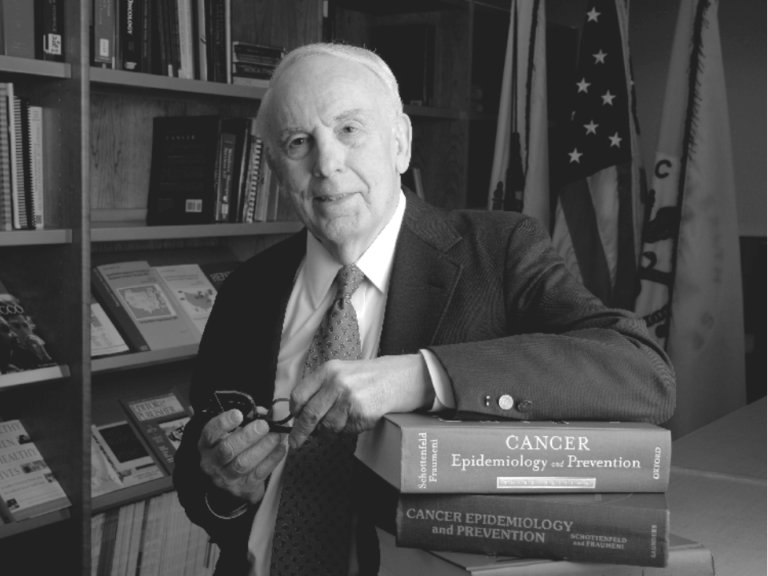
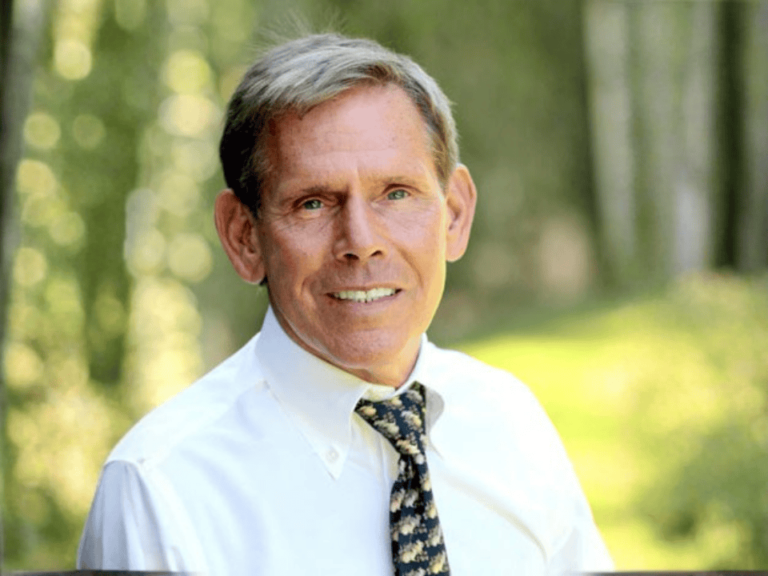
Harold Freeman, who was widely regarded as the “father of patient navigation,” was also a passionate storyteller with a special talent for coining a phrase.
As he rose to prominence in his career as a surgeon, oncopolitician, public health advocate, and booming voice of conscience, he authored editorials, gave interviews, and made statements. Some of his best lines stuck with him.
Freeman died on Aug. 11. He was 93. An obituary appears in this issue.
As obituary writers sharpen their pencils, they refer back to their archives for some of his best lines. Many of them are strikingly consistent.
In a 2014 opinion piece in The New York Times, Freeman wrote, “I imagined that I could ‘cut cancer out of Harlem.’ But I soon learned that the disease would not yield to a surgeon’s knife. Why? Because the patients were coming in too late.”
This quote, also featured in the Times obituary, is perhaps the first appearance of a line Freeman used often.
In 2022, when Freeman was interviewed for the Cancer History Project, he added a little more surgical precision:
“I’m ready to do it. I’m skilled. I know how to cut cancer out. I want to cut it out of Harlem. I can’t do that. I can’t cut it out. It won’t yield. It won’t yield to the surgeon’s knife. It won’t yield to what we call the Bard-Parker, which was the name of the surgeon’s knife. Cancer wouldn’t yield.”
Freeman knew the power of a good line, and leaned on language in the fight for health equity and racial justice that ultimately defined his career.
“The truth of the matter is that I came from nowhere,” he said in the same interview. “I had the opportunity to become a high-level trained surgeon, that I came from a particular background that caused me to be concerned about injustice, and particularly, racial injustice, and then applied it to my work.”
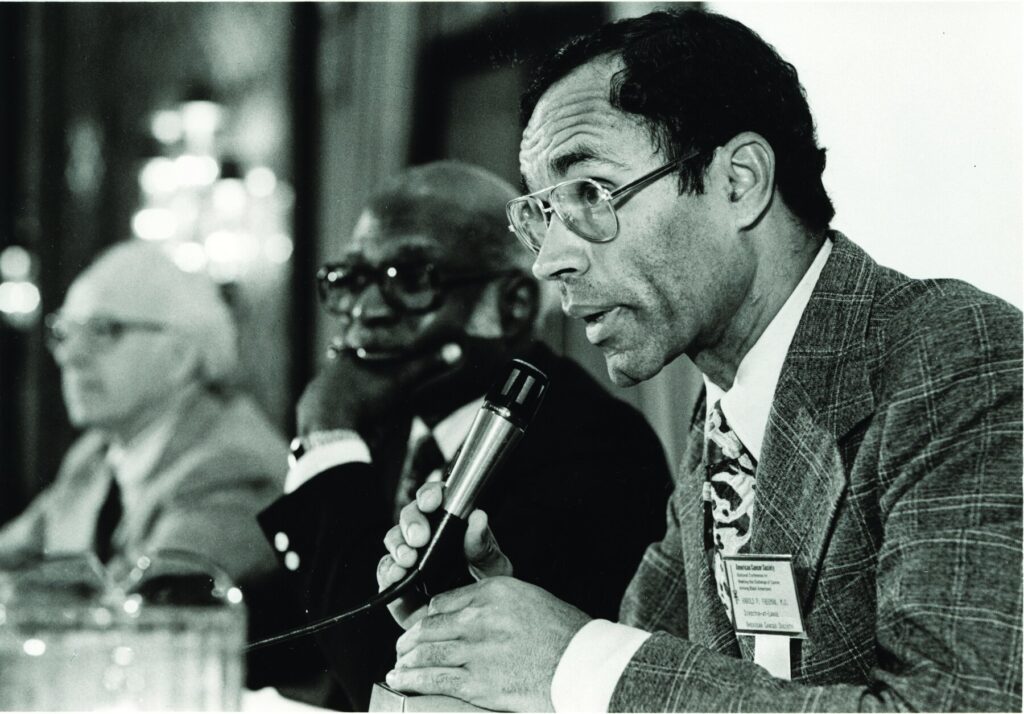
Source: American Cancer Society
If Freeman repeated a good line, it’s because it sent a strong message.
“We need to declare a new kind of war on cancer—a guerilla war—that will tear down the economic and cultural barriers to early and adequate cancer prevention, diagnosis, and treatment, and dramatically increase cancer survival rates for all Americans,” Freeman, then president of the American Cancer Society, said in 1989 (The Cancer Letter, July 21, 1989).
He said it again in 1991, in a statement on the impact of the National Cancer Act, commemorating the law’s 20th anniversary:
“We must conduct a new kind of war against cancer—a guerilla war to tear down the economic and cultural barriers to prevention, early detection, and treatment. This hand-to-hand combat must be carried out in the neighborhoods of America where people live and die.”
The truth of the matter is that I came from nowhere. I had the opportunity to become a high-level trained surgeon, that I came from a particular background that caused me to be concerned about injustice, and particularly, racial injustice, and then applied it to my work.
Harold Freeman, 2022
His quotes are iconic and repeatable because they’re powerful, as was his message:
“Poverty and racism are two distinct, destructive elements in American life. Therefore it is necessary to separate the strategies we use to fight poverty from those we use to fight racism. If you confuse those issues you will confound the solution,” Freeman said in an interview with the National Coalition for Cancer Survivorship Networker in 1994.
His message didn’t modulate for his audience—mainly because it didn’t need to.
“I believe the unequal burden of disease in our society is a challenge to science, as well as a moral and ethical dilemma for our nation,” Freeman said in remarks to NCAB in 2000 (The Cancer Letter, Sept. 15, 2000).
That message carries through the many speeches, statements, and interviews during his life and storied career.
The Cancer History Project has compiled the following archive of Freeman in his own words.
Interviews
Harold Freeman, father of patient navigation, on cutting the cancer out of Harlem
The Cancer Letter, Feb. 11, 2022
Harold Freeman had big plans after he finished his residency at Memorial Sloan Kettering Cancer Center in 1968. He planned to cut cancer out of Harlem.
“I’m ready to do it. I’m skilled. I know how to cut cancer out. I want to cut it out of Harlem. I can’t do that. I can’t cut it out. It won’t yield. It won’t yield to the surgeon’s knife. It won’t yield to what we call the Bard-Parker, which was the name of the surgeon’s knife. Cancer wouldn’t yield,” Freeman said to The Cancer Letter in an interview with Robert A. Winn, director of VCU Massey Cancer Center, and John Stewart, founding director of LSU Health/LCMC Health Cancer Center. “Then I get to the reality, I can’t cut it out. Why? Because the people were coming in too late with cancer for me to be able to cut it out.”
Freeman made his career out of asking why it was that his patients, who were poor and Black, sought treatment too late. As president of the American Cancer Society in 1988-89, he published a study, “Cancer in the socioeconomically disadvantaged,” and made an unprecedented conclusion—“that the principal reason that Black people were dying from cancer was because they were poor.”
“It was a socioeconomic invasion that was deeper than the cancer invasion in the community,” Freeman said.
Freeman hypothesized that “the combination of the three overlapping circles: poverty, social injustice, and culture, drives disparities across the continuum from where you live to when you die. That’s my theory, and if that’s true, then it should guide you about what to do about it.”
His work and background growing up in segregated Washington, D.C. schools led him to a solution.
“If people meet barriers in getting through the healthcare system with cancer and other chronic diseases, then maybe we should navigate them. Maybe we should navigate them. The concept of patient navigation came out of that experience,” he said. “People who did not have that background wouldn’t think of this, wouldn’t be challenged like this, wouldn’t care, perhaps, like I did, about it.
“The truth of the matter is that I came from nowhere. I had the opportunity to become a high-level trained surgeon, that I came from a particular background that caused me to be concerned about injustice, and particularly, racial injustice, and then applied it to my work.”
This story is part of a series of interviews conducted by Robert Winn, guest editor of the Cancer History Project during Black History Month (The Cancer Letter, Feb. 4, 2022).
The combination of the three overlapping circles: poverty, social injustice, and culture, drives disparities across the continuum from where you live to when you die. That’s my theory, and if that’s true, then it should guide you about what to do about it.
Harold Freeman, 2022
Read the full conversation on the Cancer History Project. This conversation is also available on Spotify, Apple Podcasts, and YouTube.
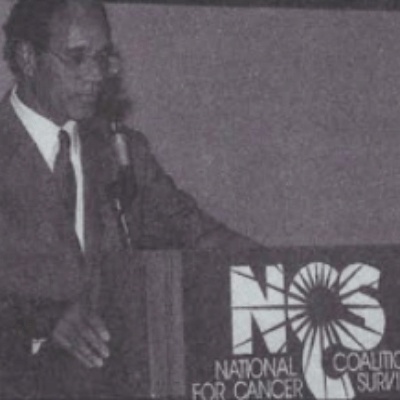
NCCS Networker, Winter 1994 – Race, Poverty, and Cancer Interview with Harold Freeman, MD
By the National Coalition for Cancer Survivorship
This interview with Harold Freeman, the founder of patient navigation, was originally published in the NCCS Networker Volume 8 Issue 4, Winter 1994, which is available on the Cancer History Project.
Freeman was interviewed by Networker associate editor Terrence Campbell. An excerpt follows.
Harold Freeman: Poverty does not respect race. Any group with inadequate income, housing, and education will suffer a higher death rate, whether they‘re white Appalachians, Black New Yorkers, or any other group.
That‘s a major point. If the disparity in survival rates was primarily due to race in itself, that would drive a different solution to the problem. We‘d probably need to explore molecular biology or genetics for solutions. But clearly the major disparities in outcome between races are due to social factors, which suggests a different approach.
Poverty is not a problem that affects only a certain segment of society. It concerns everybody. Many middle class people—whites, Blacks, and others—become poor. Anyone could lose their insurance or their job, or both. Few people could miss 2 consecutive paychecks without potentially severe consequences, such as loss of health coverage. We should therefore not see the poor as “others.” We should see reflections of ourselves in the eyes of the poor.
Of course, race and racism influence cancer outcome. If you grow up as an American Indian, you have a devastating history. If you‘re Black, you have emerged from a long history of slavery and legalized segregation. The history of a people is a powerful determinant of their current social and economic status.
We can‘t change history, but we must be very sensitive to it and not sweep it under the rug. We must also be aware that, despite much progress, we have not yet achieved a completely fair society. But the effects of racism on Native Americans and Black Americans is related more to the momentum of history, as opposed to current race relations.
Certainly, living as a Black American today has to be less onerous than living under slavery or legalized segregation. But 250 years of slavery followed by 100 years of legalized segregation has been a powerful determinant of current conditions. It is also true that changes in laws do not necessarily change the hearts and minds of people.
Read more on the Cancer History Project.
Statements and speeches
The Impact of The National Cancer Act. 1971-1991. Statements. December 18, 1991.
By the National Cancer Institute
In recognition of the 20th anniversary of the Act, the Journal of the National Cancer Institute asked individuals who had key roles since 1971 in the administration and oversight of the National Cancer Program to state what they thought the impact of the Act has been.
The following are Freeman’s remarks, published in the Journal of the National Cancer Institute, Volume 83, Number 24, Dec. 18, 1991.
Americans can be proud of the progress that has been made since the signing of the National Cancer Act and the declaration of the war against cancer in 1971. Dramatically increased cure rate in childhood cancer, Hodgkin’s disease, and the leukemias, along with significant breakthroughs in achieving an understanding of the fundamental molecular changes which explain carcinogenesis, are some of the measures of this progress.
In 1900 only one out of five patients survived cancer. Today one out of two survives. A progressively increasing survival rate is the goal, with the long-term hope of eliminating cancer as a major health problem in the coming decades. As we continue the war, it is essential that we intensify our research energy. Sufficient intensity will, hopefully, lead to the discovery of the fundamental causes of cancer and a knowledge of all the changes which occur within the host once the process of carcinogenesis is initiated.
But even as we pause to celebrate progress, it is sobering to note that within this year one million Americans will develop cancer and one-half million will die. It is also important to note that some Americans have not substantially benefited from the great scientific advance which have been made. To illustrate this point, note that poor Americans have a higher cancer incidence and a 10% to 15% lower five year survival rate than other Americans. This low survival is primarily related to late diagnosis and advanced disease at the time of initial treatment.
Currently there are an estimated 34 million poor Americans overlapping 37 million uninsured. Thus, one out of four Americans is poor, uninsured, or both.
A legitimate question arises as to whether we have properly conducted the war against cancer in all respects. A consideration of the above suggests that the guns and ammunition used in fighting the war against cancer have not been aimed to protect those who are at the highest risk for developing and dying from the disease.
In 1983, the war against cancer took on a new approach when the National Cancer Institute set a goal to diminish the mortality rate from cancer by 50% by the year 2000. The achievement of such a goal requires, among other things, the dramatic narrowing or elimination of the gap in cancer incidence and survival between the socioeconomically disadvantaged and other Americans. To accomplish this feat by the year 2000, we must conduct a new kind of war against cancer—a guerilla war to tear down the economic and cultural barriers to prevention, early detection, and treatment. This hand-to-hand combat must be carried out in the neighborhoods of America where people live and die. Therefore, the designated battlegrounds for waging such a guerilla war should include geographically and culturally delineated areas of high cancer incidence and mortality. Such areas should be targeted with an intense approach to providing culturally relevant education, control of tobacco use, appropriate access to early diagnosis and treatment, and an improved social-support network.
Since access to early diagnosis and treatment are key components of the fight, the National Cancer Institute is not empowered to conduct this war alone. A successful ground war against cancer requires that the Congress and the Executive Branch of government have the unwavering political will to win this war and that the American people, through lifestyle changes, become foot soldiers in this fight for their own lives.
Harold P. Freeman, MD
Chairman, President’s Cancer Panel
1991-Present
Harold Freeman To Direct NCI Center To Reduce Cancer Health Disparities,
The Cancer Letter, Sept. 15, 2000
An excerpt of Freeman’s remarks to NCAB follows:
There’s no question that profound advances in biomedical science have occurred over the last several decades, particularly beginning with the passage of the National Cancer Act. This putting of resources into discovery has been extraordinarily important and has contributed greatly to increased longevity and improve quality of life for many Americans. However despite his progress, the heavier burden of disease is borne by some population groups in the U.S., particularly the poor and underserved.
What the center must do is to more precisely define who these populations are that are not well served. It is not so clear to me that belonging to a socially and politically determined category drives disparity itself, unless the social injustice factor is the major cause of this disparity.
I believe the unequal burden of disease in our society is a challenge to science as well as a moral and ethical dilemma for nation. So I would urge us not to just look at these things from the point of view science, because I really believe that the people who created the National Cancer Act were fundamentally interested in helping the American people with this disease, to improve results, to increase mortality, increase survival, and improve quality of life. This becomes a moral and ethical issue, because doesn’t seem morally acceptable to me we can have the country doing well in many respects against cancer, but some parts of our society are not doing well at all.
There’s a critical disconnect between research discovery programs and delivery of the results. This disconnect is, in and of itself, a key determinant of the unequal burden of cancer in our society. Barriers to prevent the benefits of research from reaching all populations, particularly those who bear the greatest disease burden, must be identified and removed.
Racial classifications have been socially and politically determined, and have no basis in biology. The President’s Cancer Panel in a report three years ago indicated that there’s no biological basis for racial classification. Though race does not exist from biological perspective, it has been invented, racism does exist in our society. We need to distinguish society’s treatment of people in those categories from whether or not people are really biologically different.
We need to declare a new kind of war on cancer—a guerilla war—that will tear down the economic and cultural barriers to early and adequate cancer prevention, diagnosis and treatment, and dramatically increase cancer survival rates for all Americans.
Harold Freeman, 1989
News coverage
ACS’ Freeman: Declare New War On Cancer; Poor Get Substandard Treatment, Lose Dignity
The Cancer Letter, July 21, 1989
“Based on the findings of this report, we need to declare a new kind of war on cancer—a guerilla war—that will tear down the economic and cultural barriers to early and adequate cancer prevention, diagnosis and treatment, and dramatically increase cancer survival rates for all Americans,” said ACS President Harold Freeman in releasing the report this week.
The society estimates that 178,000 people with cancer who might be saved through early diagnosis and treatment will die this year alone. The survival rate of cancer among poor people is 10 to 15 percent lower than other Americans, according to ACS.
ACS is sending the report to health policymakers, advocacy groups, professional societies, social service agencies and other organizations as a national “call to action.” Freeman urged local, state and national policymakers to address the issues in the report.
“Restricted access to health care is a devastating national problem that further impoverishes patients and their families, regardless of the disease involved,” Freeman said.
“On a daily basis, the conditions of poverty are all but impossible for many poor people to overcome. When a serious health problem is added to the equation, the problems become insurmountable.”
Freeman also emphasized that poverty should not be viewed as a problem of others. “The circle of poverty is not a closed circle. There are middle class people today who will become poor tomorrow. Let us see our own reflections in the faces of the poor,” he said.
Freeman, Brinker, Jako Appointed To Cancer Panel
The Cancer Letter, April 19, 1991
The White House last week announced its intention to appoint Harold Freeman as chairman of the President’s Cancer Panel, and named Nancy Brinker and Geza Jako to fill the panel’s two other seats.
Freeman, director of surgery at Harlem Hospital Center and professor of clinical surgery at Columbia Univ. in New York. served as president of the American Cancer Society in 1988-89.
The White House made the new appointments in a relatively short time, only four months after the death of Armand Hammer, who served as Panel chairman since 1981. The term of panel member John Montgomery had expired in 1989 and that of William Longmire ended in February.
In announcing the appointments, the White House officially named Freeman to succeed Longmire, but said that upon appointment, Freeman will be designated Panel chairman. Brinker was named to succeed Hammer, and Jako to succeed Montgomery.
Presumably this was done to give Freeman the longest term of the three appointments. His term expires in 1994, Brinker’s in 1993, and Jako’s in 1992. However, the law creating the panel allows members to serve until they are replaced.
Freeman Reappointed President’s Cancer Panel Chairman
The Cancer Letter, Sept. 16, 1994
President Clinton has reappointed Harold Freeman as chairman of the President’s Cancer Panel.
Freeman, director of surgery at Harlem Hospital Center and professor of clinical surgery at Columbia Univ. College of Physicians and Surgeons, has chaired the panel since 1991.
As chairman, Freeman has emphasized delivery of and access to cancer care, the role of poverty as a determinant of disease, and the impact of cancer on the family.
NCI Health Disparities Center Will Attempt To Influence Policy, Harold Freeman Says
The Cancer Letter, Nov. 3, 2000
The new NCI Center to Reduce Health Disparities will step beyond the Institute’s mission of advancing cancer research, and attempt to influence policy, said Harold Freeman, director of the new center.
“I believe it’s very critical for us to begin to think of how we can gather information that will bring evidence that can influence policy,” Freeman said to the NCI Special Populations Working Group Oct. 30.
Freeman, who is also the chairman of the President’s Cancer Panel and the CEO of North General Hospital in Harlem, made the point repeatedly, both on his own and in response to questions from the group that advises the soon-to-be-abolished NCI Office of Special Populations Research and will advise Freeman’s center that will replace it.
Freeman said he joined NCI in order to pursue the center’s ambitious new agenda. “I don’t think my coming to this thing is about business as usual,” Freeman said. “I could stay in New York if that was the case.”
According to Freeman, the Institute’s focus on cancer research, education, and communications is insufficient to solve the problem of poor health outcomes observed in some ethnic groups. “I think that we must take position that we want to end up changing America,” Freeman said.
The Cancer History Project is a free, collaborative archive of oncology history that aims to engage the scientific community and the general public in a dialogue on progress in cancer research and discovery.
This project is made possible with the support of our sponsors: City of Hope, the American Society of Clinical Oncology, the Sidney Kimmel Comprehensive Cancer Center at Johns Hopkins, the University of Texas MD Anderson Cancer Center, UK Markey Cancer Center, the National Comprehensive Cancer Network, and the Mark Foundation for Cancer Research.
The Cancer History Project is an initiative of The Cancer Letter, and is backed by over 60 partners, spanning academic cancer centers, government agencies, advocacy groups, professional societies, and more.
Interested in learning more about the history of oncology? Subscribe to our monthly podcast on Spotify or Apple Podcasts.