UAMS and Mayo Clinic researchers advance PROTAC technology for targeted molecular therapy

Share on facebook
Share on twitter
Share on linkedin
Share on email
Share on print

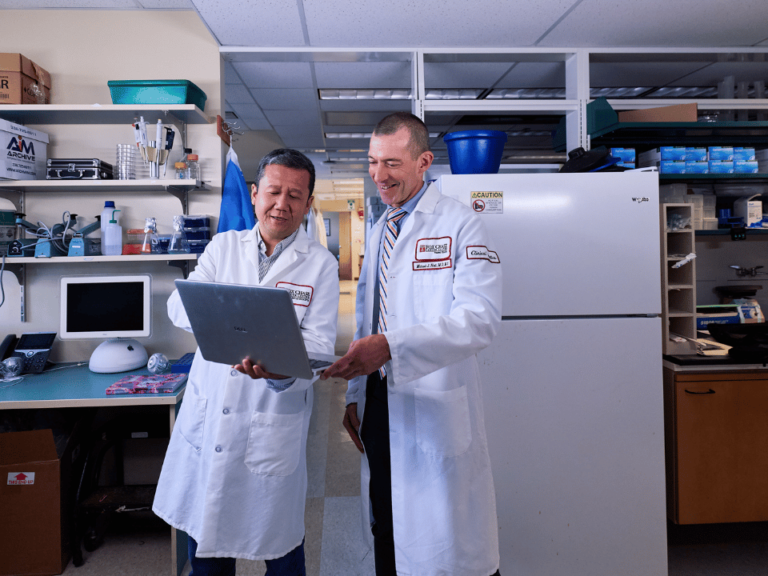
Researchers at the University of Arkansas for Medical Sciences Winthrop P. Rockefeller Cancer Institute and the Mayo Clinic have discovered a way to supercharge molecular cancer treatments to destroy more cancer-causing proteins in cells.

The research findings of UAMS’ Hong-yu Li, the Helen Adams and Arkansas Research Alliance Endowed Chair in Drug Discovery and professor of medicinal chemistry and chemical biology in the UAMS College of Pharmacy, and Haojie Huang, the Gordon H. and Violet Partels professor of cellular biology at the Mayo Clinic, were published in Advanced Science

Li and Huang’s research gives drug makers a new tool for enhancing molecular cancer treatment therapy with Proteolysis Targeting Chimeras technology. PROTACs are genetically engineered molecular compounds that bridge cancer-causing proteins with the molecules that seek to destroy them. 

The team found that adding an “oglio,” or oligonucleotide, to the PROTAC molecular compound helped degrade the targeted proteins completely, improving on conventional PROTACs. 

Table of Contents

YOU MAY BE INTERESTED IN

Those of us who have devoted our careers to treating recalcitrant cancers know the heartbreak of walking alongside an individual facing an advanced diagnosis. We not only shoulder the clinical responsibility, but also the emotional weight that accompanies every step of that journey as each patient’s story becomes connected to our own.
If you believe in the miraculous healing power of ivermectin, hydroxychloroquine, and the harm from vaccination for HPV and COVID-19, you’ve got a powerful friend in Sen. Ron Johnson (R-WI), chair of the Permanent Subcommittee on Investigations of the Senate Committee on Homeland Security and Governmental Affairs.
In a poignant keynote punctuated with anecdotes about grief, American Society of Clinical Oncology’s immediate past president Eric Small emphasized that the annual conference is not just about scientific discovery, but about a responsibility to translate discoveries into better outcomes for cancer patients globally. 

Never miss an issue!

Get alerts for our award-winning coverage in your inbox.

Login