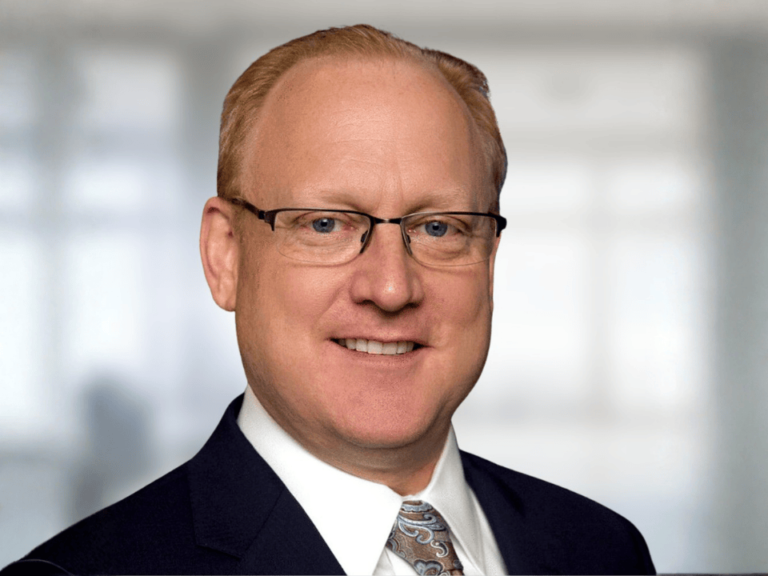
“I don’t know of a single grant that left my desk that was not approved and funded,” NCI Director Anthony G. Letai said on this episode of The Cancer Letter Podcast.
This episode is available on Spotify, Apple Podcasts, and Youtube.
Letai recapped his first year as NCI director in conversation with Paul Goldberg, editor and publisher of The Cancer Letter, and laid out his priorities for the year ahead.
In the conversation, Letai discusses his goal of calming uncertainty at the institute, and why he hopes the metrics from his first year as director—which he lays out in detail—will change the way NCI is portrayed by the media.
“I hope I don’t see any more reports of NCI cutting funding, because it just is not consistent with the facts,” Letai said.
NCI has given away all the money it intended to, Letai told Paul.
“He’s saying that NCI has not been cut back,” Paul said. “In fact, it’s giving out more money and more grants than ever before. So, that’s reality.”
While NCI is reporting thriving extramural research spending, that is not to say that the Trump administration hasn’t attempted—and succeeded in making—a litany of policy actions that imperil the cancer research enterprise, Paul said.
“[Letai] calmed the thing down,” Paul said. “He calmed the place down. But also, I don’t want to sound like everything is great or that I think everything is great. I mean, the administration really did try to cut NCI and NIH by about 40%, and the Republicans in Congress and Democrats in Congress stopped that. So, there’s that. And we’ve been covering efforts by OMB to put in political review of grants essentially, and all funding. That’s not happened. There was just a few weeks ago actually a discussion of an executive order which has not been issued. Well, we’ll see what happens after the midterms.
“So, I mean, we’re just covering politics, but we have to be realistic about what’s actually happening and what’s not happening. And what’s not happening is the cutbacks in cancer research.”
Letai credited NCI staff with the institute’s success in getting extramural funding out the door during a tumultuous time.
“These are all record-high numbers. And it’s a real tribute, I think, in a challenging year, that the NCI staff, despite a lot of public doubt, just kept their nose to the grindstone and week after week, month after month, did their job, as I said they were doing.”
Stories mentioned in this podcast include:
- With Year One metrics in hand, Letai is ready to “bring it home” in Year Two
- Michael Caputo appointed to President’s Cancer Panel
- Two years after FDA’s breast density notification rule, there is still no standard for follow-up
- MD Anderson study suggests psilocybin may prevent chemo-induced neuropathy
This episode was transcribed using transcription services. It has been reviewed by our editorial staff, but the transcript may be imperfect.
The following is a transcript of this week’s In the Headlines, a weekly series on The Cancer Letter Podcast:
Jacquelyn Cobb: This week on The Cancer Letter Podcast…
Paul Goldberg: Well, it’s really interesting because a year ago, your first order of business was to get people to calm down because everybody was bracing for some really catastrophic events.
Anthony Letai:I think that’s true. That was a top priority of mine was just to calm things down. Partly I affected that by, in the words of a famous journalist, being boring and repetitive. But it was just because I really think I had a simple message and I didn’t see a reason to change it. The simple message was the NCI is in business. It remains in business. Its priorities haven’t changed. Its mission hasn’t changed. And our goal is to reduce cancer suffering in the United States.
Paul Goldberg: You’re listening to The Cancer Letter Podcast. The Cancer Letter is a weekly independent magazine covering oncology since 1973. I’m your host, Paul Goldberg, editor and publisher of The Cancer Letter.
Jacquelyn Cobb: And I’m your host, Jacquelyn Cobb, managing editor of The Cancer Letter. We’ll be bringing you the latest stories, groundbreaking research, and critical conversations shaping oncology.
Paul Goldberg: So, let’s get going.
Jacquelyn Cobb: Hello, Paul. How’s it going?
Paul Goldberg: Hi Jacquelyn. How are you? Where are you? Are you in Canada? Are you in Maine? Where in the world?
Jacquelyn Cobb: I am back in Maine. This is my space. But yeah, we went to Nova Scotia. This weekend was insane. I cannot put it into words. I had no idea it was up there. I feel so ignorant, but it literally is like a little Big Sur, Cape Breton Island National Park. We did a 10-mile hike and it was ridiculous.
Paul Goldberg: Sounds great.
Jacquelyn Cobb: Yeah, I’m on a high from it for sure. But anyways, I can take us through last week’s headlines. Story one was of course our conversation with the cancer letter that was with NCI director Anthony Letai. Paul had a conversation with him at the year anniversary of his directorship. And that’s really what this podcast is going to be. It’s what it’s going to be, the conversation with Paul, between Paul and Dr. Letai. But before we go there, we’ll kind of just go through the rest of the issue so that you all can hear about everything else that went on, which was a lot last week. It was a really cool, really full issue.
And just the last plug for the Directors, I would suggest even if you just listen to this via audio, I would definitely suggest reading Paul’s story because I think he had some fun with the language and it was a really fun read. So, I would definitely suggest that and that compliment-
Paul Goldberg: So, it’s a consumer warning, right?
Jacquelyn Cobb: If that’s what you want to say. I would never say such a thing, but-
Paul Goldberg: Well, if I was having fun with the language-
Jacquelyn Cobb: Yeah, yeah, which is I feel like-
Paul Goldberg: … it’s a consumer warning.
Jacquelyn Cobb: Yes, yes. We’ll leave it mysterious.
Paul Goldberg: Be aware.
Jacquelyn Cobb: But our story too has a very similar reaction for me to be honest. It was also a really fun writing story from Paul and also news that we broke. Michael Caputo was appointed to the President’s Cancer Panel. Do you want to talk a little bit about that, Paul, a little bit more about the story?
Paul Goldberg: Yeah, it’s sort of an interesting story because in a larger part of the story, the bigger picture, there you go, is that NCI has these special mandates, special privileges, special authorities under the National Cancer Act of 1971. And one of them is the President’s Cancer Panel. And the President’s Cancer Panel is as effective as the relationship between its members and the president. And here’s a guy who is a longtime political operative, Republican political operative, who ended up getting a head and neck cancer and being treated while running the PR part of COVID response some time ago.
And it seems to have, I hate to use the word politicized him, but that is kind of the word because that’s kind of how this guy operates. It’s politics, politics, politics all the time. And it’s actually kind of interesting that he did get named to the President’s Cancer Panel. And it’s also interesting that the idea of that special authority of NCI, of the cancer panel to just walk with something into the Oval Office is something he takes very seriously. So, we ended up having an interesting chat. His big interest is the microbiome and survivorship issues, which certainly deserve attention. And it’s also of interest to the White House chief of staff, Susie Wiles, who is a breast cancer survivor.
So, it was kind of an interesting question. And by the way, if you are interested in lowering toxicities and that sort of thing, then there’s really no place better position, no place that can really do this, but NCI and the publicly funded research because think of it this way, if you have a branded drug that’s on the market, would you be deescalating, running deescalation studies? Probably not because you already have an approval and who wants to sell less drug, even though of course prices can be adjusted and all that, whatever. So, really the incentives aren’t there.
Or if you’re dealing with something like a platinum drug, which is what gave this guy a lot of toxicity, Mike Caputo, then it’s an off-patent drug. So, it’s not a branded drug. Who’s going to investigate deescalation there if that’s even necessary? I don’t know. Nobody. NCI could ask that kind of questions. And then the microbiome, it’s a diet. So, who would run that kind of study but NCI? So, publicly funded research is really important and it’s interesting to see this, to hear this from someone who is on the right side of the political spectrum. So, Republicans get cancer.
And by the way, going back to what our most important story for this week was, which is my chat with Dr. Letai, he’s saying that they haven’t really, NCI has not been cut back. In fact, it’s giving out more money and more grants than ever before. So, that’s reality.
Jacquelyn Cobb: Yeah. I feel like it really kind of hearkens back. That’s a little bit of a dramatic way to say that, but to just a lot of the coverage we did when we were covering the potential NCI cuts, just the idea that they’re really the only ones who are able to fund basic science in the same way where it’s riskier, not so obviously profitable or not so confidently profitable or introduce revenue, however you want to say it. But yeah, this is a really, really cool issue to have so many examples of it right in a row and the hope and the positive news that Letai is saying that things are really not only fine, but good.
Paul Goldberg: Yeah, he’s calmed the thing down. He calmed the place down. But also, I don’t want to sound like everything is great or that I think everything is great. I mean, the administration really did try to cut NCI and NIH by about 40% and the Republicans in Congress and Democrats in Congress stopped that. So, there’s that. And we’ve been covering efforts by LOMB to put in political review of grants essentially and all funding. So, that’s not happened. There was just a few weeks ago actually a discussion of an executive order which has not been issued. Well, we’ll see what happens after the midterms.
So, I mean, we’re just covering politics, but we have to be realistic about what’s actually happening and what’s not happening. And what’s not happening is the cutbacks in cancer research.
Jacquelyn Cobb: Yeah, absolutely. Well, kind of a tenuous transition here, but speaking of survivorship and the potential side effects of chemotherapy, is that too loose? I’m going to skip to Sara’s story about an MD Anderson study suggesting that psilocybin may prevent chemo-induced neuropathy. And I’m not going to get into a whole big thing here because you have Dr. Letai to listen to, but I just wanted to sort of speak to the importance of survivorship research is really, it can be a matter of survival as well when side effects affect adherence to chemotherapy and maybe lead to suboptimal doses and things like that. So, that was just one little point I wanted to say to connect because it’s very important.
And then the last story that we had last week was by Claire. She basically did a follow-up two years after FDA’s decision to mandate a breast density notification as part of mammography screening for women in the US. So, that was really the conclusion there was we still don’t really have an answer for these people. It’s really just more information that we don’t have anything, any idea of what to do with quite yet. Unless if I’m understanding correctly, and Paul, correct me if I’m wrong, unless you are already at high risk, then it sort of becomes a question of risk management and moving forward with your provider.
But that’s definitely Claire’s sort of domain, but it was a really interesting story and kind of just like a check-in of-
Paul Goldberg: A veil of confusion. That’s kind of what we’re talking about. And you receive a notification and what does it actually mean? Your doctor won’t be able to tell you most likely. So, it’s a cool story, very cool story. I really like that.
Jacquelyn Cobb: Yeah. And then we had a sponsored article about the ASCO GU Cancer Symposium. And then we had some really interesting cancer policies as well. One about the H-1B visa fee making a return, but then a federal judge blocking it and as well as Trump targeting HHS as well as other areas of the government in an $810 million pocket rescission or a clawback.
Paul Goldberg: Which had nothing to do. Let’s just be sure before anybody starts to worry.
Jacquelyn Cobb: Yes, yes, yes. Thank you, Paul.
Paul Goldberg: NCI was not touched by that.
Jacquelyn Cobb: Yes, yes. And if you listen to the NCI or the Letai conversation, you will hear that directly from Letai himself. So, with that, Paul, is there anything else we can kind of hand it off to previous you?
Paul Goldberg: Hand it off.
Jacquelyn Cobb: All right.
Paul Goldberg: Thank you for listening. Hey, Dr. Letai, thank you for finding the time to talk with me and congratulations on your first year as NCI director.
Dr. Anthony Letai: Thank you very much.
Paul Goldberg: How is it going?
Anthony Letai: Well, it continues to be, I would say, an interesting and invigorating job. I’m pretty excited about how things have been going. What I really wanted to do is make sure the NCI kept working, and I think it basically has.
Paul Goldberg: It’s really interesting, because a year ago, your first order of business was to get people to calm down, because everybody was bracing for some really catastrophic events.
Anthony Letai: Yeah. I think that’s true. That was a top priority of mine—just to calm things down.
And partly I effected that by, in the words of a famous journalist, “being boring and repetitive.”
But it was just because I really think I had a simple message, and I didn’t see a reason to change it. The simple message was, “The NCI is in business. It remains in business. Its priorities haven’t changed. Its mission hasn’t changed. And our goal is to reduce cancer suffering in the United States.”
Paul Goldberg: Well, it seems people have been calm for a while now, mostly. Mostly.
Can we talk about something that has just happened?
Last week, an FDA advisory committee recommended the approval of GRAIL’s Galleri test. And I realized while editing the story that NCI is the only place in the U.S. government that’s willing to ask questions about efficacy, well, excuse me—efficacy is really not the right word, but about the utility of screening modalities such as [Galleri].
Anthony Letai: I’m not sure I would endorse it. We do ask questions. We ask no end of research questions about a lot of things, including screening and prevention devices.
But I don’t think I’d say we’re the only people that do it, but I’m happy to talk about how the NCI feels.
Paul Goldberg: Well, let me defend myself. I’m not sure what USPSTF is going to be able to do. And it’s been removed by an act of Congress from playing any role in payment for this. Of course, payment and the USPSTF… it’s a recent development, relatively speaking, in USPSTF’s history.
And we did [see] Phil Castle show up and speak at an open public hearing about the trials that you are conducting or trial you’re talking about investigating—
Anthony Letai: The Vanguard trial.
Paul Goldberg: So, that’s when I said, “Wait, there is no one else who plays that role that I know of, for certain.” It’s possible USPSTF will be very functional. I doubt it, but it’s possible.
Anthony Letai: Well, I think the NIH for health and the NCI for cancer, it is our role to be the research arm of HHS, the federal government, for matters regarding cancer. So, I think it’s appropriate that we would look into these things. I also would say, “Don’t underestimate the importance of USPSTF on adoption and utilization, even if not directly on reimbursement and FDA-approval.”
That’s still, I think, a very important role that they have to play.
But let me just share a few thoughts about the Galleri test, which is… it goes a little beyond that.
I think I’ll use the term MCED, M-C-E-D. I’ll leave you to write that however you like, but MCED, just to say it easy, for multiple cancer early detection devices, like Galleri, as an example.
I think if you ask the question, “Are MCEDs a good idea?”
The answer is yes.
I hope that would be great and I would love to see them work. I think a real challenge in communicating about MCEDs is that when you mention MCED, people immediately picture a very idealized MCED.
And that is an MCED where every positive result is a cancer, every negative result is no cancer.
It’s sensitive to detect very early cancers. And when they detect very early cancers, that essentially equates with a life saved.
And I think everyone would endorse an assay that performed like that. That is the ideal MCED assay. And I think very often in our conversations, people have in their mind that type of very ideal assay.
However, I think it’s also important to understand the actual assays that we have on hand. So, with regard to Galleri, and this is just based on the company’s own evidence, I think we just have to be realistic in how it performed. For instance, it’s referring to the article in The New England Journal of Medicine and the trial run at the NHS [UK National Health Service].
I think it’s a very well-designed trial, and I congratulate GRAIL for doing a very good trial.
But we can ask the question like, how good was it at detecting early cancers? And the answer is that it detected no more than 20% of them, depending whether it’s stage 2 and a slightly lower number at stage 1.
So, it wasn’t great at detecting early cancers.
That means that at least four out of five early cancers slipped under the detection of GRAIL.
The other question I think that’s pertinent to ask is, “When you see a positive result, what proportion of those really represented a patient with cancer?”
About half. So, if you had a positive test, there was a 50% chance, roughly, or 48% chance, that you didn’t actually have cancer.
That’s more than a modest concern.
I think people who are getting a test like this are probably people who are very concerned or worried about getting cancer. And if they get a positive test like this, it’s going to wreck their life for a while. In addition, it’s going to subject them to sometimes costly, and even maybe a little risky, interventions like biopsies and CT scans and MRIs and the like.
So, it’s not risk-free to have false negatives.
Now, I think they do a pretty good job. I mean, analytically, it’s a very tough job in a population that has only a small proportion of cancer in it, which is what a general population looks like.
They still do a pretty good job, but I think what we have to ask is, “What’s the overall clinical benefit?” Now, they had set for themselves the task as the primary objective to reduce the number of stage 3 and stage 4 cancers—of late-stage cancers.
The idea is that if you diagnose a sufficient number at an early stage in the intervention arm, that you would have a reduction in late-stage cancers, which are the most troublesome ones, compared to the control arm that didn’t get the assay.
They did not demonstrate that. So, it was a negative trial.
It was a clearly negative trial with regard to their primary objective, which is the reduction of stage 3 and 4 cancers. So, I think it’s just important to understand the limitations of the real world assay that we have in hand.
And yes, they and other MCED companies aspire to the more idealized MCED I described, but that’s not the MCED we have on hand right now. And we need to keep trying for that MCED.
Paul Goldberg: And FDA is not really looking at that aspect of it, which is clinical benefit. It’s looking at the ability to, or at least based on the [advisory committee] meeting, it’s looking exclusively at the ability to detect cancer, which is I guess there, sort of.
So, the question, I guess the rest is sort of outside your bailiwick, but you are going to be doing the [Vanguard] trial; right?
Anthony Letai: Yes. Our plan is to continue the Vanguard trial.
Paul Goldberg: Right. Right. And then as far as terminology, do you prefer MCD, or MCED, or do you care?
Anthony Letai: I think MCED.
Paul Goldberg: Really?
Anthony Letai: I don’t really care, but I think that’s more commonly used now. I think I saw MCD a little bit more last year and the year before.
Now, I think MCED is more commonly used. Yes.
Paul Goldberg: Interesting. Interesting. Because that was a question of whether FDA should allow the use of the word “early,” but again, that’s an FDA problem, not yours.
Can we go on to another question that’s causing people to tear their hair out at the moment, which is AI?
As the NCI director, how do you think about the question of safety of AI? I know NCI is hoping to use AI, and is using it.
Anthony Letai: Right. I am not an AI expert, and no one should depend on me to gauge their level of concern about serious impacts of AI down the road. I think when people are talking about really worrisome effects of AI, it has nothing to do with cancer applications, so I’ll leave that to others.
But with regard to applications in cancer, I think we’re already seeing them. AI is very widely used in the in silico modeling of drug-protein interactions, modeling your small molecules to better fit or interact with your targets of interest, just as one of many examples.
There’s a lot of efforts of using AI at various steps in the clinical trial progression—that is, writing up protocols, consent forms, organizing data input, analyzing data afterward. These are all things that AI is either being used [for] or I think shortly will be used [for].
Of course, we also see it not in everyday clinical use yet, but in the analysis of pathologic and radiologic data, I think we’re going to increasingly see use of AI for those purposes. I don’t think any of those applications will be trained in a way that would possibly be any sort of danger to the population at large.
But I’ll say what I said yesterday in a different forum, which is: It behooves us as the cancer researchers and cancer practitioners of the country that when we interact with people who are doing AI research, that we make sure they understand what we need.
I think very often discussions of AI with AI experts rapidly gets down to how they’re doing what they’re doing, and the techniques and the technology that they’re deploying.
And there isn’t as much time left for a very, very explicit discussion of, “What problem are you solving for me?”
Me, the cancer researcher or oncologist.
What problem are you solving for me?
What question are you asking?
Which specific function are you replacing?
We hear a lot about gathering data, organizing databases, sharing it, interoperability. These are all important things, but at the end of the day, you can have all the data in the world.
It requires us to let them know what problem we need solved.
Paul Goldberg: Do you need to put together a group, maybe, to have a look at it? A group of experts? Or is this not at that level yet?
Anthony Letai: There’s no shortage of groups. I mean, our CBIIT [Center for Biomedical Informatics and Information Technology] here is actively involved in discussing, with a lot of people, applications of AI.
There’s no shortage…
This is from my perspective. There’s no shortage of work going into this, or even applications and testing. However, I think it’s very important that we pay attention to the opportunity to employ solutions that are interoperable.
And when I say this, I especially think across the NCI-designated cancer centers.
I think there’s an opportunity to use an interoperable AI solution to really unify our NCI-designated cancer centers to work more as a unit, to share data as a unit.
I know there’s going to be challenges in doing that, and data-sharing is never easy. But I think that opportunity exists, and I want to see if we can take advantage of it.
Paul Goldberg: Can we talk about the cancer centers… Last year, when the NOFO came out, it was too early for you to have an impact on it. How is it going now? Where is that issue of reviewing cancer centers?
Anthony Letai: So, now when we review cancer centers, the initial peer review is done at the [NIH] Center for Scientific Review.
Those comments, and the score, come to the NCI, as well as the individual cancer centers. And then we do an in-person visit with our leader of our cancer center program, which is Krzysztof Ptak, P-T-A-K. The difficult-to-spell Slavic name.
Paul Goldberg: It means “bird,” by the way.
Anthony Letai: Oh, it does? Okay.
Paul Goldberg: It does.
Anthony Letai: I didn’t know that.
Anyway, we have a panel of experts, largely other cancer center directors, that actually make an in-person visit to the cancer center for further evaluation. [This] allows the cancer center being reviewed to expand on certain things, correct certain misapprehensions.
And so far, I would say that they’ve been very satisfied with that and they welcome the opportunity. I think these reviews are going extremely well.
Since you bring up the subject of cancer center review, though, you probably may also know that there’s a new NOFO that we’ve submitted for the next series, the next round, of Cancer Center Support Grant reviews.
This NOFO is still under review, but I want to just mention an important part of that, because an important part of that next NOFO is that we will be including performance in clinical trial metrics as part of the cancer center evaluation by the NCI.
And by that, I mean that we are going to see if cancer centers are starting and executing clinical trials in a timely, efficient manner.
It’s very well-understood in the government and pretty much anyone who pays attention to this sort of thing, that our clinical trials can be made more efficient.
And we know this is the case, because there are a lot of countries where they are more efficient and there’s no reason why we can’t do what they do. I think Australia is the most prominent example, but China is another example. I think China is a more difficult model for us to try to imitate, but even European countries. We have to figure out ways to do things faster—we need to activate faster, and we need to enroll better.
Paul Goldberg: Well, I’ve heard you were trying to streamline the review, simplify it. Is that happening? How are you going to do that?
Anthony Letai: The cancer center review is going to be greatly streamlined. We would estimate it’s going to, roughly, cut the paperwork in half, and these site visits are going to be much shorter than they were before.
Paul Goldberg: So, in terms of this required paperwork, how much less?
Anthony Letai: I would say if you want an accurate answer on that, talk to Krzysztof. He’ll give you a more detailed answer. He can tell you the specific items of data that have been… We’ve consolidated certain sections, and we’ve also reduced some of the data requirements. But he could give you a better estimate, like exactly what he thinks that’ll shrink. I said something like half, but he could tell you.
Paul Goldberg: Something like half is good enough. Yes, I heard from center directors that your director’s meeting went incredibly well.
Anthony Letai: Oh, good. I thought it went well.
Paul Goldberg: Because basically these were people who were very worried for when you came in, and now they’re—
Anthony Letai: Don’t say it like that. They were worried before I came in.
Paul Goldberg: Correct. I stand corrected. So, what about… one of the first things you brought in was the therapeutic vaccine initiative. How is that going?
Anthony Letai: I think it’s going very well. We’re at this stage now—there’s a white paper that’s out, and it, I think, does a good job laying out the skeleton of how we want to progress, which is two to three clinical trials investigating—it prioritizes some of the different tumors we’d want to investigate.
But we specifically want to go after niches, or contexts, that are not being explored by commercial entities. Our job here is not to directly compete with commercial entities, but to investigate techniques, approaches, and also disease contexts that are not being fully studied in the commercial world. And I want to mention—that includes some pediatric tumors.
So, our goal right now is, this is going to be a public-private partnership. This is being led by the FNIH, the Foundation for NIH.
And right now, FNIH is busy sort of raising money for the private part of that.
Paul Goldberg: So, the money is coming in; are you hearing anything?
Anthony Letai: Yes. Well, they’re in the business right now of collecting the commitments.
Paul Goldberg: That’s great to hear. Is there a very clear—has it been published, rather, what the plan is?
Anthony Letai: The white paper contains a pretty good look at the plan.
Then, I think the more specifics are going to await a more formal competition for individual sites and trials, and so forth.
Paul Goldberg: Well, getting back to NCI, everybody’s really mostly looking at the grants getting out. Were you able to pay out everything? I should have really started with this, but…
Anthony Letai: Were we able to pay out everything?
Absolutely we were.
And I’m very well-prepared now with some numbers.
So, as you might know, or anyone might know who is sort of fine with it, there has been a lot of consternation. I think some of it wasn’t all that well-informed.
People were accumulating data from sources, that weren’t quite clear to me, and purported that the NCI, and the NIH, more generally, was not going to be able to complete payment of the extramural budget; that people were falling behind.
Now, I think we’re all aware there were a lot of events at the beginning of the year that gave us a slow start, and some changes in how we were making grant decisions that needed to be accommodated into an existing program.
However, from way back when, I tried to make it very clear that we have a professional staff that was aware of the work that was set before it between then and the end of the fiscal year, that we were getting the grants out, that we were going to get the job done on time.
And all I can say is, again, sort of in a slow, boring way, we did our job and we got all the grants out.
And I’m happy to report, this was an extremely successful year. I can give you some top-line numbers if you’d like.
Paul Goldberg: I would love them. And if you have them in the table, we’ll publish the table, as well.
Anthony Letai: I actually was going to give them to you in a bar graph form. Would that be acceptable?
Paul Goldberg: Fine. Yes, that’s good.
Anthony Letai: So, for instance, in terms of total extramural dollars, I’ve made the point before, that in 2025, despite what you might think by reading a lot of reports, we actually paid out more—this is before I arrived—more extramural dollars than ever before.
So, this is in millions of dollars.
This will make boring reading, just listing out numbers, but that’s what I’m about to do.
So, Fiscal Year 2024: $5,350. FY25: $5,460. FY26—and this is just an estimate; it’s not final until we formally report to the NIH, but it’s $5,610.
So, as expected, higher than FY24, higher than FY25, and another record expenditure of extramural money by the NCI, which is what I’ve been suggesting for a long time.
And I hope I don’t see any more reports of NCI cutting funding, because it just is not consistent with the facts.
People are concerned about numbers of research project grants. This is just raw numbers, not thousands, obviously.
FY24: 1,224. FY25—there was a dip because of the multi-year funding—964. FY26, our estimate, again, is 1,309.
So, a significant increase over FY24. People are concerned about early-stage investigators. Now, I’m going to give you the numbers the way we count them. The NCI counts them a little bit differently.
We count the actual awards; they count the investigators, and it’s a higher number. I can give you both, but FY24, 127; FY25, 90; FY26, 147.
Using the NIH accounting system, 199 early-stage investigators will receive RPG funding this year.
These are all record-high numbers. And it’s a real tribute, I think, in a challenging year that the NCI staff, despite a lot of, sort, of public doubt, just kept their nose to the grindstone and week after week, month after month, did their job, as I said they were doing.
And they accomplished an excellent year of extramural funding.
Paul Goldberg: That’s interesting. And everything that gets to your desk gets approved?
Anthony Letai: I don’t know of a single grant that left my desk that was not approved and funded.
Paul Goldberg: Is there anything that you can say about the grants that might not have reached your desk, or is this where there could be a—
Anthony Letai: I’ll just say what I’ve said before: the grants that reach my desk, reach my desk as a result of purely scientific review.
There’s nothing but scientific review between the application and them reaching my desk. There is no hidden panel.
The only political appointee who is making a decision on these grants is the NCI director.
Paul Goldberg: That’s fascinating.
There was a rescission last week. Is that affecting NCI in the least?
Anthony Letai: No.
Paul Goldberg: I didn’t see that, either, so that’s good to know. I guess now a really fun question: functional precision medicine—how’s that going?
Anthony Letai: There we go.
Paul Goldberg: That’s your thing.
Anthony Letai: Yeah. So, just so people know what I mean by functional precision medicine.
First, I think we need to consider precision medicine broadly as a concept. It is the job of getting the right drug to the right patient. And I think, unfortunately, this became synonymous due to some very legitimate successes, but this became synonymous with genomic precision medicine.
Paul Goldberg: I see.
Anthony Letai: And I think we lost sight of the fact that there are other ways to assign the right drug to the right patient.
I sort of stumbled on this thinking myself in the work I did with venetoclax, where we were able to assign venetoclax to CLL and AML, and with many collaborators, get it FDA-approved for both of those in a very precision way.
But without genomics, there’s no BCL-2 mutations to direct a BCL-2 inhibitor like venetoclax to CLL or AML. It got me thinking more broadly about this, and basically determined that there’s a lot that we can get out of putting the drug you’re interested in directly on the living, functioning cell that you’re interested in and measuring something worthwhile.
That’s the essence of functional precision medicine: Put the drug on the living cell and measure something useful.
I got interested in this 10 years ago or so.
I discovered there were other people around the world who were very interested in this, and we formed a society, and I think it’s gained a lot of steam.
We had a very productive workshop a couple of months ago up at Shady Grove. Over a thousand people attended that.
We are now in the process, in the planning stages, of setting up a functional precision medicine laboratory at Frederick to do intramural work. And I await a white paper from that workshop that I mentioned to start planning for extramural support for functional precision medicine.
I’m convinced that this is going to help get active drugs to patients.
I think you can think of three main ways that can be used.
It can be used as a companion diagnostic, when you already know the drug you want to use and you want to stratify a patient population to only give that drug or combination of drugs to the ones that it will work on. There’s a role right there.
Another role is when you have a patient who doesn’t have any standard-of-care options. You can screen that patient’s tumor tissue, living tumor tissue, against a large number of drugs and identify ones that are active.
Finally, pure discovery.
There you don’t have to rely purely on FDA-approved drugs or even things with drug-like properties—they could be tool compounds—and you can screen tumors. And I would suggest especially tumors for which we don’t have great options, and test whether or not we can identify brand new pathways to be targeted, brand new sort of chemical entities that could be developed into drugs for tumors that lack an option.
So, there’s discovery, companion diagnostic, and I’d say personalized precision medicine tools are three important applications of functional precision medicine.
Paul Goldberg: When is the white paper coming out?
Anthony Letai: Good question. We don’t have a deadline for that, but I would expect in the next couple of months.
Paul Goldberg: Yeah. We would cover it. Certainly we would make a note of it.
Anthony Letai: Great. We’ll make you aware.
Paul Goldberg: Also, looking back, I think it was a few weeks ago, ASCO changed its view on this. And the position was formed way back, a generation ago, in response to chemosensitivity testing, which is a whole other universe.
Anthony Letai: Right. There’s definitely a lot… There’s sort of like primordial ex vivo, or in vitro, chemosensitivity tests. That’s very old technology, and in a setting where there weren’t very many drugs. And they just didn’t have great utility.
Nowadays, we can do single-cell imaging, we can do AI-assisted analysis of tumor samples, and we’re much better at ex vivo culturing.
We can do things much faster, which is hugely advantageous when you’re trying to study a primary patient tissue. So, there’s many, many technological advantages we have that they didn’t have back then.
And we thought, in the field of functional precision medicine, that the previous ASCO cautions were a little bit outdated and excessively negative. And all I can say is, we’re very grateful to ASCO for reconsidering the issue and putting out what I think will be a very useful statement that will end up helping patients.
Paul Goldberg: Well, it was, I mean… to their defense, they formulated their rather nihilistic statement at the time when it wasn’t nihilistic; it was just basically consumer protection from something that wasn’t ready for…
Anthony Letai: I agree. I want to make it clear: I don’t think they ever did anything inaccurate or wrong.
I just think that we both realized that there was an opportunity here for an update, and I think they provided a very useful update.
Paul Goldberg: I mean, the science moved on. That’s really a fascinating story. We should stay on top of that.
Getting back to something you’ve mentioned, which is the clinical trials competitiveness. Is there more to say about this? You mentioned it in the context of cancer centers.
Anthony Letai: Well, I guess what I could say is, there are a lot of parts to this puzzle, and there’s no one logjam and there’s no one problem.
I think that we need to keep as our standard. Our goal is to be the best in the world. And I think we can achieve that. The U.S. has the resources, and we have the population.
Everyone already, I think, respects the quality of the data you get out of a clinical trial performed in the United States. That’s not the problem. The problem is not the quality. It’s getting to that quality.
If you consider late-phase clinical trials, it is too hard and takes too long to accrue American patients to clinical trials here in the United States.
If you consider early-phase clinical trials, where you’re generally not enrolling as many people, the problem becomes the difficulty, the resources required, and the time required to activate those clinical trials.
So, we need to solve all of these, but there’s many different solutions. There’s things that cancer centers can do differently that I outlined. There’s things that pharma can do differently.
I hope to make some progress on contracting and budgeting. This is something that… we at the NCI can act as honest brokers in bringing these different parties together.
And I think it’s come up multiple times, that one of the big challenges, especially with respect to timing, is contracting and budget negotiations and indemnification, especially when you consider this has to be done sometimes in multi-center trials again and again and again and again, and everyone has a different solution to every different center.
I think this can be harmonized, and I think part of it will just require agreement, a will to make things work faster, and an acceptance that, maybe, we will not be able to mitigate every last bit of risk.
And a little more risk is going to have to be adopted by both sides in order to make things move faster. I think that pharma, they’ve expressed a willingness to pay the money it requires to do clinical trials here. They’re very concerned about just reliability and being able to do them fast.
I think we can help with that, and you can see the cancer centers who have made this a priority—I think NYU Perlmutter [and] San Diego are two great examples of that—have cut their activation times at least in half.
So, there’s a lot that can be done and that’s why I’m optimistic that we can provide some solutions to this.
I think, also, cancer centers and the cancer ecosystem can act as a very important test laboratory for some of these ideas that can then be extended throughout the entire medical ecosystem.
Paul Goldberg: What about NCORP and cooperative groups? Is there a role for them? Can they be a part of the solution here?
Anthony Letai: I mean, I think so. I think NCORP is a great idea, a great organization. I think they could potentially—[by] enrolling in the communities rather than in big cancer centers—be part of the solution.
Paul Goldberg: NCI could really play a huge role in bringing it all together, all the players, and making it all happen.
Anthony Letai: I should say that we participate in a Project Trailblazer. We have regular meetings throughout HHS.
And there’s many entities throughout HHS that are very interested in this, but also, Congress is very interested in this. It’s a bipartisan issue. Everyone in government wants a healthy biotech and pharmaceutical industry in the United States, and they also want our patients to be getting the latest and most interesting drugs as soon as possible.
Paul Goldberg: At the most recent NCAB, you spoke about early-onset cancers. What’s NCI doing on that?
Anthony Letai: Well, first, we continue to measure the magnitude of the issue. I think it’s important to recognize that early-onset cancers are still on the rare side, so that even an increase in early-onset cancers doesn’t mean a massive increase in cancer mortality more generally in America.
But it’s a very important problem, because it tells us something is changing in our population or in our environment, and whatever that something is, we haven’t identified what it is.
To me, it acts as a really, really important signal that we need to understand. So, part of what we continue to do is fund research to measure the size of the effect.
The other is to try to test, and we fund in our extramural program a lot of research looking at, “What are the causes?”
Can we identify, test some hypotheses as to what are the environmental cues or the population-wide cues that we can identify in people who are contracting these early-onset cancers, so that we can work at reversing what we see as an unfavorable trend?
Paul Goldberg: Is there a plan? Is there anything that’s coming?
Anthony Letai: We don’t have a centralized plan. What we’ve chosen to do is [to] activate the hive mind of the extramural community to help us learn, “What are the hypotheses we need to test to get to the bottom of this?”
Paul Goldberg: Before you got to NCI—so, you have nothing to do with this—during the DOGE era, NCI lost its communications infrastructure, and that’s actually one of the requirements, one of the provisions, of the National Cancer Act of 1971, so NCI had the same mandates as NASA.
Are you bringing it back? I mean, Your NCI Tuesdays with Tony, the Fred Hutch contract for public information, PDQ [Physician Data Query]. Well, how much of it is coming back? How are you going to bring it back?
Anthony Letai: I think you’ve given a list. We do have a greatly-reduced, but very active and productive, communications staff that continues to support the NCI directly, here at the NCI.
We’re grateful to have that. There’s also central communications, a lot of communications. There were some reductions in force, but also communications were centralized to the NIH.
So, we do get support from the NIH on communications as well. But I’d say most of the things that you mentioned are performed by our reduced staff here at the NCI, led by Nancy [Murphy] who is sitting immediately to my left.
Paul Goldberg: Some of what you are describing is really kind of free, like Tuesdays with Tony, probably doesn’t cost the taxpayers very much.
Anthony Letai: Right. I think that’s one of the beauties of the modern world is that, for better or for worse, it’s easy to share one’s ideas for free on a lot of different platforms.
And we continue to do that.
I think you’ll see another NCI video coming out very soon. We’re very excited about that. We hope to let people know how excited we are about recent advances in targeting RAS, and just remind people that that all started with NCI grants.
Paul Goldberg: So that’s really… your NCI is all about that.
Anthony Letai: I think the American taxpayers deserve to know what’s being done with their tax dollars here at the NCI.
And I think you need some of these long-form stories to describe the decades-long efforts that the NCI funds, up until something actually becomes a drug, or a therapeutic, or a test, or a preventative aid.
I think these things started with NCI funding, sometimes decades ago. By the time they reach the consumer, the fingerprint of the NCI is maybe less obvious, but people should know that it was their dollars that allowed grandfather to have this new RAS drug.
Paul Goldberg: Well, we should actually figure out a way to highlight each of these more, or maybe even to make a longer version of the same thing, which we’ve been doing. We just haven’t been doing it in a very systematic way.
We just cover RAS, but the fact that it began with the NCI grant, we should be doing more on.
Can PDQ come back? I know it’s not been eliminated, but can it come back? Can the groups that run it, all of that, the review groups, expert panels?
That’s not Tuesdays with Tony.
That’s not free.
Anthony Letai: Just to remind everyone, the important job of PDQ was to organize boards of experts to advise us, essentially, what content should be provided on cancer.gov.
Many of those people have expressed a willingness to work even for free, which is very nice of them, but there still are some logistical struggles to making that happen.
But the long and the short of it is, it’s a work in progress, and we’re investigating whether there are ways to bring those people back.
Paul Goldberg: So, there’s money attached to that potentially, so you might actually make it work.
Anthony Letai: I don’t think that we’ll need to expend the same resources we did in the past if we stand this back up again.
Paul Goldberg: I think you’re probably right. Yes. So, what should we expect next year in terms of your priorities?
Anthony Letai: So, last year was a year, in my view, of calming things down and starting some things up.
So, you talked about the therapeutic cancer vaccine initiative; functional precision medicine; stabilizing grants funding; getting our communications, I think in a more proactive role; and then improving clinical trial competitiveness.
Now, things like the therapeutic cancer vaccine and functional precision medicine and clinical trials competitiveness, these are things that arose during the year.
And I can’t rule out that new things are going to rise in this coming year that I want to pursue.
But my focus right now is, I feel that we’ve identified a lot of important initiatives that I just mentioned.
And what I want to do is execute on them.
So, I really think, I hope for my Year Two, that we can really focus on executing on a lot of these initiatives that we’ve started. It does no good to start an initiative if you can’t bring it home.
So, I view Year Two being a big year of execution.
Paul Goldberg: You know what I actually forgot to ask, now that I think about it? I forgot to ask about microbiome.
Anthony Letai: We have, for several years, funded microbiome research. I think we did an estimate that we may spend something up to $100 million a year studying the influence of the microbiome on cancer, and maybe it’s a reciprocal influence on cancer on the microbiome.
How the microbiome might influence initiation of cancer, and how it might influence response to therapy. So, it continues to be an important topic of study at the NCI.
This is something you might be interested in.. It’s the beginning of January, we’re going to host a workshop on the microbiome in cancer here at the NCI. It’s available online. So, if you want to do us a favor, Paul, you could put down the exact dates in this article.
Paul Goldberg: We will. Absolutely. I’m glad I asked, which actually brings me to the final question, which is, is there anything besides microbiome that I forgot to ask?
Anthony Letai: You’ve been pretty thorough. I think most of the topics that I wanted to talk about overlap pretty well with the ones you seem to want to talk about.
Paul Goldberg: Well, that’s great. I’ve been awake all year! It’s good. Congratulations on your first year. Let’s hope there’s not going to be another shutdown.
Anthony Letai: Well, it’s looking good through December; right?
Paul Goldberg: Right. Anyway, congratulations again. Thank you so much.
Anthony Letai: All right. Thank you, Paul. It’s my pleasure.
Paul Goldberg: Hey, Dr. Letai, thank you for finding the time to talk with me, and congratulations on your first year as NCI director.
Anthony Letai: Thank you very much.
Paul Goldberg: How is it going?
Anthony Letai: Well, it continues to be, I would say, an interesting and invigorating job. I’m pretty excited about how things have been going. What I really wanted to do is make sure the NCI kept working, and I think it basically has.
Paul Goldberg: It’s really interesting, because a year ago, your first order of business was to get people to calm down, because everybody was bracing for some really catastrophic events.
Anthony Letai: Yeah. I think that’s true. That was a top priority of mine—just to calm things down.
And partly I effected that by, in the words of a famous journalist, “being boring and repetitive.”
But it was just because I really think I had a simple message, and I didn’t see a reason to change it. The simple message was, “The NCI is in business. It remains in business. Its priorities haven’t changed. Its mission hasn’t changed. And our goal is to reduce cancer suffering in the United States.”
Paul Goldberg: Well, it seems people have been calm for a while now, mostly. Mostly.
Can we talk about something that has just happened?
Last week, an FDA advisory committee recommended the approval of GRAIL’s Galleri test. And I realized while editing the story that NCI is the only place in the U.S. government that’s willing to ask questions about efficacy, well, excuse me—efficacy is really not the right word, but about the utility of screening modalities such as [Galleri].
Anthony Letai: I’m not sure I would endorse it. We do ask questions. We ask no end of research questions about a lot of things, including screening and prevention devices.
But I don’t think I’d say we’re the only people that do it, but I’m happy to talk about how the NCI feels.
Paul Goldberg: Well, let me defend myself. I’m not sure what USPSTF is going to be able to do. And it’s been removed by an act of Congress from playing any role in payment for this. Of course, payment and the USPSTF… it’s a recent development, relatively speaking, in USPSTF’s history.
And we did [see] Phil Castle show up and speak at an open public hearing about the trials that you are conducting or trial you’re talking about investigating—
Anthony Letai: The Vanguard trial.
Paul Goldberg: So, that’s when I said, “Wait, there is no one else who plays that role that I know of, for certain.” It’s possible USPSTF will be very functional. I doubt it, but it’s possible.
Anthony Letai: Well, I think the NIH for health and the NCI for cancer, it is our role to be the research arm of HHS, the federal government, for matters regarding cancer. So, I think it’s appropriate that we would look into these things. I also would say, “Don’t underestimate the importance of USPSTF on adoption and utilization, even if not directly on reimbursement and FDA-approval.”
That’s still, I think, a very important role that they have to play.
But let me just share a few thoughts about the Galleri test, which is… it goes a little beyond that.
I think I’ll use the term MCED, M-C-E-D. I’ll leave you to write that however you like, but MCED, just to say it easy, for multiple cancer early detection devices, like Galleri, as an example.
I think if you ask the question, “Are MCEDs a good idea?”
The answer is yes.
I hope that would be great and I would love to see them work. I think a real challenge in communicating about MCEDs is that when you mention MCED, people immediately picture a very idealized MCED.
And that is an MCED where every positive result is a cancer, every negative result is no cancer.
It’s sensitive to detect very early cancers. And when they detect very early cancers, that essentially equates with a life saved.
And I think everyone would endorse an assay that performed like that. That is the ideal MCED assay. And I think very often in our conversations, people have in their mind that type of very ideal assay.
However, I think it’s also important to understand the actual assays that we have on hand. So, with regard to Galleri, and this is just based on the company’s own evidence, I think we just have to be realistic in how it performed. For instance, it’s referring to the article in The New England Journal of Medicine and the trial run at the NHS [UK National Health Service].
I think it’s a very well-designed trial, and I congratulate GRAIL for doing a very good trial.
But we can ask the question like, how good was it at detecting early cancers? And the answer is that it detected no more than 20% of them, depending whether it’s stage 2 and a slightly lower number at stage 1.
So, it wasn’t great at detecting early cancers.
That means that at least four out of five early cancers slipped under the detection of GRAIL.
The other question I think that’s pertinent to ask is, “When you see a positive result, what proportion of those really represented a patient with cancer?”
About half. So, if you had a positive test, there was a 50% chance, roughly, or 48% chance, that you didn’t actually have cancer.
That’s more than a modest concern.
I think people who are getting a test like this are probably people who are very concerned or worried about getting cancer. And if they get a positive test like this, it’s going to wreck their life for a while. In addition, it’s going to subject them to sometimes costly, and even maybe a little risky, interventions like biopsies and CT scans and MRIs and the like.
So, it’s not risk-free to have false negatives.
Now, I think they do a pretty good job. I mean, analytically, it’s a very tough job in a population that has only a small proportion of cancer in it, which is what a general population looks like.
They still do a pretty good job, but I think what we have to ask is, “What’s the overall clinical benefit?” Now, they had set for themselves the task as the primary objective to reduce the number of stage 3 and stage 4 cancers—of late-stage cancers.
The idea is that if you diagnose a sufficient number at an early stage in the intervention arm, that you would have a reduction in late-stage cancers, which are the most troublesome ones, compared to the control arm that didn’t get the assay.
They did not demonstrate that. So, it was a negative trial.
It was a clearly negative trial with regard to their primary objective, which is the reduction of stage 3 and 4 cancers. So, I think it’s just important to understand the limitations of the real world assay that we have in hand.
And yes, they and other MCED companies aspire to the more idealized MCED I described, but that’s not the MCED we have on hand right now. And we need to keep trying for that MCED.
Paul Goldberg: And FDA is not really looking at that aspect of it, which is clinical benefit. It’s looking at the ability to, or at least based on the [advisory committee] meeting, it’s looking exclusively at the ability to detect cancer, which is I guess there, sort of.
So, the question, I guess the rest is sort of outside your bailiwick, but you are going to be doing the [Vanguard] trial; right?
Anthony Letai: Yes. Our plan is to continue the Vanguard trial.
Paul Goldberg: Right. Right. And then as far as terminology, do you prefer MCD, or MCED, or do you care?
Anthony Letai: I think MCED.
Paul Goldberg: Really?
Anthony Letai: I don’t really care, but I think that’s more commonly used now. I think I saw MCD a little bit more last year and the year before.
Now, I think MCED is more commonly used. Yes.
Paul Goldberg: Interesting. Interesting. Because that was a question of whether FDA should allow the use of the word “early,” but again, that’s an FDA problem, not yours.
Can we go on to another question that’s causing people to tear their hair out at the moment, which is AI?
As the NCI director, how do you think about the question of safety of AI? I know NCI is hoping to use AI, and is using it.
Anthony Letai: Right. I am not an AI expert, and no one should depend on me to gauge their level of concern about serious impacts of AI down the road. I think when people are talking about really worrisome effects of AI, it has nothing to do with cancer applications, so I’ll leave that to others.
But with regard to applications in cancer, I think we’re already seeing them. AI is very widely used in the in silico modeling of drug-protein interactions, modeling your small molecules to better fit or interact with your targets of interest, just as one of many examples.
There’s a lot of efforts of using AI at various steps in the clinical trial progression—that is, writing up protocols, consent forms, organizing data input, analyzing data afterward. These are all things that AI is either being used [for] or I think shortly will be used [for].
Of course, we also see it not in everyday clinical use yet, but in the analysis of pathologic and radiologic data, I think we’re going to increasingly see use of AI for those purposes. I don’t think any of those applications will be trained in a way that would possibly be any sort of danger to the population at large.
But I’ll say what I said yesterday in a different forum, which is: It behooves us as the cancer researchers and cancer practitioners of the country that when we interact with people who are doing AI research, that we make sure they understand what we need.
I think very often discussions of AI with AI experts rapidly gets down to how they’re doing what they’re doing, and the techniques and the technology that they’re deploying.
And there isn’t as much time left for a very, very explicit discussion of, “What problem are you solving for me?”
Me, the cancer researcher or oncologist.
What problem are you solving for me?
What question are you asking?
Which specific function are you replacing?
We hear a lot about gathering data, organizing databases, sharing it, interoperability. These are all important things, but at the end of the day, you can have all the data in the world.
It requires us to let them know what problem we need solved.
Paul Goldberg: Do you need to put together a group, maybe, to have a look at it? A group of experts? Or is this not at that level yet?
Anthony Letai: There’s no shortage of groups. I mean, our CBIIT [Center for Biomedical Informatics and Information Technology] here is actively involved in discussing, with a lot of people, applications of AI.
There’s no shortage…
This is from my perspective. There’s no shortage of work going into this, or even applications and testing. However, I think it’s very important that we pay attention to the opportunity to employ solutions that are interoperable.
And when I say this, I especially think across the NCI-designated cancer centers.
I think there’s an opportunity to use an interoperable AI solution to really unify our NCI-designated cancer centers to work more as a unit, to share data as a unit.
I know there’s going to be challenges in doing that, and data-sharing is never easy. But I think that opportunity exists, and I want to see if we can take advantage of it.
Paul Goldberg: Can we talk about the cancer centers… Last year, when the NOFO came out, it was too early for you to have an impact on it. How is it going now? Where is that issue of reviewing cancer centers?
Anthony Letai: So, now when we review cancer centers, the initial peer review is done at the [NIH] Center for Scientific Review.
Those comments, and the score, come to the NCI, as well as the individual cancer centers. And then we do an in-person visit with our leader of our cancer center program, which is Krzysztof Ptak, P-T-A-K. The difficult-to-spell Slavic name.
Paul Goldberg: It means “bird,” by the way.
Anthony Letai: Oh, it does? Okay.
Paul Goldberg: It does.
Anthony Letai: I didn’t know that.
Anyway, we have a panel of experts, largely other cancer center directors, that actually make an in-person visit to the cancer center for further evaluation. [This] allows the cancer center being reviewed to expand on certain things, correct certain misapprehensions.
And so far, I would say that they’ve been very satisfied with that and they welcome the opportunity. I think these reviews are going extremely well.
Since you bring up the subject of cancer center review, though, you probably may also know that there’s a new NOFO that we’ve submitted for the next series, the next round, of Cancer Center Support Grant reviews.
This NOFO is still under review, but I want to just mention an important part of that, because an important part of that next NOFO is that we will be including performance in clinical trial metrics as part of the cancer center evaluation by the NCI.
And by that, I mean that we are going to see if cancer centers are starting and executing clinical trials in a timely, efficient manner.
It’s very well-understood in the government and pretty much anyone who pays attention to this sort of thing, that our clinical trials can be made more efficient.
And we know this is the case, because there are a lot of countries where they are more efficient and there’s no reason why we can’t do what they do. I think Australia is the most prominent example, but China is another example. I think China is a more difficult model for us to try to imitate, but even European countries. We have to figure out ways to do things faster—we need to activate faster, and we need to enroll better.
Paul Goldberg: Well, I’ve heard you were trying to streamline the review, simplify it. Is that happening? How are you going to do that?
Anthony Letai: The cancer center review is going to be greatly streamlined. We would estimate it’s going to, roughly, cut the paperwork in half, and these site visits are going to be much shorter than they were before.
Paul Goldberg: So, in terms of this required paperwork, how much less?
Anthony Letai: I would say if you want an accurate answer on that, talk to Krzysztof. He’ll give you a more detailed answer. He can tell you the specific items of data that have been… We’ve consolidated certain sections, and we’ve also reduced some of the data requirements. But he could give you a better estimate, like exactly what he thinks that’ll shrink. I said something like half, but he could tell you.
Paul Goldberg: Something like half is good enough. Yes, I heard from center directors that your director’s meeting went incredibly well.
Anthony Letai: Oh, good. I thought it went well.
Paul Goldberg: Because basically these were people who were very worried for when you came in, and now they’re—
Anthony Letai: Don’t say it like that. They were worried before I came in.
Paul Goldberg: Correct. I stand corrected. So, what about… one of the first things you brought in was the therapeutic vaccine initiative. How is that going?
Anthony Letai: I think it’s going very well. We’re at this stage now—there’s a white paper that’s out, and it, I think, does a good job laying out the skeleton of how we want to progress, which is two to three clinical trials investigating—it prioritizes some of the different tumors we’d want to investigate.
But we specifically want to go after niches, or contexts, that are not being explored by commercial entities. Our job here is not to directly compete with commercial entities, but to investigate techniques, approaches, and also disease contexts that are not being fully studied in the commercial world. And I want to mention—that includes some pediatric tumors.
So, our goal right now is, this is going to be a public-private partnership. This is being led by the FNIH, the Foundation for NIH.
And right now, FNIH is busy sort of raising money for the private part of that.
Paul Goldberg: So, the money is coming in; are you hearing anything?
Anthony Letai: Yes. Well, they’re in the business right now of collecting the commitments.
Paul Goldberg: That’s great to hear. Is there a very clear—has it been published, rather, what the plan is?
Anthony Letai: The white paper contains a pretty good look at the plan.
Then, I think the more specifics are going to await a more formal competition for individual sites and trials, and so forth.
Paul Goldberg: Well, getting back to NCI, everybody’s really mostly looking at the grants getting out. Were you able to pay out everything? I should have really started with this, but…
Anthony Letai: Were we able to pay out everything?
Absolutely we were.
And I’m very well-prepared now with some numbers.
So, as you might know, or anyone might know who is sort of fine with it, there has been a lot of consternation. I think some of it wasn’t all that well-informed.
People were accumulating data from sources, that weren’t quite clear to me, and purported that the NCI, and the NIH, more generally, was not going to be able to complete payment of the extramural budget; that people were falling behind.
Now, I think we’re all aware there were a lot of events at the beginning of the year that gave us a slow start, and some changes in how we were making grant decisions that needed to be accommodated into an existing program.
However, from way back when, I tried to make it very clear that we have a professional staff that was aware of the work that was set before it between then and the end of the fiscal year, that we were getting the grants out, that we were going to get the job done on time.
And all I can say is, again, sort of in a slow, boring way, we did our job and we got all the grants out.
And I’m happy to report, this was an extremely successful year. I can give you some top-line numbers if you’d like.
Paul Goldberg: I would love them. And if you have them in the table, we’ll publish the table, as well.
Anthony Letai: I actually was going to give them to you in a bar graph form. Would that be acceptable?
Paul Goldberg: Fine. Yes, that’s good.
Anthony Letai: So, for instance, in terms of total extramural dollars, I’ve made the point before, that in 2025, despite what you might think by reading a lot of reports, we actually paid out more—this is before I arrived—more extramural dollars than ever before.
So, this is in millions of dollars.
This will make boring reading, just listing out numbers, but that’s what I’m about to do.
So, Fiscal Year 2024: $5,350. FY25: $5,460. FY26—and this is just an estimate; it’s not final until we formally report to the NIH, but it’s $5,610.
So, as expected, higher than FY24, higher than FY25, and another record expenditure of extramural money by the NCI, which is what I’ve been suggesting for a long time.
And I hope I don’t see any more reports of NCI cutting funding, because it just is not consistent with the facts.
People are concerned about numbers of research project grants. This is just raw numbers, not thousands, obviously.
FY24: 1,224. FY25—there was a dip because of the multi-year funding—964. FY26, our estimate, again, is 1,309.
So, a significant increase over FY24. People are concerned about early-stage investigators. Now, I’m going to give you the numbers the way we count them. The NCI counts them a little bit differently.
We count the actual awards; they count the investigators, and it’s a higher number. I can give you both, but FY24, 127; FY25, 90; FY26, 147.
Using the NIH accounting system, 199 early-stage investigators will receive RPG funding this year.
These are all record-high numbers. And it’s a real tribute, I think, in a challenging year that the NCI staff, despite a lot of, sort, of public doubt, just kept their nose to the grindstone and week after week, month after month, did their job, as I said they were doing.
And they accomplished an excellent year of extramural funding.
Paul Goldberg: That’s interesting. And everything that gets to your desk gets approved?
Anthony Letai: I don’t know of a single grant that left my desk that was not approved and funded.
Paul Goldberg: Is there anything that you can say about the grants that might not have reached your desk, or is this where there could be a—
Anthony Letai: I’ll just say what I’ve said before: the grants that reach my desk, reach my desk as a result of purely scientific review.
There’s nothing but scientific review between the application and them reaching my desk. There is no hidden panel.
The only political appointee who is making a decision on these grants is the NCI director.
Paul Goldberg: That’s fascinating.
There was a rescission last week. Is that affecting NCI in the least?
Anthony Letai: No.
Paul Goldberg: I didn’t see that, either, so that’s good to know. I guess now a really fun question: functional precision medicine—how’s that going?
Anthony Letai: There we go.
Paul Goldberg: That’s your thing.
Anthony Letai: Yeah. So, just so people know what I mean by functional precision medicine.
First, I think we need to consider precision medicine broadly as a concept. It is the job of getting the right drug to the right patient. And I think, unfortunately, this became synonymous due to some very legitimate successes, but this became synonymous with genomic precision medicine.
Paul Goldberg: I see.
Anthony Letai: And I think we lost sight of the fact that there are other ways to assign the right drug to the right patient.
I sort of stumbled on this thinking myself in the work I did with venetoclax, where we were able to assign venetoclax to CLL and AML, and with many collaborators, get it FDA-approved for both of those in a very precision way.
But without genomics, there’s no BCL-2 mutations to direct a BCL-2 inhibitor like venetoclax to CLL or AML. It got me thinking more broadly about this, and basically determined that there’s a lot that we can get out of putting the drug you’re interested in directly on the living, functioning cell that you’re interested in and measuring something worthwhile.
That’s the essence of functional precision medicine: Put the drug on the living cell and measure something useful.
I got interested in this 10 years ago or so.
I discovered there were other people around the world who were very interested in this, and we formed a society, and I think it’s gained a lot of steam.
We had a very productive workshop a couple of months ago up at Shady Grove. Over a thousand people attended that.
We are now in the process, in the planning stages, of setting up a functional precision medicine laboratory at Frederick to do intramural work. And I await a white paper from that workshop that I mentioned to start planning for extramural support for functional precision medicine.
I’m convinced that this is going to help get active drugs to patients.
I think you can think of three main ways that can be used.
It can be used as a companion diagnostic, when you already know the drug you want to use and you want to stratify a patient population to only give that drug or combination of drugs to the ones that it will work on. There’s a role right there.
Another role is when you have a patient who doesn’t have any standard-of-care options. You can screen that patient’s tumor tissue, living tumor tissue, against a large number of drugs and identify ones that are active.
Finally, pure discovery.
There you don’t have to rely purely on FDA-approved drugs or even things with drug-like properties—they could be tool compounds—and you can screen tumors. And I would suggest especially tumors for which we don’t have great options, and test whether or not we can identify brand new pathways to be targeted, brand new sort of chemical entities that could be developed into drugs for tumors that lack an option.
So, there’s discovery, companion diagnostic, and I’d say personalized precision medicine tools are three important applications of functional precision medicine.
Paul Goldberg: When is the white paper coming out?
Anthony Letai: Good question. We don’t have a deadline for that, but I would expect in the next couple of months.
Paul Goldberg: Yeah. We would cover it. Certainly we would make a note of it.
Anthony Letai: Great. We’ll make you aware.
Paul Goldberg: Also, looking back, I think it was a few weeks ago, ASCO changed its view on this. And the position was formed way back, a generation ago, in response to chemosensitivity testing, which is a whole other universe.
Anthony Letai: Right. There’s definitely a lot… There’s sort of like primordial ex vivo, or in vitro, chemosensitivity tests. That’s very old technology, and in a setting where there weren’t very many drugs. And they just didn’t have great utility.
Nowadays, we can do single-cell imaging, we can do AI-assisted analysis of tumor samples, and we’re much better at ex vivo culturing.
We can do things much faster, which is hugely advantageous when you’re trying to study a primary patient tissue. So, there’s many, many technological advantages we have that they didn’t have back then.
And we thought, in the field of functional precision medicine, that the previous ASCO cautions were a little bit outdated and excessively negative. And all I can say is, we’re very grateful to ASCO for reconsidering the issue and putting out what I think will be a very useful statement that will end up helping patients.
Paul Goldberg: Well, it was, I mean… to their defense, they formulated their rather nihilistic statement at the time when it wasn’t nihilistic; it was just basically consumer protection from something that wasn’t ready for…
Anthony Letai: I agree. I want to make it clear: I don’t think they ever did anything inaccurate or wrong.
I just think that we both realized that there was an opportunity here for an update, and I think they provided a very useful update.
Paul Goldberg: I mean, the science moved on. That’s really a fascinating story. We should stay on top of that.
Getting back to something you’ve mentioned, which is the clinical trials competitiveness. Is there more to say about this? You mentioned it in the context of cancer centers.
Anthony Letai: Well, I guess what I could say is, there are a lot of parts to this puzzle, and there’s no one logjam and there’s no one problem.
I think that we need to keep as our standard. Our goal is to be the best in the world. And I think we can achieve that. The U.S. has the resources, and we have the population.
Everyone already, I think, respects the quality of the data you get out of a clinical trial performed in the United States. That’s not the problem. The problem is not the quality. It’s getting to that quality.
If you consider late-phase clinical trials, it is too hard and takes too long to accrue American patients to clinical trials here in the United States.
If you consider early-phase clinical trials, where you’re generally not enrolling as many people, the problem becomes the difficulty, the resources required, and the time required to activate those clinical trials.
So, we need to solve all of these, but there’s many different solutions. There’s things that cancer centers can do differently that I outlined. There’s things that pharma can do differently.
I hope to make some progress on contracting and budgeting. This is something that… we at the NCI can act as honest brokers in bringing these different parties together.
And I think it’s come up multiple times, that one of the big challenges, especially with respect to timing, is contracting and budget negotiations and indemnification, especially when you consider this has to be done sometimes in multi-center trials again and again and again and again, and everyone has a different solution to every different center.
I think this can be harmonized, and I think part of it will just require agreement, a will to make things work faster, and an acceptance that, maybe, we will not be able to mitigate every last bit of risk.
And a little more risk is going to have to be adopted by both sides in order to make things move faster. I think that pharma, they’ve expressed a willingness to pay the money it requires to do clinical trials here. They’re very concerned about just reliability and being able to do them fast.
I think we can help with that, and you can see the cancer centers who have made this a priority—I think NYU Perlmutter [and] San Diego are two great examples of that—have cut their activation times at least in half.
So, there’s a lot that can be done and that’s why I’m optimistic that we can provide some solutions to this.
I think, also, cancer centers and the cancer ecosystem can act as a very important test laboratory for some of these ideas that can then be extended throughout the entire medical ecosystem.
Paul Goldberg: What about NCORP and cooperative groups? Is there a role for them? Can they be a part of the solution here?
Anthony Letai: I mean, I think so. I think NCORP is a great idea, a great organization. I think they could potentially—[by] enrolling in the communities rather than in big cancer centers—be part of the solution.
Paul Goldberg: NCI could really play a huge role in bringing it all together, all the players, and making it all happen.
Anthony Letai: I should say that we participate in a Project Trailblazer. We have regular meetings throughout HHS.
And there’s many entities throughout HHS that are very interested in this, but also, Congress is very interested in this. It’s a bipartisan issue. Everyone in government wants a healthy biotech and pharmaceutical industry in the United States, and they also want our patients to be getting the latest and most interesting drugs as soon as possible.
Paul Goldberg: At the most recent NCAB, you spoke about early-onset cancers. What’s NCI doing on that?
Anthony Letai: Well, first, we continue to measure the magnitude of the issue. I think it’s important to recognize that early-onset cancers are still on the rare side, so that even an increase in early-onset cancers doesn’t mean a massive increase in cancer mortality more generally in America.
But it’s a very important problem, because it tells us something is changing in our population or in our environment, and whatever that something is, we haven’t identified what it is.
To me, it acts as a really, really important signal that we need to understand. So, part of what we continue to do is fund research to measure the size of the effect.
The other is to try to test, and we fund in our extramural program a lot of research looking at, “What are the causes?”
Can we identify, test some hypotheses as to what are the environmental cues or the population-wide cues that we can identify in people who are contracting these early-onset cancers, so that we can work at reversing what we see as an unfavorable trend?
Paul Goldberg: Is there a plan? Is there anything that’s coming?
Anthony Letai: We don’t have a centralized plan. What we’ve chosen to do is [to] activate the hive mind of the extramural community to help us learn, “What are the hypotheses we need to test to get to the bottom of this?”
Paul Goldberg: Before you got to NCI—so, you have nothing to do with this—during the DOGE era, NCI lost its communications infrastructure, and that’s actually one of the requirements, one of the provisions, of the National Cancer Act of 1971, so NCI had the same mandates as NASA.
Are you bringing it back? I mean, Your NCI Tuesdays with Tony, the Fred Hutch contract for public information, PDQ [Physician Data Query]. Well, how much of it is coming back? How are you going to bring it back?
Anthony Letai: I think you’ve given a list. We do have a greatly-reduced, but very active and productive, communications staff that continues to support the NCI directly, here at the NCI.
We’re grateful to have that. There’s also central communications, a lot of communications. There were some reductions in force, but also communications were centralized to the NIH.
So, we do get support from the NIH on communications as well. But I’d say most of the things that you mentioned are performed by our reduced staff here at the NCI, led by Nancy [Murphy] who is sitting immediately to my left.
Paul Goldberg: Some of what you are describing is really kind of free, like Tuesdays with Tony, probably doesn’t cost the taxpayers very much.
Anthony Letai: Right. I think that’s one of the beauties of the modern world is that, for better or for worse, it’s easy to share one’s ideas for free on a lot of different platforms.
And we continue to do that.
I think you’ll see another NCI video coming out very soon. We’re very excited about that. We hope to let people know how excited we are about recent advances in targeting RAS, and just remind people that that all started with NCI grants.
Paul Goldberg: So that’s really… your NCI is all about that.
Anthony Letai: I think the American taxpayers deserve to know what’s being done with their tax dollars here at the NCI.
And I think you need some of these long-form stories to describe the decades-long efforts that the NCI funds, up until something actually becomes a drug, or a therapeutic, or a test, or a preventative aid.
I think these things started with NCI funding, sometimes decades ago. By the time they reach the consumer, the fingerprint of the NCI is maybe less obvious, but people should know that it was their dollars that allowed grandfather to have this new RAS drug.
Paul Goldberg: Well, we should actually figure out a way to highlight each of these more, or maybe even to make a longer version of the same thing, which we’ve been doing. We just haven’t been doing it in a very systematic way.
We just cover RAS, but the fact that it began with the NCI grant, we should be doing more on.
Can PDQ come back? I know it’s not been eliminated, but can it come back? Can the groups that run it, all of that, the review groups, expert panels?
That’s not Tuesdays with Tony.
That’s not free.
Anthony Letai: Just to remind everyone, the important job of PDQ was to organize boards of experts to advise us, essentially, what content should be provided on cancer.gov.
Many of those people have expressed a willingness to work even for free, which is very nice of them, but there still are some logistical struggles to making that happen.
But the long and the short of it is, it’s a work in progress, and we’re investigating whether there are ways to bring those people back.
Paul Goldberg: So, there’s money attached to that potentially, so you might actually make it work.
Anthony Letai: I don’t think that we’ll need to expend the same resources we did in the past if we stand this back up again.
Paul Goldberg: I think you’re probably right. Yes. So, what should we expect next year in terms of your priorities?
Anthony Letai: So, last year was a year, in my view, of calming things down and starting some things up.
So, you talked about the therapeutic cancer vaccine initiative; functional precision medicine; stabilizing grants funding; getting our communications, I think in a more proactive role; and then improving clinical trial competitiveness.
Now, things like the therapeutic cancer vaccine and functional precision medicine and clinical trials competitiveness, these are things that arose during the year.
And I can’t rule out that new things are going to rise in this coming year that I want to pursue.
But my focus right now is, I feel that we’ve identified a lot of important initiatives that I just mentioned.
And what I want to do is execute on them.
So, I really think, I hope for my Year Two, that we can really focus on executing on a lot of these initiatives that we’ve started. It does no good to start an initiative if you can’t bring it home.
So, I view Year Two being a big year of execution.
Paul Goldberg: You know what I actually forgot to ask, now that I think about it? I forgot to ask about microbiome.
Anthony Letai: We have, for several years, funded microbiome research. I think we did an estimate that we may spend something up to $100 million a year studying the influence of the microbiome on cancer, and maybe it’s a reciprocal influence on cancer on the microbiome.
How the microbiome might influence initiation of cancer, and how it might influence response to therapy. So, it continues to be an important topic of study at the NCI.
This is something you might be interested in.. It’s the beginning of January, we’re going to host a workshop on the microbiome in cancer here at the NCI. It’s available online. So, if you want to do us a favor, Paul, you could put down the exact dates in this article.
Paul Goldberg: We will. Absolutely. I’m glad I asked, which actually brings me to the final question, which is, is there anything besides microbiome that I forgot to ask?
Anthony Letai: You’ve been pretty thorough. I think most of the topics that I wanted to talk about overlap pretty well with the ones you seem to want to talk about.
Paul Goldberg: Well, that’s great. I’ve been awake all year! It’s good. Congratulations on your first year. Let’s hope there’s not going to be another shutdown.
Anthony Letai: Well, it’s looking good through December; right?
Paul Goldberg: Right. Anyway, congratulations again. Thank you so much.
Anthony Letai: All right. Thank you, Paul. It’s my pleasure.
Jacquelyn Cobb: Thank you for joining us on The Cancer Letter Podcast, where we explore the stories shaping the future of oncology. For more in-depth reporting and analysis, visit us at cancerletter.com. With over 200 site license subscriptions, you may already have access through your workplace. If you found this episode valuable, don’t forget to subscribe, rate, and share. Together, we’ll keep the conversation going.
Paul Goldberg: Until next time, stay informed, stay engaged, and thank you for listening.