What should a cancer center look like in an era of AI, genomics, complex patient populations, rising costs, and declining public trust in science?
Two directors—both pursuing NCI designations, and serving contiguous Gulf Coast catchment areas—offer profound thoughts on the matter of building a modern cancer center.
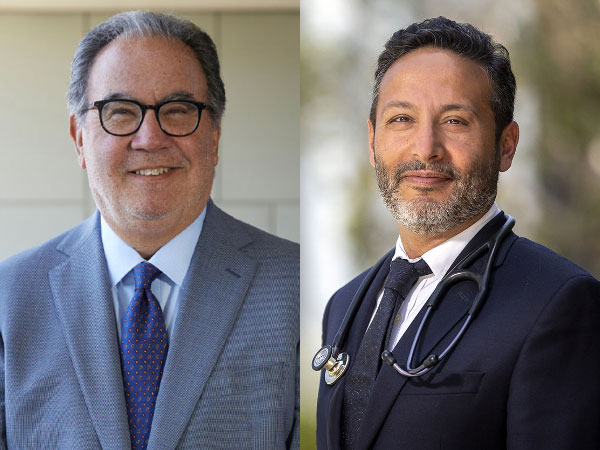
Raghu Kalluri, senior vice president, executive director, and chief scientific officer of the University of Texas Medical Branch Cancer Center, and Lucio Miele, director of Louisiana State University-LCMC Health Cancer Center, are thinking about what a cancer center should look like over the next 50-100 years.
“There’s a tremendous catchment out there of people who are interested in doing something new, doing something different. And I’m one of them. For me, this is a great opportunity that leadership presented from the UTMB to the University of Texas system, and it was a great opportunity to go do something new,” said Kalluri, who joined UTMB from the University of Texas MD Anderson Cancer Center, where he served as professor and chair of Cancer Biology and director of the Metastasis Research Center (The Cancer Letter, Sept. 11, 2026).
Rather than treating the current revolution in science and medicine as a threat, Kalluri and Miele see it as an opportunity to do more than just replicate existing models.
“I’m finding the exact same thing. Finding people who are interested in doing something new in an environment where they have room to grow is possible and not particularly difficult in this day and age, given sufficient resources. So, yes, this is a good time to start the cancer center, paradoxically—despite all the challenges,” said Miele, who is also a senior associate dean for research at LSU Health New Orleans School of Medicine, chair of the Department of Genetics, and Cancer Crusaders Professor of Genetics.
Kalluri and Miele appeared together on The Directors, a monthly series which focuses on the problems that keep directors of cancer centers up at night, moderated by Paul Goldberg, editor and publisher of The Cancer Letter.
This episode is available exclusively on The Cancer Letter Podcast—on Spotify, Apple Podcasts, and YouTube.
The directors agree that building a cancer center requires a huge, deliberate investment.
“Recruitment is, of course, a huge part of building a cancer center, and we have been recruiting very intensely, both in the clinical and research areas. Here’s how I describe it: I’m trying to build an orchestra, so I recruit great musicians who are able and willing to play together,” Miele said.
Transdisciplinary collaboration has become more important because technology now allows disciplines to work together in ways that weren’t possible decades ago, Miele said.
To Kalluri, building a cancer center is like creating a successful soccer team roster.
“People have seen how teams that play well together succeed in the end, winning a game—versus having one or two superstars. And I think that’s what comprehensive cancer care is. It is about passing the care between all the players, so that each person is contributing to the care of the patient, and then, the cure, or the success of the treatment, is a goal you get. Now, you can have one player being so good that they can go from one end to the other, and occasionally get a goal, but usually the success is comprehensively doing it as a team,” Kalluri said.
Kalluri and Miele also envision something bigger than two competing institutions.
Miele said that federally supported research is essential for the kind of large-scale population work they want to do.
People have seen how teams that play well together succeed in the end, winning a game— versus having one or two superstars. And I think that’s what comprehensive cancer care is.
Raghu Kalluri
During the podcast, Kalluri and Miele, who didn’t previously know each other, started to brainstorm the idea of a “Gulf Coast Cancer Consortium” in which Texas and Louisiana institutions share data, collaborate on trials, and coordinate care across the region.
“I think that it’s really exciting for me that Lucio and I can work together and build something where our identities will be seen by NCI as coming together to get these designations, but in a way we’ve collaborated on to do that,” Kalluri said.
NCI designation provides more than funding or recognition, Kalluri said. It provides access to a network of NCI-designated cancer centers where researchers can collaborate and share data. The strategy shouldn’t be to reproduce what successful cancer centers already do, but instead develop research programs distinctive enough that NCI sees value in adding them to the network.
“The goal here is better care and better access to early diagnosis, prevention, and clinical trials for cancer patients. And collaboration is the name of the game. Just as we said, cancer care is now a team sport. Cancer centers now need to team up together to provide the best care and the best access to innovative clinical trials for their patients. I can see us opening the same clinical trial at both sites. I can see us collaborating on standards of care, sharing data—that is, collaboration is truly the name of the game,” Miele said.
Explore previous episodes of The Directors.
Some highlights:
On population research
The Gulf South provides a uniquely diverse population for cancer research.
“With population genetics involved, the genetic components now can be done very quickly. For example, Galveston, where the UTMB main hospital is located, has 50,000 people. And one of the ideas we’re discussing is, do we make that as a model island, the Blue Zone as a model island? Maybe sequence all of them, and follow them and things, because we have an opportunity—because it’s an island—and we can execute certain plans from the long-term and see evolution. Maybe think of ideas like the Framingham trials (Massachusetts) and do that for cancer here,” Kalluri said.
The region also includes populations connected to NASA and SpaceX, and a highly diverse Gulf Coast population.
Also, UTMB cares for about 115,000 incarcerated people in Texas and treats roughly 7,000 cancer cases in that population, making them the largest provider for the incarcerated population in Texas for all their care, including cancer care.
Meile describes Louisiana as a “melting pot of melting pots” due to its complex genetic ancestry, urban and rural populations, and socioeconomic differences. Research shows that patients who identify similarly on the census can nevertheless have highly mixed genetic ancestries, he said.
Said Miele:
Last year, we published a paper on the transcriptomics of triple-negative breast cancer, and we studied the ancestry of the patients who participated in this study, and it was fascinating. Pretty much everybody was multi-ancestral, irrespective of what the census said they were. So you have to think in those terms when you’re thinking of things like polygenic risk scores, genomic research, and stuff like that.
And the same is true if you’re talking about, for example, Hispanic populations. They’re common in Texas. Well, Hispanic is an ethnicity, but it’s not an ancestry. In the past, we published another paper on luminal B breast cancer in populations in various parts of South America. And again, multi-ancestral moving on a continuous line between European, Native American, African, and a touch of Asian. So we both have extremely complex populations from a genetic standpoint.
We both have rural and urban. Louisiana has New Orleans, and it has also Shreveport and Baton Rouge, of course, but it also has large rural areas, including the so-called Acadiana, the Cajun parishes. They are descendants of the Acadians who came from Nova Scotia, from people of French descent, who have their own very interesting genetics—for example, the highest incidence, apparently, of colorectal cancer in men under the age of 50. What is this? We don’t know. It’s not Lynch syndrome, that we know, but our main hospital partner, UMC, University Medical Center, is in the middle of New Orleans, but it is also a rural referral hospital. So what we’re trying to do is reach out to urban and rural Louisiana, which differ in various respects, both in terms of population composition, but also in terms of socioeconomics and access to care.
Variety is the name of the game. We have all possible cancer populations, and they have different needs. We also take care of imprisoned people. So we have some of the most difficult and most interesting populations to study in cancer research, and that’s another reason for us to want to collaborate.
Then, layer on the comorbidities, including diabetes, obesity, and more, said Kalluri, plus a KRAS mutation—and the result is a complex, diverse population that requires special thinking in terms of population science research and cancer care delivery.
On cancer prevention
Kalluri wants to rethink what “cancer prevention” means.
Finding mutations isn’t enough, he said. By age 60, many people have detectable mutations somewhere in their bodies. The real question: which mutations will progress to cancer, and which people will live their entire lives without those mutations becoming malignant?
Said Kalluri:
You know the statistics, that the cancer incidence keeps going up with age, but about 75 is an inflection. If you can beat the malignant disease of cancer by about 75, then there are other reasons people die more than cancer, so it just drops.
That means that we, as care providers, can keep people healthy, make sure that they don’t get the disease of cancer, the malignant disease of cancer, and have them reach 75 or so.
Then we give them a shot for living much longer without getting the disease, right? And so I agree with you, and I think models of how Europe and how the society lives there are important for us. And I appreciate your thinking that, and we should even combine Louisiana into the Blue Zone and ask, “How do we bring this idea together?”
Miele agrees that helping people to age in good health is the goal.
“I was born in Italy. My mother was born in 1927. She is going to turn 100 in a few months, and the lifestyle [in Italy] is completely different than it is in our region of the United States. And if we can get more people to age gracefully, in good health, that is really what we’re all trying to do for our patients,” Miele said.
“So there’s an exciting collaboration for us to think about,” Kalluri said.
Said Kalluri:
People don’t realize that Texas is increasing in population quite a bit. And in fact, it’s almost 30 million now, and it’ll be 40 million in the next 10 to 15 years. The population is growing, and [growing] also in the areas of Louisiana.
So, between all of this, in the southern parts of our state, where Louisiana and the capture area of Dr. Lucio’s own cancer center [are], we’re talking about millions of people who need care, who don’t want to go up to the north.
They need care where they are. And you know this, Paul, really well. It’s not about having just all the knowledge and the resources that one thinks is needed to give really high-level cancer care. What’s more important is to give high-level cancer care to everybody who walks in. That is an important need. And I think one of the things that was recognized in starting our cancer center is that we need to really be prepared in partnership with the state, philanthropy, and others so that we don’t turn away people who need care.
So, how do you build a business model, a financial model, that doesn’t operationally cause stress to the system? But, at the same time, we care for these people here who have different economic standards, or living standards, compared to other people in Texas. So all of these challenges bring us and the LSU Cancer Center together, because I think our population base is similar. We can exchange ideas, combine resources so we don’t turn away any patient.
The last thing I want to add is that we’ve been talking about the cancer center—the other area for collaborations for newly developing cancer centers is to think about research in a way so that we don’t duplicate things. For example, if I’m doing population-based cancer prevention research here, it would be absolutely correct for me to call on the cancer center in Louisiana and say, “Can you participate in this so we can increase our numbers?” I don’t think the demographics and things are that different between Southwest Texas and Southeast Louisiana. So, we can collect all of this together. I think research also is an area where we can come together collaboratively and build projects that could help us convince NCI of something unique that we’re doing here as a team.
Socioeconomics and rural geography are driving factors for many cancer disparities, Miele said, and those are disparities that are shared between Southwestern Louisiana and Southeastern Texas.
Said Miele:
The big question that we, meaning both of us, are going to face is, “How do you assure quality cancer care, early diagnosis, and prevention irrespective of socioeconomics?” That has an economic dimension as well that goes beyond the cancer centers themselves. In another one of the cancer centers where I worked, I used to remind people in positions of power that when you don’t screen somebody, when you don’t diagnose somebody, they don’t disappear. They come back later on with a late-stage diagnosis of cancer. Their outcomes are going to be worse and the expense is going to be larger to take care of them.
So, it behooves us to find ways to prevent, diagnose as early as possible, and treat as effectively and as early as possible, not only from a benevolence standpoint—we all went to medical school to help people—that even from a financial standpoint, it’s better to do that than to not take care of people and then have them have worse outcomes and, unfortunately, mortality, because mortality is not free.
On using AI strategically
AI needs to be incorporated into the aspiring and emerging centers from the outset, and Miele and Kalluri envision external advisory boards that also include AI specialists, engineers, mathematicians and modelers, geneticists, pathologists, and cyber security experts.
Most patients are already using AI to interpret their cancer diagnoses and seek treatment recommendations. Physicians therefore need enough understanding of AI to engage with patients who arrive with these large amounts of AI-generated info.
“I actually know of somebody whose relative uploaded her entire chart into ChatGPT, perhaps not realizing that that put it in the public domain, and essentially got a second opinion, complete with recommendations for treatment and clinical trial enrollment out of ChatGPT. Now, there are major privacy concerns with doing something like that, and I don’t recommend doing it, but people do do stuff like that,” Miele said.
In this particular case the recommendations were reasonable Miele said, but there is no guarantee that AI won’t hallucinate.
Kalluri said patients are also using AI platforms to choose their care providers.
“We are going to deal with information-loaded patients, and they are going to come wanting a quick resolution of how you take all that information and provide care,” Kalluri said. “And the care is not just actually the diagnostic and the therapeutic—it’s about caring to make sure that they have the correct information, that they are being put on the right path for treatment; not just what was said on the AI platform. So, that is also care for me—the care to make sure that we understand their anxieties, they understand the volume of information they have, and how we put them on a path for success.”
AI can be useful, but it isn’t an oracle, said Miele, and there are major privacy, bias, and accountability questions.
“But AI is here to stay,” Miele said. “It can be extraordinarily useful, but that does change the playing field quite a bit.”
On society’s relationship with science
Science was once broadly respected, but Miele worries that this trust in science has eroded in recent years.
Said Miele:
I’ve grown up in a system where science was universally respected. People understood that it is fallible, but it is the one effective method to find out things about nature.
I often remind people, we saw the approval of daraxonrasib. Well, that’s wonderful. But the story of RAS started in the 1960s, with the discovery of rodent viruses that caused tumors. There’s decades of basic science behind it, which nobody questioned.
In this day and age, we don’t have that carte blanche trust that society used to give us, and so we need to be ready to communicate and defend the scientific method as the one effective way to find new cures, new diagnostic methods, and new prevention methods. And we have to do this not necessarily all with high-tech. We have to do it by being better communicators, because ultimately, society is paying for our research, and we need to be sure that they trust us.
So, we have to be rigorous in the way we do science, but we also have to explain ourselves much more than we used to.
I’ll give you an example. I was at a San Antonio breast cancer conference, and a patient advocate asked me, “Is it true that you guys have a cure for breast cancer, but you’re not releasing it because you are trying to assist drug companies?”
I didn’t give a high-minded answer. I said, “Okay, look. I have one mother, two sisters, one wife, three sisters-in-law, and two daughters. There are five cases of breast cancer among them. Do you seriously think that if I knew some magic agent that could take care of them, I would keep it hidden so that someone else can make money?”
And she looked at me and she went, “I didn’t realize you guys are people.”
Kalluri, too, believes trust in science and scientists is crumbling.
I think it’s the respect for science and research. I think that when I entered this, there was a feeling, I thought, in society that people admired scientists, and there was a certain respect given to academic professors and scientists, because we really were doing things for our passion of what we’re interested in.
And I see that eroding quite a bit, and that keeps me up at night.
And I think it’s becoming a problem in the United States; it was also a bit of a global problem.
Kalluri said it is leadership’s responsibility to instill trust and respect for science back into our culture again.
“We’re not in an ivory tower devising conspiracies and coming up with plots to give dangerous treatments to people. We’re trying to help people because we are people,” Miele said.
Listen to the full episode on Spotify, Apple Podcasts, and YouTube.
A transcript of the podcast is available below:
Claire Marie Porter: Welcome back to the Directors, a special segment of The Cancer Letter Podcast, moderated by Paul Goldberg, editor and publisher of The Cancer Letter, and sponsored by the American Society of Clinical Oncology.
This time, Raghu Kalluri, senior vice president, executive director, and chief scientific officer of the University of Texas Medical Branch Cancer Center, and Lucio Miele, director of the Louisiana State University-LCMC Health Cancer Center, are thinking about what a cancer center should look like over the next 50-100 years.
Both directors are pursuing NCI designations for their cancer centers, and serving contiguous Gulf Coast catchment areas.
Kalluri joined UTMB from the University of Texas MD Anderson Cancer Center, where he served as professor and chair of Cancer Biology and director of the Metastasis Research Center.
Miele is also a senior associate dean for research at LSU Health New Orleans School of Medicine, chair of the Department of Genetics, and Cancer Crusaders Professor of Genetics.
And with that, let’s get started!
Paul Goldberg: Welcome to The Directors Podcast of The Cancer Letter, and with us today we have Dr. Lucio Miele from Louisiana State University LCMC (LSU LCMC) Cancer Center, director of it, and a new director, Dr. Raghu Kalluri, who is a senior vice president and executive director of the University of Texas Medical Branch (UTMB) Cancer Center, as well as the chief scientific officer of the institution. And the two things our guests have in common: one of them is the Gulf Coast, and the other is plans to go for the NCI designation. So my question is: This is kind of an uncertain time—why is the NCI designation still the prize worth going after? And since Dr. Miele has been at this longer, we should start with Dr. Kalluri.
Dr. Raghu Kalluri: Well, thank you very much. First, it’s a really amazing opportunity to speak to you today and really share some of the ideas that we have here at the UTMB to build a cancer center. So, it’s a great question. Why now? Why during this time? And I think it’s because this is an amazing time for our patients, because I think many new drugs are coming into the market. We have lots of advances in cancer research that are translating into the clinic. And it’s time to really put ourselves to work in the best way possible to really bring all of these to our patients. So I think that the opportunity to really build cancer centers with a vision of where it’ll go in the next 25 years.
It’s a great opportunity in 2026 to think, how do I build a cancer center in 2026? Not the way it was done 20 years ago or 30 years ago. What are the ways that we can build a clinical practice, a service line, that can benefit our patients? I think there’s lots of new technological advances. I think it’s a great time to think of a cancer center with the idea of attracting NCI’s attention, that we are doing something unique and could use that recognition of designation.
Dr. Miele?
Dr. Lucio Miele: Yes. Good afternoon and thank you, Paul, again, for having me over. I do agree with Raghu. Despite everything, it is a great time to build an academic cancer center. Why designation? It provides a clear goal—a bar, if you will—to be reached. It focuses the attention and the effort of the entire cancer center team, and it provides a set of objective standards to be reached, so that rather than just saying, “We want to be a really good academic cancer center,” we set our eyes on a goal. We want to reach the standard that the other existing designated cancer centers in the country already have reached, and maintain it.
The important thing about NCI designation is that it’s a grant, and it’s renewed every five years. Not only do you have to reach a certain level of standard in clinical care, clinical research, basic research, population research, community engagement, and cancer education, but you also have to maintain those standards. So I do think it’s a very worthwhile effort, even though it’s a huge effort in this day and age, but it’s definitely worthwhile.
Well, it takes a war chest, and it takes time. What kind of a war chest do your centers have, and how much time? You’re just starting, Dr. Kalluri, and how long do you think it will take? And Dr. Miele, you’ve been at this for a while and how long do you think it will take?
Dr. Raghu Kalluri: Well, I mean, I think that… Go ahead. You go ahead, please.
Dr. Lucio Miele: Okay. So one of the very first things I did when I took over the job was to complete our strategic plan that has a set of deliverables every year, and members of my leadership team are responsible for each of these deliverables, and we track our progress with a mind to apply [for NCI designation] sometime in 2029. That’s in the strategic plan. And, of course, you’re right, it does take money to do all this. Ours comes from several sources, from the university itself, from our clinical partner, LCMC Health, from the State of Louisiana, and from philanthropy.
So we have this multi-part budget, which we, of course, track every year. We follow expenditures and we follow progress on all aspects of the application, and adjust the timeline accordingly. So it needs to be a very strategic, very deliberate process, and that’s what we’re doing here.
You started a couple of years ago.
Dr. Lucio Miele: Yes.
I mean, you took the job two years ago, yeah.
Dr. Lucio Miele: Yes, yes. In January 2025.
Do you have a number?
Dr. Lucio Miele: I’m sorry?
Do you have the number? What’s the budget overall?
Dr. Lucio Miele: It’s in the range—
You don’t have to tell me.
Dr. Lucio Miele: Well, I can tell you that we’re spending about $30 million a year.
A year?
Dr. Lucio Miele: Yeah.
Dr. Kalluri, you’ve just begun.
Dr. Raghu Kalluri: Yes, yes, absolutely. So I think that you heard some strategic points that are already made. The first task is to really coalesce this service line into a very organized cancer center set-up, and that’s been an exciting challenge for me already, and it’s really fun. [I have] great colleagues here. And so our clinical service and cancer service was aligned and in cooperation with other places in Texas, so we just decided to separate and start our own cancer center. And so it really is a goal for us to now bring all the service lines together and create a strategy. Now, we’ve been very fortunate—we have great philanthropy support from the Sealy & Smith Foundation that really supports UTMB.
We have other philanthropy support that is coming in to really start this cancer center, especially because we plan to take care of South Houston down to the coast to Southeast Texas, including the island of Galveston. So I think there’s a capture area there that really requires a robust cancer center. Now, as far as resources, we are spending a similar amount, as you heard, close to $30 to $50 million a year. But not just that—we have other ways that the state supports us because we’re a state institution. Our salary supports come from the UT system and state appropriations.
And, we are expanding outside Galveston in the League City area, Clear Lake City area, which is about 25 minutes south of Houston. And there, our expansion has been given $300 million by the state and the system to really expand that hospital area. And that’s where a lot of the newer clinical practices related to cancer will also be placed. So we are quite fortunate to have great support from our UT system, our chancellor, and of course, the president of UTMB and all the leadership there, and also philanthropy and the state itself wanting to really expand cancer care in this area of Texas.
So $50 million a year?
Dr. Raghu Kalluri: About, yes. If you take into consideration that some of the salaries are directly provided through other appropriations in the state and things. But again, remember, we just started our service line by ourselves only six, seven months ago, and I’ve only joined two weeks ago. So we’re just beginning to really create this ecosystem to care for our patients here.
How long would it take?
Dr. Raghu Kalluri: I mean, seeing the progress we’ve made in the last six months, I am very quite bullish that we have a very ambitious timeline to get to certain metrics in three years, because there’s tremendous need for care here. We are now actively hiring physicians, because we’re not able to really keep up with the enthusiasm of the patients that come to us versus going to other places. So we are expanding our care system. And so I think that we are bullish that in three years we’ll reach certain metrics and be able to engage NCI’s enthusiasm for designation.
Wow, that’s quick. How does a cancer center built today differ from what it was 10 years ago, five years ago?
Dr. Lucio Miele: Ah, that’s an excellent question.
Dr. Raghu Kalluri: Well, I mean, I can go first.
Dr. Lucio Miele: Yeah, sure. Go ahead.
Dr. Raghu Kalluri: No, no, no, you go ahead.
Dr. Lucio Miele: No, no, no, please.
Dr. Raghu Kalluri: Please go ahead. Go ahead. You’ve been doing this longer.
Dr. Lucio Miele: Well, it is different. It is different than it used to be. It’s more complex, if you will, because you have to take into account multiple partners—health systems, the university, the state, et cetera. Also, the funding environment is different than it was, and that is one of the things that keep us all awake at night, and it’s the future of the next generation of cancer investigators. So you have to be very careful in how you recruit. Recruitment is, of course, a huge part of building a cancer center, and we have been recruiting very intensely, both in the clinical and research areas. Here’s how I describe it: I’m trying to build an orchestra, so I recruit great musicians who are able and willing to play together.
The team dimension of building a cancer center is more important now perhaps than it used to be in the past, because transdisciplinary integration powered by technology that we simply didn’t have decades ago makes things possible that weren’t possible in the past. So you are trying to build a team you recruit to that vision, knowing that you’re going to have to play that symphony, which is a Cancer Center Support Grant (CCSG) application. And so we have been recruiting not only intensely, but very deliberately, for people who want to do two things: who want to make a difference for a state that hasn’t ever had an NCI designated cancer center and needs one, and who are willing to work together toward a goal that’s bigger than just building their own careers.
Dr. Raghu Kalluri: Yeah. I mean, I like the analogy very much. I usually call it more of a soccer team that I’m building… maybe also a reflection of a successful World Cup we had in the United States, and people have seen how teams that play well together succeed in the end, winning a game—versus having one or two superstars. And I think that’s what comprehensive cancer care is. It is about passing the care between all the players, so that each person is contributing to the care of the patient, and then the cure, or the success of the treatment, is a goal you get. Now, you can have one player being so good that they can go from one end to the other, and occasionally get a goal, but usually the success is comprehensively doing it as a team.
So I think that for us, that’s been the goal now. And I think one of the things I’ve learned in my last 29 years of being part of different cancer centers now, two of them, is that it’s really becoming clear now that the patients expect care much faster. Care does not necessarily mean that they want to see diagnostics right away, or therapy strategy right away. They want to be cared for. They want information. And that, Paul, is where I think we are very different now.
Patients have come in with tremendous background knowledge already. It’s quite amazing, how when you see them for the first time, they know what mutations can cause certain things. And even if there’s a lump, they’ve already decided that lump could be five different things based on what they read.
So, I think the care they want is, how do you take that information and then, while talking to experts, bring that to the way that they’re comfortable, they’re not nervous, and they know that there is a strategy and a plan. That’s not the way we built cancer centers before, because we would give [patients] information. Now we have to take that information, distill it down, and then provide the care through nurses and many others who are participating. So, for me, I’ve decided from day one that the nurses and the nurse practitioners and others also become a huge component of a new cancer center because they need to be educators—they need to be also quite knowledgeable—and even researchers.
So, patients have another layer of knowledge they get from providers. These are all some ideas of how things are different now. Data, information, knowledge, and how that’s quickly applied to treatment is going to take a very new strategy now on how to build a service line that benefits our patients.
Well, how does the technology differ? It does, but how does the technology meet the care or the research? Is that something that’s giving you all kinds of freedom, or…?
Dr. Lucio Miele: It’s both freedom and complexity. Just as Raghu said, the way we communicate with our patients and with the community around us is affected by an environment that is saturated with information: Some of it good, some of it not so good. And we need to be much better than we used to be in the past at communicating accurate, evidence-based information to patients and to communities. We didn’t have the amount of misinformation and disinformation that’s floating online 20 years ago. We do now, and railing against it isn’t going to help. We need to be better at communicating.
And in terms of team care, absolutely. The idea that a doctor can treat your cancer belongs in the past. It’s always a team effort—not only of physicians from several specialties, but also other healthcare providers that have to work as a team. That is an absolutely essential strategic, not only goal, but even tactical approach to a cancer service line today.
Yeah, it’s interesting looking at your catchment areas. Texas has a lot of cancer centers. Louisiana is kind of a blank spot on the NCI map. But looking at this, I’m just wondering if the state is really the boundary, because the two of you have more in common than not. How do you look at your catchment areas and maybe possibilities for collaboration?
Dr. Lucio Miele: Go ahead.
Dr. Raghu Kalluri: Well, I mean, I can tell you that you made a very good point about… geographically, I don’t see where we are much different than most of the Southwestern part of Louisiana, because all of these areas are connected in a way for patients to go where they think that they’ll get the best care. I truly believe that, at least in our capture area, we’ll be working a lot with the cancer center in Louisiana and other places that are interested in cancer care, and form collaborations so that we can actually help see patients maybe in the border areas in a way that they can have access to us. You started this, Paul, in the most appropriate way. I see this as a Gulf Coast Cancer Consortium. It is about the whole coast and all of the areas around that.
And I think we’ll be working very closely with the LSU Cancer Center and everybody else in saying that, “Let’s think about how the Gulf Coast, or as sometimes we call it the Third Coast, has all of us working for our patients in a way that we exchange information, we put our data together so that the data can drive decisions of care.” So, I think that it’s really exciting for me that Lucio and I can work together and build something where our identities will be seen by NCI as coming together to get these designations, but in a way we’ve collaborated on to do that. So, I look forward to that.
Dr. Lucio Miele: I completely agree. The goal here is better care and better access to early diagnosis, prevention, and clinical trials for cancer patients. And collaboration is the name of the game. Just as we said, cancer care is now a team sport. Cancer centers now need to team up together to provide the best care and the best access to innovative clinical trials for their patients. I can see us opening the same clinical trial at both sites. I can see us collaborating on standards of care, sharing data—that is, collaboration is truly the name of the game.
Remember, NCI requires inside each institution that team science be part of the criteria for promotion and tenure, because NCI has recognized from long ago that team science was going to be the way that cancer research would progress. Well, team science extends outside of the institution. It extends to other cancer centers that we can partner with, and we are absolutely open to collaboration.
Have the two of you discussed this before, or did I just start something?
Dr. Lucio Miele: No, you started something, yes.
Dr. Raghu Kalluri: I think, Paul, you started something. I think this is really great that you brought us together. Yeah, I think that it’s a great idea for you to have brought us together because people don’t realize that Texas is increasing in population quite a bit. And in fact, it’s almost 30 million now, and it’ll be 40 million in the next 10 to 15 years. The population is growing, and [growing] also in the areas of Louisiana. So, between all of this, in the southern parts of our state, where Louisiana and the capture area of Dr. Lucio’s own cancer center [are], we’re talking about millions of people who need care, who don’t want to go up to the north. They need care where they are. And you know this, Paul, really well. It’s not about having just all the knowledge and the resources that one thinks is needed to give really high-level cancer care. What’s more important is to give high-level cancer care to everybody who walks in. That is an important need. And I think one of the things that was recognized in starting our cancer center is that we need to really be prepared in partnership with the state, philanthropy, and others so that we don’t turn away people who need care.
So, how do you build a business model, a financial model, that doesn’t operationally cause stress to the system? But, at the same time, we care for these people here who have different economic standards, or living standards, compared to other people in Texas. So, all of these challenges bring us and the LSU Cancer Center together, because I think our population base is similar. We can exchange ideas, combine resources so we don’t turn away any patient.
The last thing I want to add is that we’ve been talking about the cancer center—the other area for collaborations for newly developing cancer centers is to think about research in a way so that we don’t duplicate things. For example, if I’m doing population-based cancer prevention research here, it would be absolutely correct for me to call on the cancer center in Louisiana and say, “Can you participate in this so we can increase our numbers?” I don’t think the demographics and things are that different between Southwest Texas and Southeast Louisiana. So, we can collect all of this together. I think research also is an area where we can come together collaboratively and build projects that could help us convince NCI of something unique that we’re doing here as a team.
Dr. Lucio Miele: Absolutely. Socioeconomics really is a driving factor for a lot of cancer disparities, as well as rurality. And those things are shared between Southwestern Louisiana and Southeastern Texas. And the big question that we, meaning both of us, are going to face is, “How do you assure quality cancer care, early diagnosis, and prevention irrespective of socioeconomics?” That has an economic dimension as well that goes beyond the cancer centers themselves. In another one of the cancer centers where I worked, I used to remind people in positions of power that when you don’t screen somebody, when you don’t diagnose somebody, they don’t disappear. They come back later on with a late-stage diagnosis of cancer. Their outcomes are going to be worse and the expense is going to be larger to take care of them.
So, it behooves us to find ways to prevent, diagnose as early as possible, and treat as effectively and as early as possible, not only from a benevolence standpoint—we all went to medical school to help people—that even from a financial standpoint, it’s better to do that than to not take care of people and then have them have worse outcomes and, unfortunately, mortality, because mortality is not free.
What about the grants and programs and NIH grants that count toward designations? Where are you on that, both of you? What are the areas where you’re trying to hire and beef up?
Dr. Lucio Miele: We have three programs, as many emerging cancer centers do. One is, broadly, cancer biology. The second is translational oncology and the last one is population science. There are thematic areas that cross between these programs, because these are factors that affect the inhabitants of Louisiana and, in fact, of the Gulf region. One is metabolism and cancer, i.e. obesity, diabetes, and their interaction with cancer. The other one is viruses and cancer. We forget that about 20% of human cancers are caused by viruses, and that people with certain chronic viral infections are more prone to certain cancers.
Another one is cancer prevention and population science. Now, population science, as Raghu said, requires large sample sizes. So, the more populations that participate in a study, whether it’s a clinical biomedical informatics study or a genomic study or a biomarker study, the better. And so, again, we have recruited heavily in population science. We are recruiting in clinical and basic science, but with a goal toward the risk factors that are most common in Louisiana. And these are obesity, alcohol, viruses, and environmental risk factors, if you will. Those are the four guiding principles that we are using to recruit investigators at all levels and throughout the translational continuum from T0 to T4.
Raghu?
Dr. Raghu Kalluri: Well, I mean, you’ve heard already some very important ideas that need to be incorporated, so I don’t want to repeat those, because those are very important, and they are central to any cancer center that you think about ways of bringing all the molecular revolution that is happening in cancer research with respect to identifying targets, to drug development. I mean, it’s really quite an amazing time how all the basic science is translating. So, we need to really be at the cutting edge to be competitive for generating grant revenue, as you said. We are also a bit fortunate, as you know, in the State of Texas to have CPRIT [the Cancer Prevention & Research Institute of Texas]. So, we have our own funding agency that provides significant money.
It behooves us to find ways to prevent, diagnose as early as possible, and treat as effectively and as early as possible, not only from a benevolence standpoint—we all went to medical school to help people—that even from a financial standpoint, it’s better to do that than to not take care of people and then have them have worse outcomes and, unfortunately, mortality, because mortality is not free.
Lucio Miele
Also for recruitment, as you know, we can recruit from assistant professors to full professors with the CPRIT recruitment awards. So, that’s a pretty good resource for us to add to our own resources that we can provide. And that’s the great goal for us now, because we don’t really have much of a cancer research presence right now at UTMB. And that’s one of my mandates—to really hire people to develop that. Now, you’ve heard some of the ideas, but let me tell you something else that I’ve been thinking about, because Paul, when you start something brand new, you say you are founding a new cancer center in 2026, what do you do? What are the things that you can think about?
Now, personally, it is quite important to recognize that my own children, who are 14 and 16, have the possibility to live 300 years, the way that the medical revolution’s happening. So, now thinking about a cancer center that we start today, the question is not only should we think about prevention from the perspective of risks and other things that exist, and the mutations we screen with potential other risks that people have to predict when the disease of cancer comes, but also the fact that we want people to live to be 100 and not get the disease of cancer. So, how do you achieve that? It’s not important that you live to be 100, but from 80 to 100, you’re not healthy and you’re battling all morbidities.
So, I think the question for us has been, what do we do? So, we’ve decided to connect aging research, aging, and actually creating the Blue Zone area in Galveston to other places and thinking about cancer from the perspective also that healthy living and aging are connected to delaying the emergence of malignant cancer. Because Paul, you know this very well. Everybody over the age of 60… if you screen for something in any of the organs, you’ll find mutations. They already are there. The question is, which one will progress to become malignant disease? Which individuals progress to make that conversion, and which individuals live their lifespans without that? Could that be connected to how well we’ll age, how well we take care of our health, and all of the things?
So, I’m just giving you some other thoughts of what we’re thinking, because we have a shot here to start programs in a way that one was not thinking about at least 20, 30 years ago. So, that’s where we are. And I only started this job two weeks ago, as you know. So, we’re sitting down and brainstorming to see what are the unique programs we can come up with so that our cancer prevention program is not just detection of mutation. That’s not actually informative. It’s identifying risks of which people will convert that mutation into malignant disease and find intervention so that they can live their lifespan out.
Yeah. We did this study—well, essentially a survey of our readers—and we asked, “Are you open to finding a new job? Are you actively looking for a new job?” And about a third of the people said that they were open or looking for a new job, so having money right now and hiring is probably a good thing.
So, are people beating down your doors?
Dr. Raghu Kalluri: Well, let me start here. So, I started about two weeks ago, and I’ve already received close to 80 emails from people who are interested from the cancer operations side—nurses to physicians, and young people who are finishing fellowships and want to come into new areas to serve, and of course, some established people wanting to see if they can come and start a new program.
So, I agree with you, Paul, that there’s a tremendous catchment out there of people who are interested in doing something new, doing something different. And I’m one of them. For me, this is a great opportunity that leadership presented from the UTMB to the University of Texas system, and it was a great opportunity to go do something new. And I think you’re correct, many people are looking to see… as Lucio was saying, that we are in an exciting area and time for cancer research and cancer care. So, people want to go and be in places where new ideas can be developed, versus established places where you’re so large that change will be much slower, correct? By nature of being a large organization.
Dr. Lucio Miele: I’m finding the exact same thing. Finding people who are interested in doing something new in an environment where they have room to grow is possible and not particularly difficult in this day and age, given sufficient resources. So, yes, this is a good time to start the cancer center, paradoxically—despite all the challenges.
Or, because of all the challenges.
Dr. Lucio Miele: Yes.
Just having a place where people are happy.
Dr. Lucio Miele: Yes. And I wanted to applaud Raghu on the notion of a Blue Zone. I was born in Italy. My mother was born in 1927. She is going to turn 100 in a few months, and the lifestyle [in Italy] is completely different than it is in our region of the United States. And if we can get more people to age gracefully, in good health, that is really what we’re all trying to do for our patients.
Dr. Raghu Kalluri: Yes. Absolutely. And you know the statistics, that the cancer incidence keeps going up with age, but about 75 is an inflection. If you can beat the malignant disease of cancer by about 75, then there are other reasons people die more than cancer, so it just drops. That means that we, as care providers, can keep people healthy, make sure that they don’t get the disease of cancer, the malignant disease of cancer, and have them reach 75 or so. Then we give them a shot for living much longer without getting the disease, right? And so, I agree with you, and I think models of how Europe and how the society lives there are important for us. And I appreciate your thinking that, and we should even combine Louisiana into the Blue Zone and ask, “How do we bring this idea together?”
Dr. Lucio Miele: Absolutely.
Dr. Raghu Kalluri: So, there’s an exciting collaboration for us to think about.
Dr. Lucio Miele: Yep.
Really interesting. Well, it’s also… both of you have really interesting populations besides it being the Gulf Coast population, which is by itself fascinating—multi-ethnic, beyond multi-ethnic. But also, Raghu has the prison system… what, 80% of the Texas prison system comes to you?
Dr. Raghu Kalluri: Yes. We take care of 115,000 incarcerated people at UTMB. So, we are the largest provider for the incarcerated population in Texas for all their care, including cancer care.
So, it’d be about 5,000 or 6,000 cases of cancer, probably, right?
Dr. Raghu Kalluri: Probably about, yeah. So, about 7,000 or so, yeah.
Plus, you’ve got NASA, you’ve got prisons, you’ve got [Elon] Musk…
Dr. Raghu Kalluri: SpaceX, yeah.
And Lucio, what are some of the more interesting populations you have?
Dr. Lucio Miele: Well, Louisiana is a melting pot of melting pots—both genetically and socially. Last year, we published a paper on the transcriptomics of triple-negative breast cancer, and we studied the ancestry of the patients who participated in this study, and it was fascinating. Pretty much everybody was multi-ancestral, irrespective of what the census said they were. So, you have to think in those terms when you’re thinking of things like polygenic risk scores, genomic research, and stuff like that.
And the same is true if you’re talking about, for example, Hispanic populations. They’re common in Texas. Well, Hispanic is an ethnicity, but it’s not an ancestry. In the past, we published another paper on luminal B breast cancer in populations in various parts of South America. And again, multi-ancestral moving on a continuous line between European, Native American, African, and a touch of Asian. So, we both have extremely complex populations from a genetic standpoint.
We both have rural and urban. Louisiana has New Orleans, and it has also Shreveport and Baton Rouge, of course, but it also has large rural areas, including the so-called Acadiana, the Cajun parishes. They are descendants of the Acadians who came from Nova Scotia, from people of French descent, who have their own very interesting genetics—for example, the highest incidence, apparently, of colorectal cancer in men under the age of 50. What is this? We don’t know. It’s not Lynch syndrome, that we know, but our main hospital partner, UMC, University Medical Center, is in the middle of New Orleans, but it is also a rural referral hospital. So, what we’re trying to do is reach out to urban and rural Louisiana, which differ in various respects, both in terms of population composition, but also in terms of socioeconomics and access to care.
Variety is the name of the game. We have all possible cancer populations, and they have different needs. We also take care of imprisoned people. So, we have some of the most difficult and most interesting populations to study in cancer research, and that’s another reason for us to want to collaborate.
Dr. Raghu Kalluri: And also then, you take that, and you layer that on comorbidities like diabetes, obesity, and other things. So, then you are… KRAS mutation in the background of diabetes will progress with pancreatic cancer differently than others. So, in all of those, there’s a tremendous amount of diabetes in areas of our capture areas, like in Brownsville and other places. So, we have quite a diverse population that requires a special thinking of how to deliver care for them.
And you’re talking about population science research as the foundation of all of it, right?
Dr. Raghu Kalluri: Absolutely—with population genetics involved, so the genetic components now can be done very quickly. For example, Galveston, where the UTMB main hospital is located, has 50,000 people. And one of the ideas we’re discussing is, do we make that as a model island, the Blue Zone as a model island? Maybe sequence all of them, and follow them and things, because we have an opportunity—because it’s an island—and we can execute certain plans from the long-term and see evolution. Maybe think of ideas like the Framingham trials (Massachusetts) and do that for cancer here.
So, actually, this is the reason to have NCI designation. I’m getting back to my first question, because who else is going to do it?
Dr. Lucio Miele: Right. This isn’t something that can be easily done by anyone other than federally-funded investigators. So, no doubt, NCI designation is necessary to do all this.
Dr. Raghu Kalluri: It allows data sharing also, right? The entire purpose of being an NCI-designated cancer center is not just the grant, or the recognition; it’s also becoming a club member among other NCI-designated institutions that you can collaborate and share data with. Not that you cannot do without it, but it provides you another way of doing collaborative teamwork. So, I think that it’s an aspirational goal, and I think that having that goal allows us to be focused, and then also come up with what’s unique. Generally, the tendency is that you need to do what other successful NCI-designated cancer centers have done so that they’ll see that that’s what you’re doing.
I feel that for us, we’re going to try to go a different route. Let us do things that nobody else is doing. Let’s do things that are unique and different, so the NCI will look and say, “You need to be part of this club, because you are doing something not many other people are doing, so we can have you benefit those cancer centers.” And of course, what you’re not doing in large numbers, what other places are doing will benefit you.
Yeah, it’s really interesting because, I mean, the EAB, External Advisory Board, is an amazing cultural institution. Raghu, have you had a chance to put one together in the past two weeks or not yet?
Dr. Raghu Kalluri: Well, I mean, obviously it’s a very important aspect of a cancer center, and we’re actively discussing it. And I think I can tell you this, that our EAB will have a very different structure to it, in the sense that we will have AI engineers in it, to people who are doing hardcore math modeling for cancer evolution, and also geneticists, also pathologists. But I think this is going to be a different era.
And I think Paul, again, as you said, why now? Why a cancer center now? Exactly for that reason. We cannot not incorporate AI tools into our cancer care, but having an EAB with experts who understand how to deploy it, how to execute it, how to keep it safe. Our EAB will have people who are about cybersecurity and things, because those are important. Because people are coming into the clinic, and while they’re waiting in the room to see the doctor, they’re talking to AI platforms and starting to get information.
And then if your doctors don’t have a molecular understanding of it, they’re not able to answer those questions. The way that doctors have to be prepared now to talk to patients with all these AI tools is very important. So, we must prepare ourselves for what knowledge exists out there that AI is putting out, so that we are ahead of the game a bit.
Dr. Lucio Miele: No doubt. No doubt at all. I mean, I actually know of somebody whose relative uploaded her entire chart into ChatGPT, perhaps not realizing that that put it in the public domain, and essentially got a second opinion, complete with recommendations for treatment and clinical trial enrollment out of ChatGPT. Now, there are major privacy concerns with doing something like that, and I don’t recommend doing it, but people do do stuff like that.
But what are the recommendations?
Dr. Raghu Kalluri: And to a large extent, and people are contacting us. So, what happened is exactly what you said, Lucio. So, they did that, or they used some information; they put it in these AI platforms, and then they say, “Who are the best to see in the world?” And it gives a list. So, they call them and say that the platform said that you are the best to see.
So, they’re even contacting people with that information, or contacting, like… I have a distinct relative who contacted me yesterday, saying that, “This place was identified by this AI platform as a person that I should go see. What do you think?” And I was just stunned by that high detail—that [AI platforms are] suggesting who to go and see.
So, I think coming back, Paul, to summarize this concept is that we are going to deal with information-loaded patients, and they are going to come wanting a quick resolution of how you take all that information and provide care. And the care is not just actually the diagnostic and the therapeutic—it’s about caring to make sure that they have the correct information, that they are being put on the right path for treatment; not just what was said on the AI platform. So, that is also care for me—the care to make sure that we understand their anxieties, they understand the volume of information they have, and how we put them on a path for success.
Which leads back to the question to Lucio—when this person had the ChatGPT recommendation, was the recommendation good or was it going to kill this person?
Dr. Lucio Miele: No, it was accurate, actually.
It was good?
Dr. Lucio Miele: It’s what she would’ve heard from an actual oncologist.
Oh, no.
Dr. Lucio Miele: However, there is no guarantee that this could happen again, or that the AI wouldn’t hallucinate. Plus, the fact that anything that you upload on a platform like that, you lose privacy. But AI is here to stay. It can be extraordinarily useful, but that does change the playing field quite a bit. We’ve implemented an algorithm—it’s called Eon—that reads radiology reports, and identifies the potential for early lung cancer lesions better than a human, and so we’ve seen a shift toward earlier diagnosis of lung cancer by deploying this tool. That said, AI is not the Oracle of Delphi. You cannot just get every answer out. So, we do need to be knowledgeable about how it works. In fact, we’ve had town hall meetings to discuss with the community AI in medicine: what’s good, what’s not good. And I got one large language model to give two completely opposite answers depending on how I prompted the system.
I would say that the biggest challenge is communications. How do you communicate in an information-saturated environment, like we are in now, when people can get all sorts of information out of their phones? Some of it’s good, some of it’s not good, and how do you tell? And how do you get the most accurate information out of these models? That’s not necessarily trivial. There’s a whole issue of prompt engineering. So, we do need to be much better communicators than we used to be in the past.
Dr. Raghu Kalluri: And I would add one more thing—completely concur with you—is that remember, all these AI platforms are being run by for-profit organizations. They are businesses, and we need to be aware that sometimes, the recommendations given could have a bias to it, or an influence to it. How do we know that certain organizations are not constructing in a way that the person is getting recommendations to go someplace because a background deal has been made? We have to be very careful about this. I agree with you. I see some of the recommendations are accurate and some of the recommendations are not, especially when it starts going to rare cancers and things like that. So, I think that it’s a good screening right now, but as physicians, we have to be ready.
We have to be ready because people are coming into our examination room with that knowledge, and they are patients, and you have to deal with that information, not make them feel like they did something wrong, because that information is available for them. That’s what I mean. You have to carefully, with care, guide them to what is good for them. Sometimes it may align with what the AI said, and sometimes it’s not going to align. And so we have to really be prepared for that in our cancer care as we move on, and in making sure that other biases are not built in.
Yeah. What do you do about an “oops” moment?
Dr. Lucio Miele: Right.
Yeah.
Dr. Lucio Miele: Well, and we’re in uncertain legal territory. What if an AI commits malpractice? Who’s responsible?
Dr. Raghu Kalluri: Yeah.
Right. That “oops” moment.
Dr. Raghu Kalluri: And will that business organization, for-profit organization, be responsible for it? See, that’s the other thing. Remember, these are owned by multi-billion dollar companies who are doing well financially. So, if mistakes are made, well, do they blame the machine and walk away, or is it their responsibility because they’re engineering it? Remember, AI is a learning model. It’s a machine learning. You have to provide information, let it capture information, process it. And so, they have to make sure that the information that it’s receiving is with judgment processed, to a certain extent.
So, we are in a very interesting inflection point right now of how we will tackle this, but I am very bullish and excited about this that we will do the right thing in the end. I’ve heard the same thing when iPhones came, or when computers came into play. I had the first [generation] Apple computer. People thought computers would take over people. Dot-com revolution, people thought human beings will not have jobs anymore. But let me tell you, AI platforms will need humans to make sure they do their job well, right? So, there’s a lot of other things that’ll come into play.
Unless they decide that we’re extraneous, but then again, that’s kind of… whether it’s science fiction or not, but I’m not going to ask that as a question right now. Actually, this is kind of a backward program here today, because my first question is usually, ‘What’s keeping you up at night as you run your institution?’ And I think I’m going to ask that last: what’s keeping you up at night?
Dr. Lucio Miele: Honestly, the relationship between science and society. I’ve grown up in a system where science was universally respected. People understood that it is fallible, but it is the one effective method to find out things about nature. I often remind people, we saw the approval of daraxonrasib. Well, that’s wonderful. But the story of RAS started in the 1960s, with the discovery of rodent viruses that caused tumors. There’s decades of basic science behind it, which nobody questioned. In this day and age, we don’t have that carte blanche trust that society used to give us, and so we need to be ready to communicate and defend the scientific method as the one effective way to find new cures, new diagnostic methods, and new prevention methods. And we have to do this not necessarily all with high-tech. We have to do it by being better communicators, because ultimately, society is paying for our research, and we need to be sure that they trust us.
So, we have to be rigorous in the way we do science, but we also have to explain ourselves much more than we used to. I’ll give you an example. I was at a San Antonio breast cancer conference, and a patient advocate asked me, “Is it true that you guys have a cure for breast cancer, but you’re not releasing it because you are trying to assist drug companies?”
I didn’t give a high-minded answer. I said, “Okay, look. I have one mother, two sisters, one wife, three sisters-in-law, and two daughters. There are five cases of breast cancer among them. Do you seriously think that if I knew some magic agent that could take care of them, I would keep it hidden so that someone else can make money?”
And she looked at me and she went, “I didn’t realize you guys are people.”
Oh, boy.
Dr. Lucio Miele: We’re not in an ivory tower devising conspiracies and coming up with plots to give dangerous treatments to people. We’re trying to help people because we are people.
Right.
Dr. Lucio Miele: That’s really what we need to communicate.
That’s a lot to keep you up at night.
Dr. Lucio Miele: Mm-hmm.
Roughly what’s keeping me up at nights these days as well. How about you, Raghu? What’s keeping you up at night?
Dr. Raghu Kalluri: Well, I think that both of you have nailed it. I think it’s the respect for science and research. I think that when I entered this, there was a feeling, I thought, in society that people admired scientists, and there was a certain respect given to academic professors and scientists, because we really were doing things for our passion of what we’re interested in. And I see that eroding quite a bit, and that keeps me up at night because the future generations, if not coming in with the idea that, “I will pursue this scientific question and really unravel and discover new things,” we’re going to really have a glut. And I think it’s becoming a problem in the United States; it was also a bit of a global problem. But I think that we really need leadership now to really instill that culture back again.
So, the other thing that keeps me up at night, relevant to the topic of this conversation we’re having, is cost. Cost is what keeps me up, because I just took this job two weeks ago, and let me tell you, it’s just becoming very stressful to think how we can care for our patients with these increasing costs, and the battles that we have to have with insurance companies and others and payment organizations. I mean, this is reality, because you want to care for every patient who comes in, but the reality is that we also have to keep operations going. We have to have a business model that actually can keep the lights on and keep things going. And so, I think that we have to have some intervention to come. I mean, daraxonrasib is a great drug that got approved and other things are coming up, but the cost of this is quite amazing. And so, these are the things that, relevant to this conversation, keep me up at night thinking, “How do we create a successful cancer center that cares for everybody, keeping costs low, but providing the best care?”
It can be done. It’s just that we have to have a motivation of bringing that change in as a community that brings together all cancer centers. It cannot be done with one. It cannot be just literally me thinking to do. We have to have a national, and international, effort to say, “This needs reining in a bit, how we do things.” But I still believe that we have always been a species that continues to strive to do the next best thing and next good thing for humanity. And I think we’ll come together and somehow solve this, but it’s time. The time is now.
Dr. Lucio Miele: Definitely.
Well, it sounds to me like you guys should be on each other’s EAB.
Dr. Lucio Miele: Happy to do that if you want.
Dr. Raghu Kalluri: Absolutely. We know each other’s community well, right?
Dr. Lucio Miele: Yeah.
Right. Well, thank you both so much for finding the time to talk about all of these important questions. And also, thank you to ASCO [the American Society of Clinical Oncology], the sponsor of The Directors podcast. Thank you.
Dr. Lucio Miele: Thank you, Paul.
Dr. Raghu Kalluri: Yeah. Thank you, Paul, and thank you for ASCO for the support, and I really appreciate what you’re doing, Paul, for the community.
Dr. Lucio Miele: Absolutely.
Dr. Raghu Kalluri: You really galvanized all of us to think about this deadly disease, put our heads together, and see what’s the best thing we can do for our patients. My heartfelt thank you to you, Paul, and your mission that you’ve been at for all these years, so thank you.
Thanks so much.