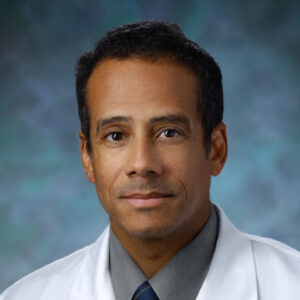
Malcolm V. Brock, director of Clinical and Translational Research in Thoracic Surgery at Johns Hopkins Kimmel Comprehensive Cancer Center, grew up in Bermuda. His father insisted that his children branch outside the small island—the country has a population of just over 60,000 people—and challenge themselves abroad.
“My father said to me, ‘Look, you’re not going to do much sitting here in a 20-square-mile place,’” Brock said. “He had a plan. [To] all of us, at about 15-and-a-half or 16-years old, he said, ‘You need to leave and go to a place where they don’t speak the language. No English.’”
Brock briefly thought about going to Sweden or another location with good skiing. But Brock’s father quickly added another round of qualifications: the destination would need to be “more serious,” and Brock would have to pay for it himself.
So, Brock applied for and was awarded a Rotary Exchange Scholarship and decided on his next stop: Japan.To prepare, Brock studied Japanese with a teacher who came to his house in Bermuda. Once Brock arrived in Japan, he mastered his ability to read and write the language, and eventually earned a degree in Japanese studies at Princeton University.
Still, the idea of becoming a physician remained appealing to Brock.
“I also wanted to be a doctor because I had an influence, a surgeon who I grew up with, who took care of me when I actually had an accident,” Brock said. “I was little, and I was always inspired by the guy.”
Brock faced a fork in the road: he became both a Rhodes Scholar and got a deferred admission to the Johns Hopkins School of Medicine. Brock ended up doing two years of Japanese Research at Oxford University and wrote a book in Japanese titled “Biotechnology in Japan.”
Brock was widely encouraged by his colleagues at Oxford to leave behind his medical career to continue at Oxford, get his PhD, join the faculty, and pursue a career in Japanese studies.
As he was facing this decision, Brock gave a lecture for the Japanese ambassador to the United Kingdom. Afterwards, the ambassador offered Brock advice that altered the course of his career.
“He basically pulled me aside, took me outside, and said, ‘What are you doing? You’ve learned our language, you’re obviously a talented guy in terms of being able to do this in such a short period of time. You can read and write. Why are you going to spend your life essentially studying people like me?’” Brock recalled. “He said, ‘You go out and make a name for yourself, you go and make the world work. You don’t watch other people making the world work.’”
The next day, Brock sent a message to Johns Hopkins to say he was coming to enroll in the School of Medicine, and the rest is history.
Brock shared the story of his start in medicine with Robert A. Winn, director and Lipman Chair in Oncology at VCU Massey Comprehensive Cancer Center, in honor of Black History Month.
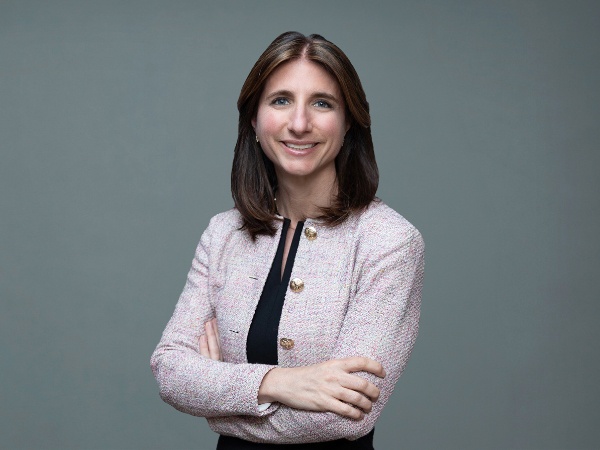
Winn is The Cancer Letter’s guest editor for Black History Month.
Since 2022, The Cancer Letter has celebrated Black History Month with a series of interviews with giants in the field of cancer research.
The full interviews will be available on The Cancer Letter Podcast. Listen to the episode of this week’s conversation between Brawley and Winn on Spotify, Apple Podcasts, and YouTube.
Brock is well-known for his approach of applying basic science research to patient care. His main research revolves around developing novel molecular biomarkers for solid tumors, in order to aid clinicians in diagnosing cancer earlier and treating it more effectively.
The clinical question that bothered me the most was: Operating on somebody, and then them dying two or three months later from metastatic disease after I told them the operation went great, that we got it all. How could we get it all, and then you’re dead in a year, or less? I said, ‘It’s got to be that we’re missing something.’
Malcolm V. Brock
He says he still uses Japanese frequently, as he currently serves as a professor of surgery at Juntendo University in Tokyo, teaching and lecturing there for two weeks every year. This passion was inspired by his 93-year old father, who Brock says he still speaks to every day and points to as one of the reasons it is important to have Black role models.
In addition to his father, Brock lists legends like Dr. Charles Drew, a pioneer in blood transfusions and storage, Dr. Daniel Hale Williams, who founded the first non-segregated hospital in the United States, and his mentor Dr. Levi Watkins Jr., a pioneer in both cardiac surgery and civil rights, as some of his biggest influences during his career.
“If anybody thinks that they got to, and especially in Black History Month, you think you got towhere you are based on your own self, you got another thought coming,” Brock said. “That is a key thing that young people need to really understand and take note of the path that has been already paved for you, so that all you have to do is just get in your car and keep on going. Whereas before, not only were they walking, sometimes they couldn’t, they had to crawl.”
Brock recently served a term as president of the Society of Black Academic Surgeons (SBAS), a society whose logo bears the likeness of one of his influences, Charles Drew. Established in 1989, Brock says SBAS was founded to introduce the benefits of being an academic surgeon to Black medical students and residents over the allure of private practice.
A quote from Drew sticks with Brock in regards to SBAS, “excellence of achievement will always eclipse the artificial barriers imposed by man.” Brock finds these words are especially true in today’s world.
“It’s all about excellence. It’s not about affirmative action. It’s about excellence and you have to have excellence as the bottom line before anything else happens,” Brock said. “SBAS is doing what it’s always done. It’s saying: look, it is not about getting a seat at the table because of your race, or because of some other accolade that’s not associated with excellence. You’re getting that seat at the table because you are excellent in what you do. You’re the best of the best.”
God has given us everything we need to beat cancer. It’s not like something else is coming in there and beating cancer. Our own immune system is waking up and beating cancer.
Malcolm V. Brock
Brock says the one thing that gives him hope is what shows up so often throughout world history: love. He believes the idea of “loving the individual, having love in the heart, and praying for those who are oppressing you is the way to go.”
In this spirit and especially during Black History Month, Brock encourages people to read “Letter from Birmingham Jail” by Martin Luther King Jr., saying every person “Black or white” needs to read and understand the message.
“Martin Luther King Jr. said, ‘I can’t talk to a mob. You try to talk to a mob, you’re gonna get lynched,’” Brock paraphrased. “But individually, you pull out the individuals from that mob, and you will find that their daughters and your daughters are doing the same thing. The things that you are struggling with, they’re struggling with. The same human things that bind us, bind each other. And individually, we like each other, and we can have a conversation, and we can even be best friends.
“What I’ve learned from an early age, being immersed and speaking Japanese, being in that culture, is you might think that is a completely different culture, but when it gets down to brass tacks, relationships between each other, we’re all one.”
Listen to the full episode on Spotify, Apple Podcasts, and YouTube.