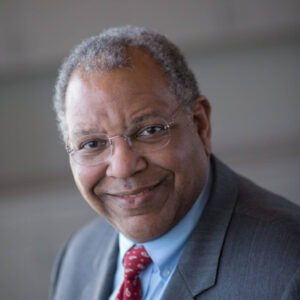
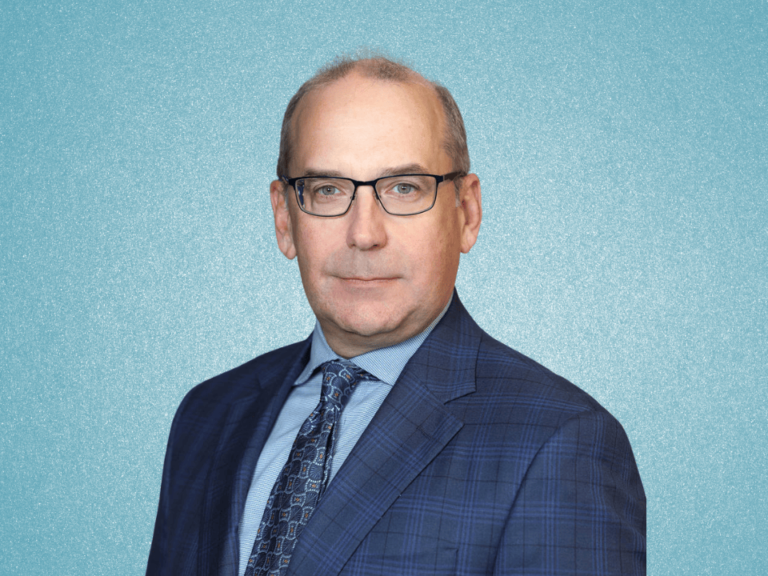
Growing up in inner-city Detroit, Otis Brawley had a thriving community made up of his parents, Jesuit priests, friends, and neighbors encouraging him that he could do anything he put his mind to.
Brawley’s parents worked at the local Veteran’s Hospital, his father in janitorial services and his mother in food services. Neither graduated from high school, but they had high aspirations for their son, and would not take no for an answer.
“I can remember in 1970, when I was 11 years old, the census taker came to the house,” Brawley said. “She was a Black woman, and she was surprised that my father expected me to go to college. He got very upset. The idea that I would not go to college was just not acceptable.”
Brawley, now the associate director of Community Outreach and Engagement at Sidney Kimmel Comprehensive Cancer Center at Johns Hopkins University, shared this story in a recent conversation with Robert A. Winn in honor of Black History Month.
Winn, who is director and Lipman Chair in Oncology at VCU Massey Comprehensive Cancer Center, is The Cancer Letter’s guest editor for Black History Month.
Since 2022, The Cancer Letter has celebrated Black History Month with a series of interviews with giants in the field of cancer research.
The full interviews will be available on The Cancer Letter Podcast. Listen to the episode of this week’s conversation between Brawley and Winn on Spotify, Apple Podcasts, and YouTube.
Along with his parents, Brawley also credits his teachers, nuns, and Jesuit priests for encouraging him through school, continuously pushing a young Brawley to pursue higher education. Brawley even credits some connections in the Westside Detroit gang the BKs, or the Black Killers, for recognizing Brawley’s ambition and supporting him.
“When I say gang people tried to help me out, I think that’s worth telling. Growing up in the inner city of Detroit, there were a whole bunch of folks who had very little hope,” Brawley said. “There were some people who were in the Westside gang who felt I was trying to make something with myself, so I got protection from them.”
Brawley graduated from the University of Chicago’s Pritzker School of Medicine and completed an internal medicine residency at University Hospitals of Cleveland, Case-Western Reserve University, where he met John Altman, who he refers to as “one of the original oncologists.” Altman would change the trajectory of Brawley’s career by not only steering Brawley to the field of oncology, but also helping him secure a fellowship in medical oncology at the National Cancer Institute.
The day Brawley was offered the position at the NCI in 1986, Altman delivered a message that still sticks with Brawley to this day:
“I want you to realize that medicine is an old boy’s club. You will thank me by getting more women and Blacks into the club,” Brawley recalled.
That directive has driven Brawley’s research to change the national conversation about how scientists view inclusion and access in regard to cancer prevention and treatment.
I can remember in 1970, when I was 11 years old, the census taker came to the house. She was a Black woman, and she was surprised that my father expected me to go to college. He got very upset. The idea that I would not go to college was just not acceptable.
Otis W. Brawley
“Trying to realize how good we actually could be if our system were truly efficient is what Otis is all about,” he said. “We’ve been trying to remove some of this racism from cancer medicine, cancer science, or actually medicine in general. We have lost lives because we have wasted resources with inappropriate or ineffective screening, diagnosis, and treatment. That’s one of the reasons why I’m always trying to get back to evidence-based. Let’s do it and do it right.”
At the NCI, Brawley worked with titans of the cancer research field, including former FDA Commissioner Steve Hahn, future cancer center directors Kevin Cullen, Douglas Yee, and one of his lifelong mentors, Barry Kramer, who impressed the importance of orthodoxy in medicine.
“One of the things that I realized is, in medicine, there’s a lot of making it up as you go,” Brawley said. “One of my mentors, Father Polakowski once told me, doctors have this incredibly bad habit of confusing things they believe with things they know.”
That sentiment was one of the catalysts for Brawley’s latest book, “How We Do Harm: A Doctor Breaks Ranks About Being Sick in America,” co-authored by Paul Goldberg, editor and publisher of The Cancer Letter.
Prior to his current role as the Kimmel Comprehensive Cancer Center’s associate director for community outreach and engagement, Brawley served as chief medical and scientific officer and executive vice president of the American Cancer Society. Like his parents, he continues to champion education as a critical growth factor for those in at-risk communities.
“It turns out that the death rate of a college-educated woman in the United States from cancer is 60 deaths per 100,000 per year. The death rate of a woman who is a high school graduate and progressed no further, or never graduated from high school is 120 per 100,000,” Brawley said. “For men, it’s almost a factor of three. High school educated men are three times more likely to die versus college. Education is really important for cancer death prevention.”
Despite barriers, Brawley does see a beacon of hope in the next generation of cancer researchers and clinicians.
“Young people have started to understand the fact that we have drugs that actually work and we’re now starting to focus a little bit more on some of the right things, on how you get people good prevention, how you get people good, appropriate screening, how you get rid of the waste. Those are the three things that make me happy.”
Listen to the full episode on Spotify, Apple Podcasts, and YouTube.
A transcript of the podcast is available below:
Jacquelyn Cobb: Hi everyone! Welcome to a special segment of The Cancer Letter Podcast celebrating Black History Month. This episode features Otis Brawley, the Bloomberg Distinguished Professor of Oncology and Epidemiology at Sidney Kimmel Comprehensive Cancer Center of Johns Hopkins University. Brawley is interviewed here by Robert A. Winn, director and Lipman Chair in Oncology at VCU Massey Comprehensive Cancer Center, who is The Cancer Letter’s guest editor for Black History Month.
And with that, enjoy the episode.
Robert Winn: Dr. Brawley, it is an absolute pleasure and an honor to be able to interview you for this portion of The Cancer Letter, where we’re gonna get to talk about some of the giants in the field, particularly during this upcoming month of February, and reflecting on the impact that we as a community have had.
You were Vice President at the American Cancer Society, your early work at the National Institutes of Health (NIH) and also the work that you currently are doing, amazing work in the context of the Sidney Kimmel Comprehensive Cancer Center at Johns Hopkins.
I’m gonna get things started with a question that I don’t know if you’ve gotten asked before. Who actually, and how were you inspired to follow a path of science, or how did you even think about becoming a doctor?
Otis Brawley: That’s interesting. By the way, it’s humbling to be interviewed by a giant such as you.
I will tell you that growing up in Detroit, my father worked in the veterans hospital and janitorial service. My mother, when I was very young, was actually working in the food service at the same hospital. Growing up, I was always encouraged by teachers to think, to express myself. I was always led to believe that I could do things.
Unfortunately, many of my colleagues in the inner city or the guys that I grew up with in the inner city of Detroit, grew up thinking that they could not. My parents were the exact opposite, neither one having graduated from high school. I can remember in 1970, when I was 11 years old. The census taker came to the house and actually sat on our couch and was asking my father these questions about the family. She was a Black woman, and at some point in time, expressed surprise that my father expected me to go to college. He got so mad, he almost threw her out of the house. The idea that I would not go to college was just not acceptable.
I was very fortunate, I had a number of teachers, the Catholic school, the Sisters of the Immaculate Heart of Mary, who ran the grade school that I was in. Always very encouraging. Some of the lay teachers who were working there as well, were always very encouraging. Sister Claire Elizabeth, who was a very good friend of my mother’s, who told me and told my mother and father that I needed to go to the Jesuit high school. That’s where all the smart people go.
Sister Claire Elizabeth actually called the Jesuit high school and told them. This kid needs to go there and ultimately arrange for me to have a scholarship to go there. A man named John Cole, up in Alpena, Michigan, he was University of Detroit Jesuit High School Class of 1939. Paid for my tuition from 1973 to 1977. Then once there, a nd the Jesuits actually don’t teach you what to think, they teach you how to think and there’s a number of Jesuit priests, and laypeople there who encouraged me to go do things.
I’ll never forget Father Polakowski, who I actually write about in the book that we’re going to be talking about. Father Polakowski, I once wrote he had these 30-minute essays you had to do with pencil. On the back of a used Mimeograph paper, they’ll give you a subject, and you have 30 minutes to write about it. I wrote one essay one day, and at the top, when I got it back, he said, ‘Rather than grade this, Otis, I’m gonna tell you, there are vacant dormitory rooms at Eastern Michigan University. Green and white, fight, fight, fight’.
Sorry for people who went to Eastern Michigan, but he was a snob about colleges. It was Father Fallon and Father Polakowski who told me I needed to go to the University of Chicago. I was guided by a number of wonderful people in high school, after the nuns in grade school, after my mother and father before them.
Once in college, I ran across a number of people who, again, were very supportive. A couple of people, Dr. Elliott Kieff, who was an infectious disease doctor. He found me when I was in my second year of college and he lobbied me for a long time to go to medical school. I was going to go to graduate school in chemistry.
Robert Winn: Were you going to go to the University of Chicago for chemistry?
Otis Brawley: I was a University of Chicago undergrad. I didn’t know where I was gonna go to graduate school. At that time one of his friends, Dr. Jonathan Fanton, who was a vice president for fundraising, also got very involved in encouraging me. Mrs. Hilary Clinton once wrote a book called “It Takes a Village”, and I was the product of actually, some black inner-city gang people even tried to help me out, nuns, Dr. Fanton is a wasp, Dr. Elliott Kieff is a Jew. It was a huge village of people who supported me over the years in doing things.
When I say gang people tried to help me out, I think that’s worth telling. Growing up in the inner city of Detroit, there were a whole bunch of folks who had very little hope. There were some people who were in the Westside gang, The BKs or the Black Killers, who felt I was trying to make something with myself, so I got protection from them.
Once I got to medical school, and Keith pushed me toward going to the University of Chicago, I met a man named Dr. John Altman, who was one of the original oncologists. He was actually behind the original staging systems in the 1950s, if you go way, way back. He’s also one of the creators of the chemotherapy regimen called SHOP. He called himself a lymphomaniac. He was a lymphoma expert. John Altman was also a member of the Overseas Secret Service during World War II, he was a spy. When he came back, he went to Oberlin for college, PNS, as he called it, for medical school. It used to be called Columbia School of Physicians and Surgeons. And then he trained in internal medicine and hematology, and he’s one of the people who brought solid tumor oncology into the world in the 1950s, 60s, and 70s. He was also the first chair of the National Cancer Advisory Board.
When the National Cancer Act came about, he had a number of friends in oncology. I was more interested in law and policy early on than oncology, and then I was interested in science, and he convinced me there was a lot of policy in oncology, and that’s how I ended up pursuing oncology.
Robert Winn: Well, thank you for telling me that because I was thinking, in that era cancer was not as curable as it is today. So what would drive you into a field that, honestly, was still bear skins and sharp knives back then about how do you cure cancer?
Otis Brawley: We’re talking the 1980s. There were almost no drugs approved for cancer between 1980 and 1992-93. There was a lot of hope. But John led me through this. John actually saw, both hope and treatment, as well as he always felt it. Even though he’s a lymphoma doctor, he actually cured some patients of lymphoma with the chemotherapies of the 1960s, 70s, and early 80s. He always felt that prevention needed to be stressed more, and he was also very much a rigorous orthodox scientist. That’s the reason why I have some of my orthodoxy to this day.
Some people get upset when I start telling people some scientific truths, and start saying we need to stop being gunslingers and coming up with these treatments and screening and so forth, and we need to be very orthodox and practice what the science says. John guided me through medical school, residency. He even told me where he wanted me to interview for fellowship and gave me 9 places to go interview for fellowship, and said, ‘As you go to them, I want you to rank them 1, 2, 3, 4, and so forth. After you’ve gone to each one, rank them, and then once you’ve been to all 9, and you will get interviews at all 9, call me’.
I went to all 9 places, and I called him up one day and said, I want to go to, and I will not mention the institution, for obvious reasons. He said, Otis, if you go there, I will never speak to you again. I said, but you told me I should interview there. He says, I wanted you to visit there, I wanted you to meet the people there, I don’t want you to train there. I said, well, in that case, I guess my first choice is the National Cancer Institute.
He says, Otis, where will you be tomorrow afternoon? And I said, well, I’m doing an intensive care rotation, and he said, how can I get ahold of you? And I gave him my pager number. The next afternoon, I’m actually coding a patient in the intensive care unit and remember we used to have secretaries at every ward. So the ward secretary has my pager, and after the code is over, she tells me that Dr. Sam Broder from the National Cancer Institute called and wants me to call him back. I called him back, Sam became a very good friend of mine later on, and Sam says, ‘I’m calling to offer you a job at the National Cancer Institute as a fellow’.
I accepted immediately, and then I called Dr. Altman. He said in his Austrian accent, ‘Otis, I have been expecting this call’. I said, thank you very much, and he said something that has stuck with me since that phone call in 1986.
He said, ‘Otis, I want you to realize that medicine is an old boy’s club. You will thank me by getting more women and blacks into the club’. That was in 1986, and that’s when I realized that every place I went to to interview, I interviewed with the director of that cancer institute.
That’s how I ended up at the National Cancer Institute.
Robert Winn: While you were there at the National Cancer Institute, there’s certainly you, but I’ve heard stories that there were other luminaries that may have been your classmates around that same time that were just troublemakers. Not to say that you were.
Otis Brawley: Dr. Steve Hahn, who became FDA commissioner, was one of the fellows with me. A number of the people who were just ahead of me, have become cancer center directors. Dr. Kevin Cullen, Dr. Douglas Yee there are a number of cancer center directors. We’ve had a lot of fun. Many of us still get together and talk about the good old days. When I got there, Dr. Vincent DeVito was the director, and he would come and round with us on Friday mornings. Eli Gladstein, the radiation oncologist, who always told us he was the best medical oncologist at the NIH. About 3 months into your fellowship, you started realizing that Eli Gladstein was the best. Dr. John Minna was a branch chief, and he’s been a very good friend.
I made friends with Dr. Barry Kramer, who’s been important to me for the rest of my life, who, again, impressed that orthodoxy. You read the study, and you apply, as the study says, and you realize what things are right and what’s wrong.
Father Polakowski, when he heard I was going to medical school, called me up. And, later put in a letter that I still have, and he said, I want you to remember that there are things that you know, things you don’t know, and things that you believe and you need to always try to figure out, is this something I know, is this something I don’t know, or is this something I believe. Then he said something very important. Remember that doctors have this incredibly bad habit to confuse things they believe as things they know.
Robert Winn: I actually am thinking about what you’re saying, and I’m wondering how much of that framework made up the inspiration for your book that you co-wrote. It’s the “How We Do Harm”, which I’m telling you now Dr. Brawley, I want to let you know I still have the copy that you’re supposed to sign, so at some point, we’re gonna get that done.
But that book, in particular, I think, has been a high-impact book. There’s some amazing things, and I’m starting to put two and two together. How important was that as the catalyst for the book of “How We Do Harm”?
Otis Brawley: It was incredibly important. One of the things that we realized is in medicine, there’s a lot of what I call gunslinging, that’s sort of making it up as you go.
To go full circle, growing up in the inner city of Detroit with people who were not highly educated, some of whom were actually quite wise, but not highly educated. I started realizing that in medicine, a lot of people think that folks that are not very wise, they don’t realize that many of those folks actually realize that doctors are frequently making it up as they go along. Some of what I hear about inner-city poor people, Black people, thinking that doctors are experimenting on them is actually those folks realizing that some doctors are making up as they go along, and not truly respecting the science.
That’s part of the reason, part of the motivation for writing the book, and the book is a series of experiences that I have had over time. Good experiences and bad experiences, showing where doctors have gone wrong by not being really orthodox. Patients have gone wrong by listing and believing some of the things that they have heard. I even talk about some of the foundations and some of the charities out there, more trying to make money, and in some instances, trying to get people to just believe.
Unfortunately, especially in the area of screening, I ultimately, under Barry Kramer, trained as a screening epidemiologist after doing medical oncology. I did a whole bunch of cancer control stuff with Barry Kramer, Peter Greenwald and Joe Fraumeni, those are big names in epidemiology and cancer control. There are a bunch of folks who want to do things in screening that are actually wasteful of resources. They don’t work, we don’t know they work, but we do them anyway and we waste resources.
I came along under Kramer in the early 1990s, and then working with Dr. Rick Klausner, when Rick became NCI Director, and working with Dr. David Satcher, who Rick introduced me to when David Satcher was Surgeon General, and was interested in the fact that certain populations don’t do as well as other populations.
We used to call that minority health, and for a time we called it special populations. I was actually in the room, there were about 12 of us in the room with the Surgeon General at the head of the table talking about how some politicians were against some minority health programs. I swear to God, I thought the Surgeon General was asleep at the time and all of a sudden, he says, ‘Why do we call it Minority Health? Why don’t we call it what it actually is? I want to see these politicians say, I am against programs to reduce disparities in health and a bell went off. That’s when it started being called health disparities.
Robert Winn: In that context, you’ve talked a lot, and particularly in the book, about what I love you said, things you know, things you don’t know, and things you believe.
Where did this impact then of the movement around evidence-based medicine? Because that had to happen somewhere. Where did the evidence-based medicine sort of movement come from, and how were you interacting with that?
Otis Brawley: I was very lucky that as I was starting to be told by even Altman in medical school that you needed to be scientific and you need to be orthodox, I did my residency at University Hospitals of Cleveland at Case Western Reserve. We had young people there who were interested in internal medicine and evidence-based medicine.
Dr. David Ransohoff, who’s still out there. He’s a gastrointestinal doctor, but he does a lot of evidence-based medicine. Dr. Seth Landefeld, who is chair of medicine at UAB, he was training there and starting to blossom, but that’s where my introduction to evidence-based medicine was.
And then evidence-based medicine came to oncology, at the NCI in the 1990s. One of the most important things that Barry Kramer ever had me do is, and this is one of my new projects that I’m talking about, the National Cancer Act of 1971 puts the National Cancer Institute in charge of education regarding cancer, education of physicians, education of the community. It’s in there, not frequently. It’s the reason why there was a Physician Data Query (PDQ), it’s the reason why there was a Cancer Information Service or cancer communications, as well as what it was called. One of the things that Kramer made me do early in the 1990s was I had to read everything that was being published by PDQ about oncology. It was a great review for the board exam, by the way.
Robert Winn: Picking up from that, as you’re thinking in the context of back then, prevention. Because one of the things I know about you is that you have been a proponent of the basic translational sciences. But this sort of focus on prevention. You mentioned Dr. Sam Broder, who actually, I think, famously said something about poverty is a carcinogen.
Otis Brawley: It’s interesting, some people think I said that.
Robert Winn: I actually was going to say that you said that, because that is what I associate strongly with you. And then I did some digging before this, and I was reading the book, and I was like, Sam Broder, how did that happen?
Otis Brawley: By the way, man y people don’t realize that Sam Broder and Dr. Bob Yarchoan, still active at the NCI, were the guys who developed the first effective anti-HIV drugs in the early 1990s. They started their work in the 1980s, and they got AZT, or Zytavutine, FDA approved in, I believe, 1990 or 1991. They did it in a clinical study that ultimately framed my thoughts about minority inclusion in clinical trials a lot, too. But Sam Broder, who’s a wonderful person who cares a lot about people. He’s the guy who said, poverty is a carcinogen. He said that when he was NCI director in the early 1990s.
Robert Winn: As you started thinking about, in the context of being at the NIH during that period of time, what was your biggest takeaway about the transition of where it was, maybe in the 60s and 70s, and what it started being able to focus on? You mentioned that, in the context of health disparities, and identifying that different communities, this is not a value judgment, it’s a scientific sort of term. Two communities with different outcomes, ultimately data that you can actually have intervention.
So during your tenure there at the NIH, did you notice was a transition of focus of the NIH or NCI, or was it pretty much the same from the time you went and the time you left?
Otis Brawley: Several of us, and Dr. Harold Freeman, who was on the National Cancer Advisory Board and the President’s Cancer Panel, who I ended up working with and publishing some papers with as well. Several of us were very concerned that this was a poverty issue, that Sam Broder was right. It wasn’t a race issue, it was a poverty issue. It’s a race issue because race frequently is the reason why people are impoverished.
But, unfortunately, in 1993 there was the NIH Revitalization Act, which started mandating minority inclusion in clinical trials, and actually legislates that the reason, if you read the actual law, the presumption is that the disparities are because the drugs work in whites, but they don’t work in blacks, because they haven’t been tested in blacks. Many of us have been upset about this ever since it was passed and signed into law by [President Bill] Clinton in 1993, because it ignores the fact that a large part of the disparities are because blacks don’t get the treatment. I’ve been outspoken in saying, if you don’t get the drug, of course the drug doesn’t work.
We’ve been trying to remove some of this racism from cancer medicine, cancer science, or actually medicine in general. We went through Vitel and the blood pressure medicine that was for Black people and not for white people. We’ve gone through a number of these things. In breast cancer there’s a period of time from about 2015 to 2020 where Black women in Massachusetts had a lower breast cancer death rate than white women in 12 states. But you’ve got a whole bunch of people out there talking about black breast cancer. We must do research in black breast cancer.
By the way, a group that my group published in 2006, 2007, said that if you look at Black women in Atlanta in the years 2000 to 2002, 7% of them who were diagnosed with an early-stage breast cancer got no treatment in the first year after diagnosis. Not bad treatment, that’s another issue we need to deal with. No treatment.
While we’ve got Congress out there causing the NIH and causing a series of programs to look at molecular differences in black people with breast cancer versus white people with breast cancer. I’m more concerned that 7% of Black women in Atlanta with localized curable breast cancer are not, pardon me for changing the English language, they ain’t getting it cut off.
Robert Winn: Actually, this brings up a really good point that you and I were once on a panel together and I remember you saying something, and I may be misquoting, but I think I remember you saying something to the extent that if we just did the freaking standard of care that there would be more people saved. Forget about the new drugs, that if we just did that. Is that near the quote?
Otis Brawley: One of the wonderful people that I’ve come to know and work with is Ahmedin Jemal at the American Cancer Society. Ahmedin , by the way, worked with me when I was at the NCI and we came back together again at the ACS.
We started trying to figure out how can we calculate or quantify the disparity in the United States for cancer and we looked at a number of different ways. One is the death rate in 2015 or so from cancer in Utah was 125 per 100,000. The death rate in Kentucky was 190 per 100,000. Those are the real numbers, by the way.
Now, one can actually have an interesting discussion about is it good living in Utah that causes it to be so low, or good living in Kentucky that causes it to be so high? But you could say, how many people would not die if everybody had the Utah death rate?
Well, Utah is very white, so let’s look at other things. What we settled on was education. It turns out that the death rate of a college-educated woman in the United States from cancer is 60 deaths per 100,000 per year. The death rate of a woman who is a high school graduate and progressed no further, or never graduated from high school is 120 per 100,000.
Exactly double. At my age, that’s important. I can remember those two numbers because it’s exactly double. By the way, women who get to college and never graduate have most of the benefits that college graduates enjoy. For men, it’s almost a factor of 3. High school educated men are 3 times more likely to die versus college. And when you look at this race drops out. Better to be a college-educated black guy than a high school-educated white guy.
Education is really, really important for cancer death prevention. By the way, that college thing tells us it’s heavily driven by pediatrics. It’s not that you got to college, it’s that you lived your first 18 years on a trajectory to get you to college.
Robert Winn: That is a very important, nuanced point, but an incredibly important point that I have not heard discussed much. We always talk about the endpoint, once you’ve gotten a degree, but what you’re describing is, it’s all of those activities, again, this whole thing about how a team, going back to your life story, how a team of people within the community, teams around you, allowed you to have that trajectory.
Otis Brawley: The people who get to college and drop out are less likely to smoke compared to the people who never go to college. They’re less likely to be obese when they’re 40, 50, and 60, compared to the people who never got to college. There’s even drinking differences, and I just hit the number 1, 2, and 3 causes of cancer right there. There are differences because of your childhood.
So what Ahmedin did was we published a paper, and basically, how 600,000 people die from cancer every year in the United States. How many would die if everybody had the risk of death, the death rate of the one-third of Americans who are college graduates. The answer is, of the 600,000 deaths, 132,000 would go away if everybody had the risk of death of a college graduate.
That’s not a new drug. That’s not a new screening test. That’s just give everybody what college graduates get. And by the way, of the 132,000, about 80,000 are white.
Robert Winn: See what’s amazing about that? That’s about a little bit over a 20% reduction in deaths.
Otis Brawley: 22% reduction.
Robert Winn: I’ve been thinking about the progress that we’ve made since 1971, and the reality is we have certainly made progress. I was quoting some of the numbers, and Dr. Doug Lowy and others, we’ve been talking about some of the numbers that show that we’re certainly making some progress, and that’s been a good thing.
But your take, from when you started as a resident to a fellow to now, what has been the thing that you’ve been most amazed about in the context of the oncology or sciences or an oncology field as just a field?
Otis Brawley: We’ve had a 34% decrease in death rates since 1991. It’s due to prevention, especially smoking cessation. It’s also due to appropriate effective screening, appropriate effective diagnostics, and appropriate effective treatment.
We have lost lives because we have wasted resources with inappropriate or ineffective screening, diagnosis, and treatment. That’s one of the reasons why I’m always trying to get back to evidence-based. Let’s do it and do it right.
We have lost people because there’s a substantial number of people, white, black, and otherwise. We usually call them poor, who get what the American Cancer Society lawyers beg me to call less than optimal care. That’s a euphemism.
So, trying to realize how good we actually could be if our system were truly efficient is what Otis is all about.
Robert Winn: Listen, we appreciate that. Wrapping up this interview, I do have the last two questions. One is, in your arc, in your time, who, particularly given the month, it’s African American History Month, were there any influences within your family, within your schools, with other doctors, luminaries, within this field?
Who actually impacted you and your life, you mentioned a number of people, but if you had to pick the one person that was actually most impactful in your life, or most impactful in the field of oncology and including African-Americans, who would that be?
Otis Brawley: It’s hard for me to separate two people. One is Barry Kramer and actually thinking back, not to get inappropriate, but Jews and Blacks have helped each other a lot over the years in civil rights and other things. Barry is Jewish, I’m Black and I wish we saw more acknowledgement of that assistance, and I wish we saw it go both ways more nowadays.
Then the other would be David Satcher. I got to work with David Satcher for almost 3 years. I was at the National Cancer Institute, but I was tasked by Rick Klausner, who was then the NCI director, to be responsible for health disparities research, and Dr. Satcher started relying on me to do a lot more than just oncology. But I learned how to be a gentle man, but firm and how not to take, what he would never call it bulls–t, but I learned how not to take bulls–t.
Robert Winn: Yes, which is an important skill in life. Last question, what brings you the most hope in the field of oncology or in the field of medicine?
Otis Brawley: There are a bunch of young folks coming up in oncology today, who all of us for 30 years, there were a whole bunch of people who just didn’t understand me. When I talk to the fellows, when I talk to the young attendings today they understand what I’m talking about.
The importance of prevention. The importance of risk reduction. I learned that one, by the way, from a patient. You can learn from your patients. We should be talking about risk reduction more so than calling it prevention. The importance of evidence-based medicine.
And then, of course something happened in the last few years that has really given me a great deal of hope. One of my mentors, again, one who I will not mention, he’s a little older than me, said, ‘you know, Otis, the drugs are actually starting to work’.
I actually said this about the time that we wrote the paper noting that there was a decline in lung cancer deaths, this was about 2013, 2014. There’s a decline in lung cancer deaths in the United States that started a long, long time ago, but the slope actually deepened around 2013-2014. The decline was nice and slow from 1990 onward because of smoking cessation that happened starting in the 1960s and 70s. But the increased decline in the slope in 2013 is the introduction of immunotherapy and some of the targeted therapies in lung cancer.
So there’s two important things about my career. When I started my career, we called it minority health and later special populations. As I’m ending my career, I’m telling you that the largest group of people who are screwed by our ineffective system are actually the majority. They’re white people. And when I started my career in the 1980s, when we were giving cisplatinum and atopicide for metastatic lung cancer, and the median survival was, we were publishing papers, we pushed the median survival from 10 months to 12 months. All of a sudden, as I end my career, we’ve got some immunotherapies, we’ve got the ALK inhibitors, we’ve got a number of targeted therapies, and you’ve got people who have been alive with metastatic disease now for 10 years.
The young people who start to understand the fact we have drugs that actually work and help people to have good, high-quality lives. The fact that we’re now starting to focus a little bit more on some of the right things, on how you get people good prevention, how you get people good, appropriate screening, how you get rid of the waste. Those are the three things that make me happy.
Robert Winn: Dr. Brawley, thank you for ending on that note. As I am going to continue to say, this has been really a highlight for me.
Personally, what I will say, and you know this, and I’ve said this to you privately, and I’ll say it publicly, you’ve been one of the major impact players for a number of us throughout the years, who aspire to make sure that excellence is excellence, no matter what, and at all times.
Thank you for that, and I want to just say it has been the most wonderful experience of you taking some time out and reflecting back on what you’ve done and the impact you’ve made, and I just want to let you know that, if you had any doubt, you should doubt no more. Your impact has been felt by many people, and so thank you.