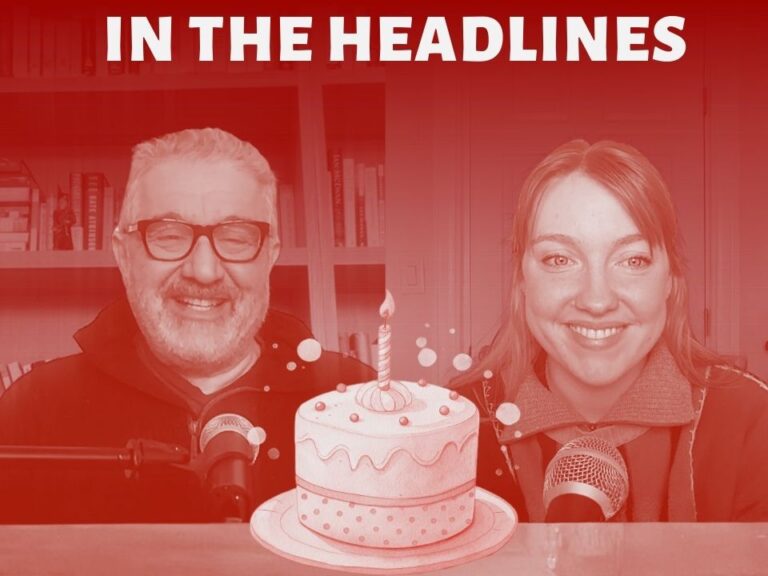
“About a year ago, in January, were these two massive fires in Los Angeles: the Palisades fire, and the Eaton Fire,” Sara Willa Ernst, reporter with The Cancer Letter, said on The Cancer Letter Podcast. On this week’s episode, Sara and Jacquelyn Cobb, associate editor with The Cancer Letter, talk about their experience working as writer-and-editor duo on The Cancer Letter’s most recent cover story, which featured emerging data about the toxic exposure and cancer risk caused by the Eaton and Palisades fires—specifically focused on the firefighters who were sent to fight them.
This episode is available on Spotify, Apple Podcasts, and Youtube.
“I remember watching the TV coverage at the time, and I’m like, ‘Is this real life? This is a huge metropolitan area that is being engulfed by flames.’ And talking to firefighters that were on the front line…Yeah, it was absolutely nuts,” Sara said. “And it’s the type of fire that people are still dealing with the ramifications of today, whether those are people living in LA because they’re rebuilding or there was exposure to smoke from their homes. And then of course, the people that had the highest concentration of exposure were firefighters on the front line breathing in that smoke.”
These early results come at a time when the culture of firefighting is beginning to shift, Sara said. Respirators—which, counterintuitively, have only just become legal to use in some wildfire settings and are still restricted—are becoming more utilized with the involvement of firefighters in research design.
“There were just really rich stories about how this culture shift is happening and what firefighters themselves are saying and thinking and how that is informing the research,” Sara said. “There’s this tension that one of the firefighters was talking about, which is that researchers don’t get it, or policy makers don’t get it, and there’s that disconnect. But at the same time, firefighters are getting involved in research in a way that has not happened before. And I’m talking about firefighters being PIs on research papers—not just research participants, their biospecimens. They’re getting in there.”
But the culture of firefighting remains distinctly its own.
“Content warning for anybody who’s reading the article,” Sara said. “There are quite a few F bombs in there, just letting you guys know, because that is how firefighters talk. This was just one of the most amazing parts of reporting. The story was talking to firefighters, and I mean, once you get them going, they’re going. They have strong opinions, and they were definitely documented in the story.
Stories mentioned in this podcast include:
- A year after LA wildfires, early data reinforce anxieties over firefighters’ cancer risks—Respirators (restricted by federal regulation) may or may not be the answer
- NIH Director Bhattacharya named acting CDC director in latest public health shakeup—The temporary appointment concentrates vast authority in the hands of one person
- Malcolm V. Brock on his journey from Bermuda to Japan to the U.S. to England–and from Japanese studies to thoracic oncology.
- Sustaining community oncology through nonprofit structures and shared technology infrastructure
- California Institute of Regenerative Medicine and Cancer Research: A promise broken?
- At Friends meeting, Pazdur, Woodcock lament FDA’s failure to protect the agency staff from political interference, warn of “lasting implications”
A transcript of this podcast is available: https://cancerletter.com/podcastc/20260225-firefighters/
The following is a transcript of this week’s In the Headlines, a weekly series on The Cancer Letter Podcast:
Jacquelyn Cobb: This week on The Cancer Letter Podcast…
Sara Willa Ernst: Part of the story, what I loved about it was getting all of these little pieces of firefighter culture from the 1800s, 1900s, and just how things have really changed. So, I learned that “the original face masks,” you can even call it that, but just what people did or what they thought or hoped or believed would actually protect them from breathing in some of the soot and debris is that firefighters would have these really, really long beards and they would maybe twirl it up, dunk it in some water, twirl it up, and then chomp on it, put it in their mouth, and just hope that some of the beard hair would pretty much act as a filter for the soot and not get in their mouth and they won’t breathe it.
I’m not really a scientist, but my hypothesis is that that didn’t really do much. But yeah, respirators, the technology, I would say have definitely developed.
Jacquelyn Cobb: Honestly though, I mean pre-respirator’s not a bad idea. Always on hand. It solves a lot of the problems we’re talking about. But now just to sort of come full circle, now, they can’t have beards, right? They can only have mustaches.
Sara Willa Ernst: Yeah. So, for the oxygen mask respirators, because it requires a seal around the face, they can’t wear facial hair. They have to shave, so it doesn’t kind of break the seal. So, if you see a firefighter with a mustache, there’s actually a reason behind it as opposed to just it looking fantastic.
Paul Goldberg: You are listening to The Cancer Letter Podcast. The Cancer Letter is a weekly independent magazine covering oncology since 1973. I’m your host, Paul Goldberg, editor and publisher of The Cancer Letter.
Jacquelyn Cobb: And I’m your host, Jacquelyn Cobb, associate editor of The Cancer Letter. We’ll be bringing you the latest stories, groundbreaking research and critical conversations shaping oncology.
Paul Goldberg: So, let’s get going.
Jacquelyn Cobb: Hey, Sara, how are you?
Sara Willa Ernst: Hey, good. How are you doing, Jacquelyn?
Jacquelyn Cobb: Good. It’s good to have you. I don’t know if you and I have ever been on the podcast. Definitely not alone.
Sara Willa Ernst: We’ve definitely been on the podcast together.
Jacquelyn Cobb: Really?
Sara Willa Ernst: But I think it’s been a hot minute. Yeah.
Jacquelyn Cobb: Okay. Okay, valid. Now that it is coming back to me now.
Sara Willa Ernst: Well, you’re on every podcast. So, if I’ve been on a podcast and I’ve definitely been on at least one podcast with you.
Jacquelyn Cobb: Yes, yes. Yeah, yeah, you’re definitely. Okay. Okay, cool. Well, good to have you back. Sorry, my memory is terrible. I’m very excited to talk about your story. I feel very personally close to this story too because we were working on it together. It was sort of one of our first, I guess, third project together probably is editor and reporter, but it was really fun. So, we can dive into that. I don’t want to get ahead of myself, it’s just what I always do every single time. But I wanted to walk us through last week’s headlines before I dive in. So, our cover story was Sara’s incredible story about basically a year after the LA wildfires, we have some early data looking at exposures and cancer risk for the firefighters.
I’m going to let Sara sort of get into the details there, but it was a really fascinating story. And also just I’m going to embarrass you. I’m sorry, but it was just so beautifully written. It was so beautifully written. It was so good. It was so fun to see Sara’s voice come out. It was so distinctly her. This podcast is probably going to be just me gushing about how good of a story it was, so I’m excited to talk about it. Our second story was about NIH director, Jay Bhattacharya, being named acting director of the CDC. It’s a temporary position in a larger public health shakeup, but definitely an interesting sort of conversation about whether that brings about conflicts of interest.
And a lot of our experts did say that there were some issues in terms of conflict of interest between NIH director and CDC director. So, something to watch for sure. We had our third installment of our Black History Month Podcast Series. This time we had Malcolm V. Brock join us, and he had the coolest story. I looked at the transcript and was really enjoying that. And he was born in Bermuda, and then he went to Japan multiple times and learned Japanese, got a Rhodes Scholarship, and then was in Oxford going to go and be a Japanese scholar. And then the ambassador of Japan, or the Japanese ambassador to the UK came and heard his lecture and was like, actually, you should not do that.
You should not study our people. You should go do something more active, or whatever. I forget exactly the phrase, but it was awesome. And then he decided to go become a thoracic oncologist. So, big switch up there. It was really cool. And he’s also just a really fun speaker. So, definitely worth listening to that podcast. Rather than just reading the transcript, we had two guest editorials. One was about the California Institute of Regenerative Medicine and Cancer Research. That was by Stephen J. Forman from City of Hope. And that is definitely a really, it’s a dense and interesting story. So, definitely worth reading, very sort of high stakes and important story.
And then we had another guest editorial by Jacob Welkley from Radiation Business Solutions about sustaining community oncology through nonprofit structures and shared technology infrastructure. So, that was very interesting as well and worth a check-out. And I think that that is it. We had cancer policy as always. There was a friends meeting recently that Richard Pazdur and Janet Woodcock, formerly from FDA, had some really strong words about what’s happening at FDA right now and lots of other things to check out. So, definitely would go look at that as well. But for now, we can talk about the fire story.
So, Sara, not to put you on the spot, but if you want to give sort of an elevator pitch just so people have sort of a touchstone for what we’re talking about.
Sara Willa Ernst: Yeah. So, about a year ago in January where these two massive fires in Los Angeles, the Palisades fire, the Eaton Fire. I remember watching the TV coverage at the time, and I’m like, “Is this real life? This is a huge metropolitan area that is being engulfed by flames.” And talking to firefighters that were on the front line, yeah, it was absolutely nuts. And it’s the type of fire that people are still dealing with the ramifications of today, whether those are people living in LA because they’re rebuilding or there was exposure to smoke from their homes. And then of course, the people that had the highest concentration of exposure were firefighters on the front line breathing in that smoke.
And recently, there’s been kind of a culture shift happening among firefighters where there is this conversation about cancer risk and cancer prevention and some of the anxieties and fears about the exposures and how that might link to their cancer is starting to come to the surface in the way that maybe it was a creeping suspicion in the back of their heads, or they would see one of their workers come down with cancer, but just it wasn’t really this organized thing. And within the past couple of years, do impart to climate change do impart to seeing these crazy fires of these magnitudes at more frequent rate, but also just some pretty brave people coming up to the forefront being like, we have to talk about this right now.
It has definitely caught my intention, and it’s caught the attention of researchers. And I think for this fire, compared to many other fires, there was just a lot of attention. People, researchers descending down, collecting bio specimens, blood samples, urine samples, just to understand what is the impact on health when you get exposed to this type of toxic smoke. So, yeah, some of those research findings are included in the story, but also some just really rich stories about how this culture shift is happening and what firefighters themselves are saying and thinking and how that is informing the research.
Jacquelyn Cobb: Yeah. Oh my gosh, I have so many follow-up questions and I read the story. So, yeah, I think what I would like to just touch base on first so that our readers have this context is the really interesting, I think new fire type is basically what I think you’re going to know what I’m talking about, and you can do a better job of explaining. And I think also just before you answer too, the idea of where this intersects with your personal interest, right? Because this story was kind of about trying to help you find a beat within oncology, and you have this personal experience writing about climate change. So, yeah, I’d love to hear that sort of, yeah, arc as well.
Sara Willa Ernst: Yeah, yeah. So, I have a little bit of a background. I wouldn’t say it’s like my… I’m trying to make it more of my beat, but I’ve done a couple of stories about the intersections between health and the environment, and all of those stories kind of made sense with The Cancer Letter. We have a lot of focus on MCDs and cancer policy stuff, but there was a little bit of a gap on stories specifically related to how environmental toxins relate to cancer risk and cancer incidence. And I wanted to build a beat on this, and this is one of my first stories really deeply digging into that. And I learned a lot about fires.
There are different types of fires and all of those and the types of fires determine in some ways what one’s cancer risk is because essentially what is a smoke made up of? So, traditionally, there have been these two categories, structure fires, the kind of traditional someone’s house is burning down, and those tends to be really small. Maybe it’s just restricted or limited to one house or maybe to a few houses in a neighborhood, and they tend to have pretty dark smoke because there’s a lot of things that are being burned in that fire. So, think about everything that’s in a house, all of the construction building materials, all of the household objects.
A lot of times, these things contain plastics. And that’s actually a shift in recent years where building materials looking for stuff that’s lighter than just kind of traditional wood. And there have been these and kind of recycled materials that contain plastics. And so, that would lead to kind of a darker, denser, theoretically more toxic smoke. Compare that to wildland fires. So, these are massive fires, but they tend to burn more “clean.” And I’m doing air quotes for those that are listening to your podcast. That’s not to mean that they’re not toxic.
That’s not to mean that you should be breathing it in and just kind of being willy-nilly about it, but there are fewer things that are burned in that fire. So, we’re talking mostly about trees, brush, natural materials, and the theory is that perhaps there are less toxins in that smoke. So, now there’s kind of the onset of the combination of these two fires, the structure fire and the wildland fire, which they call WUI fires, wildland urban interface fires, which is what the Eaton, Palisades fires were. So, just imagine really dense, toxic smoke that you see in a structure fire that has all this crap in it, and then of the size and magnitude of a wildland fire.
And then you have this WUI fire, which is becoming more and more of a risk for firefighters on the West Coast and other parts of the US, and it’s becoming a growing concern.
Jacquelyn Cobb: Yeah, yeah. I don’t mean to laugh at this at all, it’s just WUI is a funny word to me. I’m sorry, but I do… I just want everybody to know, I’m not laughing at any sort of content here is just a little bit of a…
Sara Willa Ernst: Yeah, Jacquelyn just has her inner sixth grader coming out.
Jacquelyn Cobb: Yes. Exactly, exactly. But yeah, this was so fascinating, and I think, not to sort of hone in on a very specific thing, but the smoke, I remember reading somewhere. It might’ve been in an interview. I don’t remember if it got into the actual story, but stuff that can be in there is the plastics, but also lithium batteries and just things that you do not want to be breathing in. And so, yeah, I thought that was really interesting.
Sara Willa Ernst: It’s kind of crazy to think about the end life of all of the products that we have. So, lithium batteries, that’s kind of essential to the decarbonization of the economy. We are building more electric cars. You think, “Okay, this is good for the environment,” but then you don’t really think about it getting stuck, being in the middle of a fire and at risk of exploding and everybody breathing in those toxins. But it’s kind of part of that life cycle of everything that we consume as consumers.
Jacquelyn Cobb: Yeah. And especially considering this increasing rate of WUIs and other environmental sort of disasters that are-
Sara Willa Ernst: Disasters.
Jacquelyn Cobb: … exacerbated by climate change. It’s a little spooky. So, this is kind of an open-ended question. I’m open to hearing where you want to go with it, but I would love to hear about your character building almost just because the characters in the story I think really make it, and I just would love to hear about, we don’t necessarily write about firefighters very often, and it has its very distinct culture. So, I know it’s a hard…
Sara Willa Ernst: Content warning. Content warning for anybody who’s reading the article. There are quite a few F bombs in there, just letting you guys know, because that is how firefighters talk. This was just one of the most amazing parts of reporting. The story was talking to firefighters, and I mean, once you get them going, they’re going. They have strong opinions, and they were definitely documented in the story. But first of all, speaking to firefighters on the front lines of Eaton, Palisades and just getting a sense of what they saw, and even them who are career firefighters, they’ve seen many fires in their life driving into Los Angeles, seeing the infernos, even they were like, ‘What did we sign up for?’
This is crazy. I’ll maybe pull a quote from the story. But one firefighter, we talked to Brian Buchanan, who is from the Bay Area, and he drove down because there was such a need for firefighters that they were drawing people in from all across the state and from other states, from Washington, Idaho. There was just a massive need for boots on the ground. And Brian Buchanan from the Bay Area, he said that basically he got down there and he saw miles and miles of power poles down in the streets. And as they were driving in, they were just taking a moment to really reflect on the gravity of what they were driving into.
And Brian came in with a crew of three people, so full crew of four folks, and pretty much they didn’t wear a respirator for the entire Eaton, Palisades fires. And he says that is a big regret of his. If he could go back in time, he would’ve definitely masked up. But pretty much only one person on the crew remembered bringing a mask. And so, as the fire captain, he was really trying to encourage people like, please, you wear the mask, you, you’re up in there kind of sacrificing himself a bit. I mean, that’s kind of part of the firefighter culture, which is like, we’re all in this together. Don’t be selfish and take the mask for yourself.
And so, what ended up happening was that nobody ended up wearing the mask. And he said he felt it. He said that he felt like his lungs got a beating, and he felt that way, not just the day after, but for days after. And I believe even weeks after because of just how dense and just how dense the smoke was.
Jacquelyn Cobb: Yeah. Should we talk about respirators for a second? Just because I think it’s an important sort of nuance to the story that really was uncovered here that, I mean, maybe I’m sure that there’s a community of people who is very familiar with this legislation, but for our readers, I think it’s going to be brand new info for most of them at least.
Sara Willa Ernst: And I learned about this within the past couple of months, and I was like, “What?” The first time I read about what’s going on with respirators and the fire service, I think the New York Times put out a big investigation, but essentially it’s not part of the culture and it’s not part of the policy at all. So, for the US Forest Service, basically the federal firefighters, there has been a ban on wearing respirators for wildland fires for decades. That’s not to say that for structure fires going in a town and saving a house, they’re wearing masks and they’re wearing pretty much top of the line types of masks, oxygen masks that kind of seal around the entire face.
But those masks are pretty much impossible to bring on wildland fires. They require oxygen tanks. Those oxygen tanks only last for 30 to 40 minutes. So, if you’re talking about being on a fire for days and weeks on end, you’re talking about a lot of oxygen tanks and they’re heavy. I mean, I didn’t even know that this was part of the job description for a wildland firefighter, but they’re hiking like tens of miles into nature, into the forest to reach the fire line. So, imagine having all of your gear, all of your personal protective equipment, and then, I don’t know, 10, 20 oxygen tanks on your back, that’s just physically impossible.
So, there’s all of these logistical issues behind wearing a mask. There’s definitely a lighter weight alternative. They have, let’s say, P100 masks that filter out particulate matter, but the issue is that they make it really hard to breathe. And I don’t think this has really been documented in the literature, although there are definitely some ongoing studies to see just how physically taxing is it and how much does it restrict oxygen flow to someone’s body? How much less are they able to be physically capable of fighting a fire? But definitely, at least from anecdotal conversations in the fire service, that’s basically what’s fueling the ban and also the cultural resistance from wearing a respirator.
It’s like, I need to be able to do my job and it is hot, and wearing a respirator for 12 hours on end is just really not that feasible. I’ll say real quick, sorry, go ahead. Yeah, just that there’s been an update within recent months. So, yeah, so the US Forest Service has kind of walked back the full ban. They’re still saying when you’re at the fire line, when you’re doing the most arduous work there is, as a firefighter, you can’t wear a mask. But with stuff that is less physically rigorous where you also might really get high exposure, then you’re allowed to wear a respirator. And they even have been providing some N95s to firefighters.
Jacquelyn Cobb: Yeah, yeah. And you called it, what is it, the cleanup time or what’s it called? The sort of the high exposure-
Sara Willa Ernst: Yeah, mop up.
Jacquelyn Cobb: … mop up. Thank you.
Sara Willa Ernst: Yeah, mop up is one of them, which is when they’re basically, they’re looking for any kind of rogue embers that are still lit, and then just kind of putting them out and just making sure that there isn’t the possibility of once they put out the fire, the fire erupting again.
Jacquelyn Cobb: Yeah. Yeah, absolutely. I’m trying to find, just because I remember the quote for the sort of, we can’t really wear, respirators was so strong, so I just was trying to find it, but I don’t know if I’m going to be able to do it on the spot. But all that to say is that I think you hear, I have a nuanced point in my head and I’m not sure I’m going to be able to communicate it well, but I guess you hear this, there’s a culture of pushback against respirators, and there’s a lot of machismo and pride and masculine pride in sort of firefighting culture. And I think that it’s important to walk that line between, I don’t want to come across as us dismissing that cultural thing, right?
And I think you did a great job of it, Sara, but I just want to reiterate, because it is actually impacting their health, and I think, or sorry, their work, regardless of what the studies show about actually how much oxygen gets in the brain or whatever, if it’s impeding their ability to do their job, and again, it’s in this high stress, high danger environment, things change really quickly. Terrifying. If I think about it, honestly, I’m just talking and I’m imagining it and I’m getting worked up. It’s an intense, intense experience. And it’s like on some level, we have to trust the people who are there to do the best job they can. And I just really want to find that quote.
Sara Willa Ernst: Oh, I know what quote what you’re talking about.
Jacquelyn Cobb: You know what it is? Do you know what I’m saying?
Sara Willa Ernst: I think so. Wait, maybe I can find it. Is it this one? It kind of gets to the heart of, I would say the challenges or the tensions between firefighters and researchers. But one of the firefighters said, “I don’t mean to sound arrogant by any means, and I understand that researchers are coming from a place of goodwill and good intentions, but if you’re going to make my job harder and the name of keeping me safer, then you’re going to have a fight on your hands. There was also one other thing he said that was really… oh, he said, there’s a disconnect from the people that make the rules that sit behind desks and look at data.
And the people that are doing the work on the line, I don’t care what they say, they don’t know what it’s like. And that’s going to be a universal attitude across the fire service.
Jacquelyn Cobb: Yeah, yeah. And I just think that that’s so important to this conversation. Yeah, just respectable. I truly am getting chills just reading it. And I think throughout the story, I got chills, but yeah, that was a big one.
Sara Willa Ernst: Well, I’ll jump in and say something real quick, which is, while reporting the story, I got kind of two narratives happening at the same time. And I think this is what happens when culture shifts, when there’s a paradigm shift. So, there’s this tension that one of the firefighters was talking about, which is that researchers, they don’t get it, or policy makers don’t get it, and there’s that disconnect. But at the same time, firefighters are getting involved in research in a way that has not happened before. And I’m talking about firefighters being PIs on research papers, not just research participants. They’re bio sample bio specimens. They’re getting in there.
And I mean, even in some cases, there are these amazing firefighter scientists have both hats, people that have masters in public health and also have the lived experience of being a firefighter or even like a PhD in chemistry, which is one of the firefighters in the story that we interviewed.
Jacquelyn Cobb: Cool, cool.
Sara Willa Ernst: But we see it shifting away from us versus them to collaborating together to create something that is actually reasonable and something that people want to do. And talking to firefighters themselves and being like, what are the issues as opposed to telling them what the issues are?
Jacquelyn Cobb: Yeah, yeah, a hundred percent. Getting their buy-in, getting their perspectives so that solutions actually do serve them and not just serve this impossible, sterilized ideal of what they should be doing in a perfect world, but that’s not even really the full picture, right? They can’t. So, anyway, I think I really would love to wrap up. I don’t know if you have this prepared, Sara. We can always read it if we have to. But one of the funniest parts of the story, for me, one of the most enjoyable parts was the original face masks that I need you to tell that.
Sara Willa Ernst: Yeah, yeah, yeah. So, part of the story, what I loved about it was getting all of these little pieces of firefighter culture from the 1800s, 1900s, and just how things have really changed. So, I learned that the “original face masks,” if you can even call it that, but just what people did or what they thought or hoped or believed would actually protect them from breathing in some of the soot and debris is that firefighters would have these really, really long beards and they would maybe twirl it up, dunk it in some water, twirl it up, and then chomp on it, put it in their mouth, and just hope that some of the beard hair would pretty much act as a filter for the soot and not get in their mouth and they won’t breathe it.
I’m not really like a scientist, but I don’t think that, my hypothesis is that that didn’t really do much. But yeah, respirators, the technology, I would say have definitely developed, developed quite a lot since then.
Jacquelyn Cobb: It’s come a long way. Yeah.
Sara Willa Ernst: Yeah.
Jacquelyn Cobb: That’s so funny. I love that. Honestly, though, I mean, pre-respirators? Not a bad idea. Always on hand, it solves a lot of the problems we’re talking about. But now, just to sort of come full circle, now, they can’t have beards; right? They can only have mustaches.
Sara Willa Ernst: Yeah. So, for the oxygen mask respirators, because it requires a seal around the face, they can’t wear facial hair. They have to shave, so it doesn’t kind of break the seal. So, if you see a firefighter with a mustache, there’s actually a reason behind it as opposed to just it looking fantastic.
Jacquelyn Cobb: Oh my God, what a way to end. I love it. Oh my God. Thank you, Sara. This was lovely, so much fun. And I can’t wait to have you on the podcast again soon. It’s truly such a fun time.
Sara Willa Ernst: Yeah, I’ll come back with more environmental health stories and we’ll chat about it.
Jacquelyn Cobb: Heck, yeah. See you next week.
Sara Willa Ernst: Bye.
Jacquelyn Cobb: Thank you for joining us on The Cancer Letter Podcast, where we explore the stories shaping the future of oncology. For more in-depth reporting and analysis, visit us at cancerletter.com. With over 200 site license subscriptions, you may already have access through your workplace. If you found this episode valuable, don’t forget to subscribe, rate, and share. Together, we’ll keep the conversation going.
Paul Goldberg: Until next time, stay informed, stay engaged, and thank you for listening.