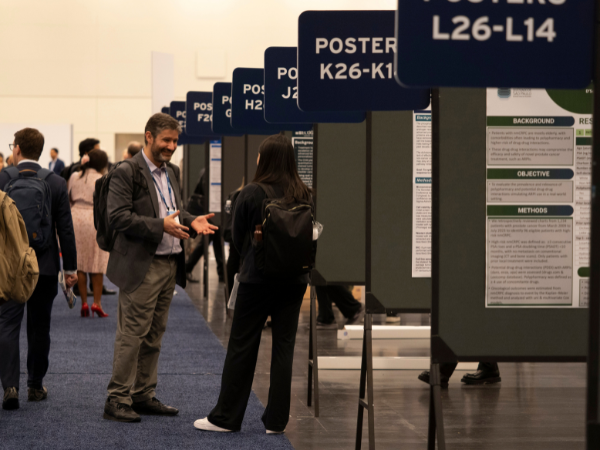
At the American Society of Clinical Oncology annual meeting, the plenary sessions are one of the main events. A handful of clinical research studies are chosen from the thousands that are presented at the conference to represent the biggest achievements from the field in the last year.
This episode is available on Spotify, Apple Podcasts, and Youtube.
This year, results from the phase III RASolute-302 trial were the unequivocal highlight of the plenary hall. With an extended standing ovation, the results showed that patients with metastatic pancreatic cancer who were given daraxonrasib, sponsored by Revolution Medicines, had a median overall survival of 13.2 months compared to a 6.7-month OS for those given chemotherapy.
A story about the trial will be in the upcoming issue of The Cancer Letter. But in this week’s In the Headlines, Paul Goldberg, editor and publisher of The Cancer Letter, and Jacquelyn Cobb, associate editor, talk about the buzz that these results are generating.
Paul has seen the prognosis of other cancer types—such as melanoma and multiple myeloma—completely transform after the development of effective drugs.
“I was there when people were saying, ‘Oh, melanoma, forget it.’ But then, suddenly, there was stuff [treatment options]. Melanoma, multiple myeloma—my God, what catastrophe that was. And look at what’s happening now. I mean, there’s a lot to be said.”
Paul said that this is a reminder of the importance of the biomedical research enterprise, and of clinical cancer researchers specifically. In last week’s issue of The Cancer Letter, the cover story was an episode of The Directors, a special segment of The Cancer Letter Podcast, where Paul spoke with two principle investigators of NCI Community Oncology Research Program, or NCORP, sites.
“This is the week where we better take a good look at how well we are treating our clinical researchers. And we better keep looking at it… Seriously, these folks are heroes,” Paul said. “They should be treated well and respected and well funded because guess what? You cannot do … NCORP brings in about a third of the clinical trials participants. You wouldn’t be able to answer the questions we’re answering and we better come up with more money for them and continue to come up with more money for them.
“You can write about all the rogues in the field all you want, but you know what? There are some really great people who are really moving this field forward and we’re all lucky to see this and covering this is a privilege,” Paul said.
This episode is sponsored by Blood Cancer United. Visit bloodcancerunited.org/equity to learn more.
Stories mentioned in this podcast include:
- The Directors: NCORP PIs discuss workforce shortages, expanding workload, and crushing burden of regulatory oversight
- When CAM is added to standard therapies, survival rates drop, observational study finds
- As rural cancer disparities persist, aligning policy with care delivery models can close the gap
- UK Markey’s Denise Fabian: Theranostics lets us pair a diagnostic with a radioactive therapeutic that target the same molecule
- A modest proposal from a former FDA commissioner: Add antidepressants to the nation’s water supply Warning: This is not a public health recommendation. Do not implement.
This episode was transcribed using transcription services. It has been reviewed by our editorial staff, but the transcript may be imperfect.
The following is a transcript of this week’s In the Headlines, a weekly series on The Cancer Letter Podcast:
Jacquelyn Cobb: This week on the Cancer Letter Podcast…
Paul Goldberg: This is the week where we better take a good look at how well we are treating our clinical researchers.
Jacquelyn Cobb: Mm-hmm. You’re so right. You’re so right.
Paul Goldberg: Yeah.
Jacquelyn Cobb: That’s so true. That’s so true.
Paul Goldberg: And we better keep looking at it. And I’m speaking again as an American citizen-
Jacquelyn Cobb: Yeah, yeah.
Paul Goldberg: … not more so than a reporter, but it’s hard to compare those things. I mean, there’s no real boundary here. But seriously, these folks are heroes.
Jacquelyn Cobb: Mm-hmm, literally.
Paul Goldberg: They should be treated well and respected and well-funded because guess what? You cannot do… NCORP brings in about a third of the clinical trials participants.
Jacquelyn Cobb: Mm-hmm.
Paul Goldberg: You wouldn’t be able to answer the questions we’re answering and we better come up with more money for them and continue to come up with more money for them. You’re listening to the Cancer Letter Podcast. The Cancer Letter is a weekly independent magazine covering oncology since 1973. I’m your host, Paul Goldberg, editor and publisher of The Cancer Letter.
Jacquelyn Cobb: And I’m your host, Jacquelyn Cobb, associate editor of The Cancer Letter. We’ll be bringing you the latest stories, groundbreaking research and critical conversations shaping oncology.
Paul Goldberg: So, let’s get going.
[ADVERTISEMENT]: Significant progress has been made in developing breakthrough treatments for blood cancer, yet many patients are unable to access these advances when they need them. At Blood Cancer United, they’re committed to changing this reality. That’s why they launched the Equity and Access Research Program to generate evidence that drives meaningful changes in healthcare policy and practice so more patients can benefit from the advances in cancer care and live fulfilling complete lives. Now, they’re inviting researchers to apply for their latest request for proposal, understanding how health insurance affects equity and access to care for individuals diagnosed with blood cancer.
They’re looking for studies that examine how insurance status, coverage design, and policy changes shape access and lead to actionable solutions. Letters of intent are due September 10th at 3:00 PM Eastern. Join Blood Cancer United’s pre-application webinar on June 17th at 1:30 PM Eastern to learn more. Equitable access to cancer care starts with evidence and the commitment to act. Visit bloodcancerunited.org/equity and access to register and apply.
Jacquelyn Cobb: Hello, Paul. How are you?
Paul Goldberg: Hi, Jacquelyn. I’m back from ASCO [American Society of Clinical Oncology annual meeting] kind of digging out in the office.
Jacquelyn Cobb: Yes.
Paul Goldberg: It’s quite something.
Jacquelyn Cobb: Yes. The ASCO this year was crazy. That’s what we’re going to be talking about, but I’m going to have to be hearing from you because I did not make it to ASCO. So I am really… Of course, it was this ASCO that I missed when there’s… What would you call that-
Paul Goldberg: Yeah, you were sick.
Jacquelyn Cobb: I was sick. Yes, to be clear. I was sick. I did not choose to miss this ASCO. The plenary that I was talking… I’m jumping ahead, but the literally-
Paul Goldberg: Yeah.
Jacquelyn Cobb: … the standing ovation was how long, Paul? I was listening to it this morning.
Paul Goldberg: I don’t know. I don’t know. I don’t compare.
Jacquelyn Cobb: I think it was over a minute. I think it was over a minute.
Paul Goldberg: It was a while. I mean, there-
Jacquelyn Cobb: It was a while.
Paul Goldberg: … are occasionally standing ovations.
Jacquelyn Cobb: Yeah, yeah.
Paul Goldberg: This one was incredibly meaningful. And actually, the more, the better.
Jacquelyn Cobb: Yeah. That’s true.
Paul Goldberg: And comparing it with Herceptin, I don’t know. I mean, it just gets you into some pseudoscience real quick.
Jacquelyn Cobb: Interesting. I was not thinking of Herceptin. Honestly, I was thinking of the [inaudible 00:04:10]-
Paul Goldberg: [inaudible 00:04:10].
Jacquelyn Cobb: Yeah, no. I was thinking about the one standing ovation that I saw, but I wasn’t even trying to compare. I’m not trying to compare either.
Paul Goldberg: No.
Jacquelyn Cobb: All I’m saying is that it was very long, so long that Dr. Brian Wolpin was like… What did he say? He was like, “I didn’t account for that in my talk, in my time here.”
Paul Goldberg: Right.
Jacquelyn Cobb: And then the moderator said, “We won’t penalize you for that because it’s so understandable why the entire crowd…” How many people are in that crowd, Paul, for people who don’t know? But for people who don’t know about ASCO plenaries, thousands, perhaps tens of thousands in that plenary room, would you say?
Paul Goldberg: I would think at least three.
Jacquelyn Cobb: At least 3,000? Okay. I’ll say 2,000.
Paul Goldberg: I don’t know. I really do not know. Let’s call ASCO and find out-
Jacquelyn Cobb: [inaudible 00:04:54].
Paul Goldberg: … but seriously, it was the full room. The entire place was filled and it was just filling up interestingly towards the last one.
Jacquelyn Cobb: Yeah.
Paul Goldberg: And oh, boy.
Jacquelyn Cobb: I mean, do you want to tell… I can do the headlines later. I feel like this is… I want to keep [inaudible 00:05:09].
Paul Goldberg: Well, I think we’re going to do a huge story on it, obviously, next week, because there’s-
Jacquelyn Cobb: This week.
Paul Goldberg: … this week rather.
Jacquelyn Cobb: Yeah.
Paul Goldberg: The implications are incredible and it’s interesting. We’re talking about that rather than…
Jacquelyn Cobb: I know.
Paul Goldberg: Yeah. Rather than what happened last week, which also was a good issue.
Jacquelyn Cobb: Yes.
Paul Goldberg: We’ve been doing some good work.
Jacquelyn Cobb: Heck yeah.
Paul Goldberg: But yeah, no, this was like seeing pancreatic cancer start to budge.
Jacquelyn Cobb: Yep, yep.
Paul Goldberg: That’s really what I saw when I saw the curves and when I saw the applause because everybody saw the same thing. That mother is starting to budge.
Jacquelyn Cobb: Mm-hmm. Yep. I love that.
Paul Goldberg: [inaudible 00:05:58].
Jacquelyn Cobb: Yeah.
Paul Goldberg: That will be our story for the next, I don’t know how long it’s going to keep budging.
Jacquelyn Cobb: Hopefully.
Paul Goldberg: [inaudible 00:06:07].
Jacquelyn Cobb: Hopefully all at once and for not very long. Right? Hopefully, it’s a very short time.
Paul Goldberg: It might start sliding down.
Jacquelyn Cobb: Yes, yes. That was, I think, and again, we have to be careful not to sort of give too much of the teaser away of the story, but I feel like-
Paul Goldberg: No, I mean, it’s been out.
Jacquelyn Cobb: … I mean, of course, of course. But that’s what I was going to say is that we wrote a story about the results of the trial when they were originally published just in a press release and that was already, what was the word? “This is the tipping point,” I think was the quote that I had gotten. It was like, oh my gosh, it’s really like you’re saying, Paul, it’s beginning to budge. We’re finally making progress. And now as we look forward, right, there’s so many more avenues to really keep going forward in this. It’s really just the tip of the iceberg.
But when I was watching, sadly again on my screen instead of in the beautiful Plenary Stadium was that I hadn’t seen the curves and they are… I think that’s what it was, right? Is that people had known the overall that it doubled survival, right? We knew the numbers, but seeing the visual of the curve that came on the screen and everyone just… You know? I don’t even think Dr.-
Paul Goldberg: [inaudible 00:07:21].
Jacquelyn Cobb: Yeah. Yeah. Yeah. Yes, yes. It was so powerful. I don’t know. Especially just in oncology. The Kaplan-Meier curves are just so quintessential. Yeah, it was powerful. And it’s such a rare, again, not that rare, but too rare that we get such a celebratory moment in oncology. God, and in pancreatic cancer we’ve never have.
Paul Goldberg: More and more frequent.
Jacquelyn Cobb: Mm-hmm, mm-hmm. Yeah. So tell me about what the potential avenues I feel like I [inaudible 00:07:53].
Paul Goldberg: [inaudible 00:07:51]. That’s for next week.
Jacquelyn Cobb: Yes.
Paul Goldberg: Let’s just sort of talk about that, but then you’re writing the story about that. So you’ll be doing that next week, talking about where it’s all going because you’ve been covering the pancreatic cancer story for months and months and months and years.
Jacquelyn Cobb: Yeah.
Paul Goldberg: So you are the lead, so I don’t want to and can’t really.
Jacquelyn Cobb: Well, I think what I mean more is that just that this drug is… It’s the first time this whole class of drugs has shown serious improvements in survival, right? But it’s not just one drug, or it is one drug, but again, it’s this tipping point because it is this class of drugs that is now again, not that they’re ready yet or whatever, but it’s just again, it’s this tipping point, it’s this budging moment, this one outcome is not necessarily the end of the story, is I guess just my point so.
Paul Goldberg: Yeah. And you’ve written once and there’s still a lot of really incredible stuff to come very, very quickly. But as you know, you should be the one talking, not me filling up the room.
Jacquelyn Cobb: Oh, no.
Paul Goldberg: You’re used to it. But here’s the thing here that’s really important to remember, especially now where we are politically… So forget science, politics. Don’t forget science actually. But politics.
Jacquelyn Cobb: No, it’s just funny. It’s like, yeah, you can tell me that. I deserve that. Yes.
Paul Goldberg: Yeah. So the thing is that this thing is connected in some way and we should actually show how to the KRAS initiative that NCI did at Frederick.
Jacquelyn Cobb: Mm-hmm. Mm-hmm, yep, yep.
Paul Goldberg: And that was done by Harold Varmus and there was work done before.
Jacquelyn Cobb: Mm-hmm.
Paul Goldberg: And a decision was made to dump money into this, to invest.
Jacquelyn Cobb: Yeah.
Paul Goldberg: And NCI did it.
Jacquelyn Cobb: Yeah.
Paul Goldberg: And this is the payoff. There’s a lot of stories like that to be told.
Jacquelyn Cobb: Mm-hmm.
Paul Goldberg: And I think we need to tell this story in the Cancer History Project.
Jacquelyn Cobb: Yeah, yeah. I mean, like I said, it’s so quintessential. It’s like fundamental oncology history, I feel, no?
Paul Goldberg: Yeah, yeah, yeah. I think we should actually do that.
Jacquelyn Cobb: Yeah?
Paul Goldberg: I think we should talk to folks who could help us make it happen. And I think that whole story [inaudible 00:10:36] and interviews because federal spending on cancer research is money really well spent.
Jacquelyn Cobb: Yeah, yeah, yeah. I mean, I think it’s like this is something that we’ve kind of talked about, I feel like almost last year actually, was just this idea that we have an understanding of this abstract idea, right, that NCI dollars help innovation, right? But in this situation, like you’re saying, Paul, to actually track exactly how NCI funding literally led to this outcome and like you said, we’ve done that before and there’s a lot of that to do because NCI does contribute to so much innovation and again, especially in the basic science realm. So yeah, I mean, I’m really excited. That’s literally what I’m doing. That’s what I was doing earlier today. What I’ll be doing after this podcast is spending time kind of tracing that drug specifically. Because RAS is a huge thing, like you said, Paul. And it’s not just pancreatic cancer.
Paul Goldberg: Yeah, of course.
Jacquelyn Cobb: Yeah.
Paul Goldberg: It’s a big stone that’s been now rolling down the hill and the faster, the better.
Jacquelyn Cobb: Yes, yes, yeah.
Paul Goldberg: So yeah.
Jacquelyn Cobb: Snowball, yeah. Lots of imagery. I like this.
Paul Goldberg: Lots of imagery. And I think what we should do is kind of go back to the right NCABs and I think they filmed. I don’t know. They’ve got to be. That’s not that long ago. And people were even saying, “Well, why KRAS? You can look at other things.” Well, yeah, you could have, and maybe we should have looked-
Jacquelyn Cobb: Yeah.
Paul Goldberg: … together with KRAS, but I’m glad we looked at KRAS.
Jacquelyn Cobb: Yeah.
Paul Goldberg: We, the American people, we. Not we journalists.
Jacquelyn Cobb: Well, actually, it’s so funny. It was in multiple myeloma, but technically my master’s was in KRAS. So that’s why I feel so, I don’t know, excited about it on a more personal level is like-
Paul Goldberg: Oh, yeah.
Jacquelyn Cobb: … I was taught it was undruggable and now, here we are. It’s druggable, literally.
Paul Goldberg: It’s druggable.
Jacquelyn Cobb: Yeah, yeah.
Paul Goldberg: It’s druggable. And it’s going to become more druggable.
Jacquelyn Cobb: Mm-hmm. Mm-hmm, mm-hmm. Yeah.
Paul Goldberg: And fast.
Jacquelyn Cobb: Yes.
Paul Goldberg: So-
Jacquelyn Cobb: Hopefully. If we have-
Paul Goldberg: Yeah, yeah.
Jacquelyn Cobb: … Yeah. Continue doing the research.
Paul Goldberg: Pancreatic cancer. Holy mackerel.
Jacquelyn Cobb: I know. I know.
Paul Goldberg: I was there when people were saying, “Oh, melanoma, forget.” [inaudible 00:13:09].
Jacquelyn Cobb: Wow.
Paul Goldberg: But then suddenly, there was stuff, melanoma.
Jacquelyn Cobb: Yeah.
Paul Goldberg: It’s multiple myeloma. My God.
Jacquelyn Cobb: Yeah.
Paul Goldberg: What catastrophe that was. And look at what’s happening now. I mean, there’s a lot to be said and [inaudible 00:13:22].
Jacquelyn Cobb: Yes. Everybody, all listeners, you’re getting our… We couldn’t, in our good conscience, simply go back to our last week’s issue when we have all of this excitement from ASCO happening. [inaudible 00:13:33].
Paul Goldberg: No, last week’s issue was really cool.
Jacquelyn Cobb: Yes. I’ll give just a quick overview of that. It’s a little bit late in the podcast, but our main story was an episode of The Directors, which is, as you’ve heard me say every month, basically I’m not going to say too, too much about it because you can go and listen to the full Directors podcast. That’s also on YouTube anywhere that you’re listening to here. It’s adjacent. It’s somewhere nearby and we’ll link it in the description as well. But this month’s episode of The Directors was unique because we had principal investigators from NCORP sites rather than from academic cancer center directors. So it was Amarinthia Curtis and Jeffrey L. Berenberg and they had a crazy conversation, so nuanced. We learned a lot basically is what I’ll say, both listening and writing it, and even just copy editing it. I learned a lot. You and Claire were really in the… Because it was the story’s talking a lot about the bureaucratic challenges that face clinical research and other things and clinical care in the community.
And so, we had to become familiar with some of these bureaucratic details and they are challenging. So that was that conversation, but it was really, really engaging, not a boring story even for all that. So our second story was just a one study story looking at, it was observational, very sort of retrospective study, but it just had an interesting sort of note, I guess, is what I’ll say, finding that breast cancer patients who elected to use, what is it? Complementary and alternative therapies is the full phrase, I’ve shortened it to CAM in my head, and have it reported to the database that the study authors use to do their retrospective analysis. In that case, there seemed to be a decrease in survival and a decrease in the use of some traditional therapies for breast cancer like radiation.
So obviously, I can’t hedge that enough, but it is an interesting sort of thing to keep in mind as CAM, complementary and alternative therapies sort of come in from the outskirts and are just more popular, more in the mindset of people in the general public for oncologists just to be reminded to really have a conversation that it’s not necessarily a replacement for traditional therapies, even though they might be. There is some evidence that adding complementary and alternative medicine to traditional therapies can be beneficial. So all that to say, still very much an open question, but just sort of another piece of evidence to add to the conversation. So that was fun. And then we had trials and tribulations about rural cancer disparities persisting and how to actually approach that. Really cool, comprehensive story. He literally lists out, I think it was four specific things that we can do to close the gap. And then we had a sponsored article from UK Markey about theranostics. So that’s a little late in the pod, but that’s the headlines.
Paul Goldberg: Yeah. Let’s talk a little bit about NCORP because really-
Jacquelyn Cobb: Sure.
Paul Goldberg: … this is the week where we better take a good look at how well we are treating our clinical researchers.
Jacquelyn Cobb: Mm-hmm. You’re so right. You’re so right.
Paul Goldberg: Yeah.
Jacquelyn Cobb: That’s so true. That’s so true.
Paul Goldberg: And we better keep looking at it. And I’m speaking again as an American citizen.
Jacquelyn Cobb: Yeah, yeah.
Paul Goldberg: Not more so than a reporter, but it’s hard to compare those things. I mean, there’s no real boundary here. But seriously, these folks are heroes.
Jacquelyn Cobb: Mm-hmm, literally.
Paul Goldberg: And they should be treated well and respected and well funded because guess what? You cannot do… NCORP brings in about a third of the clinical trials participants. You wouldn’t be able to answer the questions we’re answering and we better come up with more money for them and continue to come up with more money for them.
Jacquelyn Cobb: Yeah. Yeah. And even just the bureaucracy thing, I forget exactly the stat, but she was saying, Dr. Curtis was saying that there was… Was it her personal, she did a study? I’m sorry I [inaudible 00:17:59].
Paul Goldberg: She did… Well.
Jacquelyn Cobb: Yeah.
Paul Goldberg: She put together kind of a… She plotted all of the requirements and when they came in and how much of… It’s a great story. So she has a slide. It’s an undecipherable slide. It shouldn’t be a slide. It should be a book of something.
Jacquelyn Cobb: Yeah.
Paul Goldberg: Something other than a slide, please.
Jacquelyn Cobb: Yeah.
Paul Goldberg: But it’s fun to put it on one sheet of paper.
Jacquelyn Cobb: Yeah. Just to see-
Paul Goldberg: And just look at it and say, “Oh, geez.”
Jacquelyn Cobb: Yeah, yeah, yeah. To feel your emotional reaction to it like, “Ooh.” But what it is is bureaucratic requirements, right? That’s what it was. It was like-
Paul Goldberg: Yeah.
Jacquelyn Cobb: … more red tape and it was just a lot in recent years was the takeaway, is that-
Paul Goldberg: Yeah. Well-
Jacquelyn Cobb: … increased burden. Yeah?
Paul Goldberg: Watch the space because she has promised to write a piece about it.
Jacquelyn Cobb: Yes. Yes.
Paul Goldberg: And I can’t wait to see it. She even says it when I dig in a little bit, she says, “Oh, just wait.” I’ll wait.
Jacquelyn Cobb: Yeah, yeah, yeah.
Paul Goldberg: All right. Well, [inaudible 00:19:04].
Jacquelyn Cobb: She’s very… It worked.
Paul Goldberg: She’s now in Greece.
Jacquelyn Cobb: Wow.
Paul Goldberg: And vacationing.
Jacquelyn Cobb: Wow.
Paul Goldberg: And when she comes back, we should probably remind her. Do you want a remind her?
Jacquelyn Cobb: I’ll Remind her. I’ll write it down. I’ll write it down. I love when these turn into editorial meetings. It’s the best.
Paul Goldberg: Yeah, yeah. See, everything turns into editorial meeting. Life is an editorial meeting.
Jacquelyn Cobb: [inaudible 00:19:27].
Paul Goldberg: So the other tidbit was… Oh, your alternative medicine story, your complementary.
Jacquelyn Cobb: Yeah.
Paul Goldberg: This was the week where I think I earned my keep as an editor because I took out the word traditional and used the word allopathic.
Jacquelyn Cobb: I accept. I think you’re right. We should not have done that, but in my defense, that is what the study [inaudible 00:19:55].
Paul Goldberg: That is the word that they use. [inaudible 00:19:57].
Jacquelyn Cobb: That’s what they used to use. But yes, that’s a little misleading and especially how we’ve written about it, just the way that complementary and alternative medicines have sort of entered in there, is sort of… How would you describe it, Paul? Traditional is a synonym that people have used to describe that.
Paul Goldberg: Traditional medicine literally means things like grasses and teas and St. John’s Wort that we should all be taking.
Jacquelyn Cobb: Listen, actually, just in case, I don’t know how… St. John’s Wort, don’t take without talking to your doctor, please.
Paul Goldberg: [inaudible 00:20:33] making a bad joke. [inaudible 00:20:38]. Put it in the water.
Jacquelyn Cobb: [inaudible 00:20:42].
Paul Goldberg: Better not. Yeah. Yeah, yeah. No, we did have once a pretty good story by actually Michael Friedman about the… It was his modest proposal to put the antidepressants in the water supply. Don’t take out the fluoride. No, no, no, no, no. Don’t take out [inaudible 00:21:07]. Put in antidepressants.
Jacquelyn Cobb: Put in some antidepressants. Yes. I think I remember that now.
Paul Goldberg: He’s a former acting FDA commissioner so he should know. It’s a good story if anybody wants to look up Michael Friedman.
Jacquelyn Cobb: I’ll link it. I’ll link it in the show notes. That’s actually very easy to do.
Paul Goldberg: And thank you so much. Next week, watch this space. We’re going to have a lot of fun.
Jacquelyn Cobb: Oh, yeah. Oh, yeah, it’s going to be even more celebratory, even more exciting because we’re all… Oh.
Paul Goldberg: You can write about all the rogues in the field all you want, but you know what? There are some really great people who are really moving this field forward and we’re all lucky to see this and covering this is a privilege. It’s a great time to be a reporter because not only is there all kinds of nonsense happening, but there’s also this.
Jacquelyn Cobb: Yes. You’re so right. You put it beautifully, Paul. Thank you so much. And listeners, I’ll see you next week. Thank you for joining us on the Cancer Letter Podcast, where we explore the stories shaping the future of oncology. For more in depth reporting and analysis, visit us at cancerletter.com. With over 200 site license subscriptions, you may already have access through your workplace. If you found this episode valuable, don’t forget to subscribe, rate, and share. Together, we’ll keep the conversation going.
Paul Goldberg: Until next time, stay informed, stay engaged, and thank you for listening.