On Dec. 19, the Mikaela Naylon Give Kids a Chance Act was blocked in the Senate by Sen. Bernie Sanders (I-VT) after receiving unanimous approval from the U.S. House of Representatives Dec. 1.
This episode is available on Spotify, Apple Podcasts, and Youtube.
On this episode of The Cancer Letter Podcast, Nancy Goodman, founder and executive director of Kids v. Cancer, joins Jacquelyn Cobb, associate editor with The Cancer Letter, and Claire Marie Porter, reporter. Goodman walks Jacquelyn and Claire through the emotional highs and lows that have characterized the legislative story of the bill, which is aimed at accelerating pediatric cancer treatments and expanding access to life-saving therapies for children battling rare diseases.
The legislation was named in memory of Mikaela Naylon, a 16-year-old with osteosarcoma who had advocated for the Give Kids a Chance Act and who had spent her last weeks asking Congress to pass it.
The bill’s failure in the Senate was a total shock to Goodman and the other pediatric cancer advocates involved.
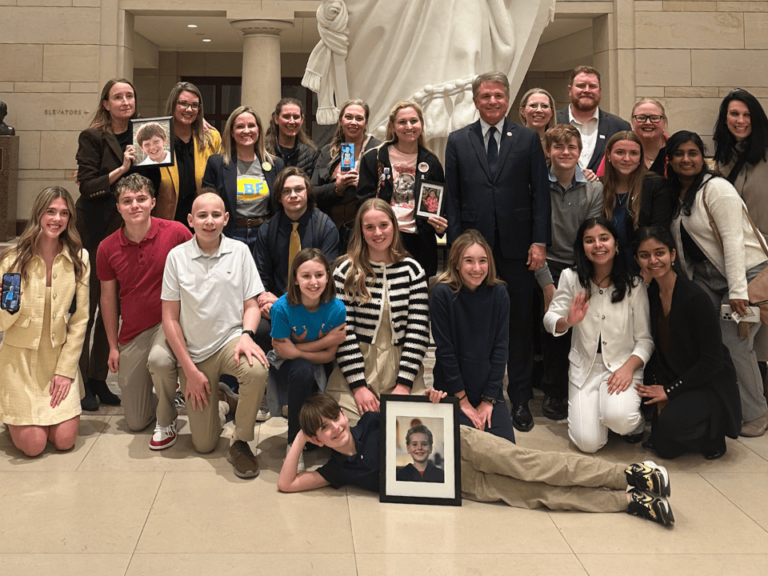
“When the House had their vote, we brought a whole slew of kids who had cancer or who were bereaved siblings or parents and Mikaela’s parents and her brother. We all watched together. It was just one of the most moving moments you can imagine. People were crying and it was this moment where we felt like Congress really cared and Congress was working. Mikaela’s family felt like her death was not for nothing. We came back to my house and celebrated,” Goodman said. “It was just this awesome party, this beautiful moment. We were so happy. We couldn’t believe it. Senator Mullin’s staff was saying they’re going to have a vote soon, and we thought, ‘Oh my gosh, this can happen before Christmas. This is going to be our Christmas gift.’ So, we were just ecstatic. We thought it was going to happen.”
But Sen. Sanders blocked the small Mikaela Naylon Give Kids a Chance Act in favor of pushing a larger, billion-dollar spending bill, Goodman said.
“What he said was he doesn’t object to the bill, but he has other priorities,” Goodman explained. “He has this huge set of priorities…And he said, ‘Look, [the 2024 CR] was a bipartisan agreement. There are over a billion dollars worth of bipartisan priorities. Before we give the Republicans any opportunity to cherry-pick what they care about…let’s pass the whole package.’”
Sen. Sanders’s larger bill was struck down by Sen. Markwayne Mullin (R-OK), leaving the Mikaela Naylon Give Kids a Chance Act without support in the Senate.
“I just wonder, Senator Sanders says he cares about kids with cancer,” Goodman said. “And I’m just asking him to show us: How does he care? Where is it?”
Stories mentioned in this podcast include:
- Mikaela Naylon Give Kids a Chance Act nixed by Senate
- House passes Mikaela Naylon Give Kids a Chance Act—next step, the Senate
- Pediatric cancer research cut from spending legislation at last minute
This episode was transcribed using transcription services. It has been reviewed by our editorial staff, but the transcript may be imperfect.
The following is a transcript of this week’s In the Headlines, a weekly series on The Cancer Letter Podcast:
Jacquelyn Cobb: This week on The Cancer Letter Podcast…
Nancy Goodman: And Senator Cassidy, he’s the chair, he’s from Louisiana, he’s Republican, and his staff were like, “Well, we don’t know if it’s going to pass.” I’m like, “What? Are you kidding me? Of course, it’s going to pass. I’ve been doing this for 16 years. Of course, it’s going to pass.” So, I brought about 20 kids with cancer, survivors, bereaved siblings, bereaves and bereaved parents. And we all went, got the Rocklands BBQ order ready to go for a part. We went into the Senate gallery to watch again. We were ready, we were incredibly excited. I had friends flying into DC, staff just training all the way.
Everyone came, everyone was really excited. Kids skipped school to come. And the debate started and it did not go well. It did not go well and Senator Sanders blocked it.
Paul Goldberg: You’re listening to The Cancer Letter Podcast. The Cancer Letter is a weekly independent magazine covering oncology since 1973. I’m your host, Paul Goldberg, editor and publisher of The Cancer Letter.
Jacquelyn Cobb: And I’m your host, Jacquelyn Cobb, associate editor of The Cancer Letter. We’ll be bringing you the latest stories, groundbreaking research and critical conversations shaping oncology.
Paul Goldberg: So, let’s get going.
Jacquelyn Cobb: Listeners, welcome back to The Cancer Letter Podcast. This is our first episode back after our beautifully long publication break in December. So, this will be our first 2026 podcast. And we have a very special episode. We have Nancy Goodman, the founder and executive director of Kids v. Cancer to talk to us about a story that Claire has been covering for a while now about the… Well, now it’s the Mikaela Naylon Give Kids A Chance Act and the legislative story that happened behind that. Our stories about this story have been some of our most widely read stories of 2025. They are consistently trending. So, clearly our readers and our listeners really want to hear more about this.
We really wanted to hone in on this and zoom in. So, before we go over to Nancy, I’m going to pop it over to Claire super quick, but I will take a backseat and let you guys chat, but if I have questions, I’ll jump in. So, thank you guys.
Claire Marie Porter: Nancy has spent four years, I believe, working on the Give Kids A Chance Act, which was cut. That bill would have allowed FDA to direct companies to undertake combination cancer treatments for kids. You’ve been pushing for the passage of this bipartisan US bill this year, which would boost drug development for children with rare diseases in my understanding, or removing some of the regulatory hurdles, as well as expanding FDA authority for pediatric trials, and then reauthorizing incentives like priority review vouchers. So, I wanted to ask you as a starting question why the Give Kids A Chance Act was renamed and the story behind that. And then if we could talk to just a little bit about what this legislation includes.
Nancy Goodman: Sure. Thanks so much, Claire. Thank you, Jacquelyn. And I just want to start off by saying I’m a massive Cancer Letter fan. I think this is just a media outlet that has incredible coverage of FDA policy and regulation. So, thank you so much for covering our story. So, the bill we’ve been working on is now the Mikaela Naylon Give Kids A Chance Act. And why is it Mikaela Naylon? This is a bill about helping seriously ill kids. In our country, we have this whole regulatory system to encourage companies and give them an opportunity to develop drugs. It’s called the patent system.
And then when the patent system doesn’t work so well, Congress promulgates all sorts of other new laws to create incentives, but they don’t apply unfortunately yet to pediatric cancer. So, we don’t have new pediatric cancer drugs and it’s because we haven’t figured out what to do now that since patent law doesn’t work, right? The markets are too small. And when you go to Capitol Hill, as everyone, all our listeners know there are a million issues Congress is addressing. There are a million FDA issues that Congress is addressing. And we just wanted to underscore that it’s not just like another issue. This is about a kid. This is about sick kids.
So, I founded Kids v. Cancer 17 years ago when my son Jacob, who was then 10 years old, died of a pediatric cancer. And the drugs used to treat Jacob. They were 40 years old. There was no theory they would ever work. You just never think that with all this incredible, exciting science occurring to develop adult cancer drugs, that there’s nothing for kids. And there isn’t. There’s nobody evil. Industry’s awesome, but industry doesn’t have a path forward. One of the things we do, so Kids v. Cancer, we have written and championed the Creating Hope Pediatric Priority Review Voucher, which Congress first passed in 2012, the Race for Children Act, which Congress passed in 2017.
And now we’ve been working on the Give Kids A Chance Act. One of the things we do is we bring incredible kids to Washington DC to meet with lawmakers and their staff and talk about pediatric cancer. These are kids who are patients, survivors, their siblings. And these kids are just the most incredible, spectacular, strong, brave, gorgeous people you will ever meet. And our biggest event is in September. This past September, we had 140 kids come. They attend their meetings with no adult supervision, no parents, no teachers, no Kids v. Cancer staff. I’m not allowed to go because we want it to be about the kids and the members. This is not about politics. This is like an opportunity for kids to have a voice.
This past September, one of the kids who came was this incredible young woman. Her name was Mikaela Naylon. Mikaela was 16 years old. She was not in good shape. She had osteosarcoma, a bone cancer. She had had multiple relapses, many, many, many surgeries. She was in a wheelchair. She had just finished radiation. She had run out of options. And she was 16. She told her mother she just had to come. And she was really not healthy enough to come. And her mother somehow got her to DC and she didn’t even make it through the entire day, but she went to as much as she could.
She met lawmakers and just made an incredible impact on them telling her story, talking about pediatric cancer. This is a woman. She’s just so smart, so articulate, so powerful. That was September 19th. By the middle of October, a month later, she was in end stage cancer. And Mikaela told her mom that what she wanted to do for the last few weeks of her life was be politically relevant. And she wanted to change the world by asking Congress to pass this bill, the Give Kids A Chance Act that she had come to DC for. It’s incredible. She’s 16 years old, and this is what she’s caring about the last two weeks of her life. Just how can any of us even just imagine that bravery?
So, I called numerous senators, Congresswomen, and Congressmen, and told them about Mikaela. And they responded by sending her videos and Zooming her, telling her how important she was to them, how committed they were to helping children with cancer, how committed they were to Give Kids A Chance Act. And their videos were just incredibly beautiful. I’m not going to share any of them with you or ever. When I asked them to make these videos, I said, “This is not about politics. This is a personal experience between you and Mikaela. And this is just about being a good human. This is not about being a politician.” And I just want to mention some of the people who… Now, I didn’t ask everybody.
So, if you’re not on this list, it just means I didn’t call them. But Michael McCaul, Congressman Michael McCaul from Texas, just the most beautiful video he sent, Congresswoman Deborah Dingell, Congressman Gus Bilirakis, Senator Chuck Schumer is just like the most sweet, beautiful guy. Bill Cassidy, Senator Bill Cassidy, Senator Markwayne Mullin, Senator Reed, Senator Hickenlooper, Senator Whitehouse, just beautiful, beautiful, beautiful videos, personal just… And then she died and they knew she was going to die. And when Michael McCaul, Congressman Michael McCaul videoed her, he said, “We’re going to name the bill after you, Mikaela.”
She knew that on her deathbed, she knew that that was going to be her legacy and she died. And the day she died, Congressman McCaul called me and he said, “That’s it. We’re going to do it.” And he called the chair of the Energy and Commerce Department, Congressman Guthrie, Congressman Bilirakis, Congresswoman Dingell, Congressman Cassidy, because he’s chair of the Senate Help Committee, which is the relevant Senate committee. And Congressman Markwayne Mullin, and they all just decided that’s what they were going to do.
And then on Dec. 1, so only a month later, which in congressional time is a blink, the House met, they changed the name and they passed the bill unanimously and they have the most incredible speeches. Right now, they’re on our website. You might want to put them on your website. They’re just incredibly beautiful, inspiring. It just shows you the best of what Congress can do. And then Senator Markwayne Mullin reintroduced the bill with her name and that’s how we got the name Mikaela Naylon Give Kids A Chance Act. I know your next question, Claire, and I’m going to stop right now is our Senate story, which was not as happy as the House story.
Claire Marie Porter: Right, right. I’m curious what, between, I don’t know how many days exactly were between when it passed unanimously in the house and then went to the Senate, but were you excited, optimistic? What was the general tenor of, I guess, people who were watching really closely? Did it feel really hopeful or you were like, “Well, we’ve done this before. We’re at the finish line.”
Nancy Goodman: We were really hopeful, Claire. When the House had their vote, we brought a whole slew of kids who had cancer or who were bereaved siblings or parents and Mikaela’s parents and her brother. We all watched together. And it was just one of the most moving moments you can imagine. People were crying and it was this moment where we felt like Congress really cared and Congress was working. Mikaela’s family felt like her death was not for nothing. And we came back to my house and celebrated. We had barbecued chicken. It was delicious and what’s it called? Rocklands right near you. And oh my God, it’s the best chicken.
Awesome. Anyways, it was just this awesome party, this beautiful moment. We were just so happy. We couldn’t believe it. And Senator Mullin’s staff was saying they’re going to have a vote soon. And we thought, “Oh my gosh, this can happen before Christmas.”
Claire Marie Porter: It’s happening. Yeah.
Nancy Goodman: This is going to be our Christmas gift. So, we were just ecstatic. We thought it was going to happen.
Claire Marie Porter: Okay. And it didn’t, obviously, is what we’re leading up to.
Nancy Goodman: Well, so, then that was Dec. 1 and then on Dec. 19… So, then the question was, well, how is it going to get through the Senate? So, maybe you’re a little younger or maybe you’ve still watched the… You’ve seen the PBS, “I’m just a bill” video, I’m just a bill, you know?
Claire Marie Porter: Oh, yes. Yeah.
Nancy Goodman: I’m just a bill… Oh my God, you haven’t seen I’m just a bill?
Claire Marie Porter: School House Rock. Yeah. Capitol Hill.
Nancy Goodman: Yeah, School House Rock.
Claire Marie Porter: Well, now…
Nancy Goodman: Well, that’s not how bills are passed, bud.
Claire Marie Porter: Right.
Nancy Goodman: Yeah. That’s not how bills are passed in Congress. That’s the sad part. So, a bill can be passed that way, but the rules of debate require just so many hours of debate that it’s just not feasible. So, then there are two other strategies. One is what’s called a unanimous consent vote in the Senate where it can be passed without debate, but every single Senator has to support it. So, we asked our sponsors to have a unanimous consent vote, please. And the response we got was, “Well, we’re not really sure because Senator Bernie Sanders might block it.”
We’re like, “What? He’s not going to block it. Are you kidding me? Senator Sanders? He cares about kids. He’s a good guy. Yes, he has other priorities. We’re going to work with him, but no, he’s not going to do that. That’s just never going to happen. This is your Republican paranoia, which we get, but just take a deep breath. It’s not going to happen. We promise you.” And so, that was what we thought. So, of course, Senator Sanders is from Vermont. He’s an independent. Senator Markwayne Mullin is a Republican from Oklahoma. And then a Democrat, Maggie Hassan from New Hampshire, she wasn’t our original sponsor, but a piece of the bill was actually one of her priorities, and she’s fantastic.
And she said, “I’m going to step up and be the driving Democratic force in this. I really care about this bill. Let’s do it. Let’s try.”
I was sure it was going to go through. And Senator Cassidy, he’s the chair, he’s from Louisiana, he’s a Republican committee and his staff said, “Well, we don’t know if it’s going to pass.” I said, “What? Are you kidding me? Of course, it’s going to pass.” I’ve been doing this for 16 years. Of course, it’s going to pass. So, we had about 20, I brought about 20 kids with cancer, survivors, bereaved siblings, and bereaved parents. And we all went and got the Rockland’s order ready to go again for another party. And we went into the Senate gallery to watch again. So, we were ready.
We were incredibly excited. I had friends flying into DC staff, just training all the way. I mean, everyone came, everyone was really excited. Kids skipped school to come. The debate started and it did not go well. It did not go well. Senator Sanders blocked it. What he said was he doesn’t object to the bill, but he said that he has other priorities. He has this huge set of priorities. They’re what you referred to, Claire, about the December 2024 CR that failed as a result of Elon Musk’s tweets.
[Sanders] said, “Look, that was a bipartisan agreement. There are over a billion dollars worth of bipartisan priorities. Before we give the Republicans any opportunity to cherry-pick what they care about, let’s pass the whole package.” Okay. So, then Senator Cassidy from Louisiana said, “Look, your biggest number one priority, community health centers, cost half a billion dollars for 2026. I commit to working on with you and getting it through the Senate this year.” I’m sitting there in the gallery. I’m getting pretty nervous, but I’m thinking, “Wow, I didn’t think that Senator Cassidy was going to come out with that kind of compromise. That was amazing.” I was pretty excited. I thought, “Well, there’s tension, but how could Sanders say ‘no’ to that? That’s what he wanted.”
And then Senator Maggie Hassan said, “[Senator Sanders], please support the bill because even if you get everything you want, the House isn’t going to pass your priorities. The bill’s just going to die.” This is a little teeny narrow bill, the Give Kids A Chance Act. It’s a tiny little narrow bill, and what you’re asking for is a major billion dollar piece of legislation. I support it. I personally think it’s fantastic, but still you’re going to hang a billion dollars worth of transformational goods on a tiny little bill for kids with cancer that we’ve been working on all these years.
Senator Sanders said, “Well, no, no, that’s not enough for me. I want the community health centers deal done at the same exact time the Give Kids A Chance Act passes, and I have three other priorities I want done at the same time. It adds up to a billion bucks today or no day. That’s just like that’s how it’s going to be.”
There was a vote. He said no.
And then he said, “Okay, well, what I want is another vote where we add all of my priorities and take another unanimous consent vote.”
Senator Markwayne Mullin blocked it.
Of course, I was disappointed. I’m going to be honest. And yeah, of course he Senator Mullin blocked it. It’s a billion dollars worth of stuff and they hadn’t even discussed it once in the Senate. By the way, I’m a hardcore Democrat myself. I can’t believe I’m in this world where I am supporting everything Senator Markwayne Mullin, a conservative Republican advocates to cross Senator Bernie Sanders, a progressive Democrat. Here I am saying, “Yes, Senator Mullin, what can I do to support you?” Anyways, that’s where we are. And I’m pissed, I’m going to be honest. That’s not fair. That’s not the right thing to do.
Claire Marie Porter: Yeah. I have just two follow-up questions about that because it is bizarre. I’m wondering if from your perspective, do you believe that Senator Sanders understands the community’s pediatric cancer community’s frustration? Even if he disagrees on the strategy, do you feel like he’s empathetically on board? There seems to be something missing.
Nancy Goodman: I think it’s never fair to ascribe an intention, or perspective of someone else before you ask them for it and so…
Claire Marie Porter: He didn’t expressed that though, I guess is what I meant.
Nancy Goodman: He didn’t express it. He did say he supports the bill and that he cares about kids with cancer. He even quoted a study that I cannot find, but that maybe it exists—I’m really a good researcher—and I couldn’t find it, anyways, that primary healthcare programs are really great for kids with leukemia and decrease death rates of kids with leukemia. Well, primary healthcare programs are important, but let me tell you, when my kid had cancer, I didn’t really want another opportunity to get primary care from my pediatrician, so I could call him and talk to him about an ear infection. I wanted a new drug; right?
I can’t imagine what that study [cited by Senator Sanders] actually said, but Senator Sanders believes there’s a nexus. What I do know is that when Senator Maggie Hassan, Democrat from New Hampshire, when she said, “Hey, don’t go this route because there’s no way it’s going to pass into law. We’re sinking our bill.” What I know is he never responded and that was okay. So, he never responded. So, I do know that, just crazy, right?
Claire Marie Porter: Okay. It is. It is hard to wrap my brain around. Well, I mean, my question was, what do you make of Sander’s strategy? Do you support the idea, I guess, of tying a pediatric cancer legislation into a broader healthcare package? Is that something that… Should this bill stand alone?
Nancy Goodman: Thank you for that question. So, look, the logic for tying them together is that they were originally together in December 2024. There were 900 pages of healthcare programs that had gone through Energy and Commerce Committee, which was Republican controlled at the time. And then the Republicans cut it [from the CR] after Elon Musk criticized it. So, I understand Senator Sanders’ comments. Of the 900 pages, we were eight pages. We were some tiny little narrow thing. Just to give you some context, like our bill, I don’t pay myself. We’re run by a bunch of parents. We don’t pay ourselves. This is my full-time job.
Most parents are doing it after they have a full-time job, put the kids to bed and contribute a couple hours at night. I mean, this is a classical grassroots effort. We don’t have the resources to do what some of these other master programs can do. I’m upset. I think it’s not fair. We are a tiny little narrow issue, and why are you barring us from passage until a massive, huge, major issue is addressed, right?
Claire Marie Porter: Yeah, I see. Yeah.
Nancy Goodman: And Senator Sander’s response is it’s the only way [his priorities are] going to be addressed because Republicans care about [Give Kids a Chance Act] and not these other primary care issues. And my response is, “What? We became a Republican issue?” That’s crazy. Since when do Democrats not care about kids with cancer? That is just totally unfair. It’s a bipartisan issue. In the House, 313 representatives out of 435 co-sponsored the bill and every single one of them voted for it. In the Senate, every single Senator, except for Bernie Sanders, voted for it. This is not a Republican issue. This is a bipartisan issue. So, I think it’s really lousy of him to do this, but I don’t know. I can’t ascribe his motives. I don’t know.
I’m going to say one more thing though, because really I feel lousy. I told you I called all those senators and Congressmen and women and asked them to do personal videos. After this vote, which was December 19th, I contacted Senator Sanders staff and I said, “Look, we’re having this terrible relationship. Things are not going well.” By the way, there’s this kid, she’s from Rhode Island. She’s not your constituent in Vermont. She’s in Rhode Island. She’s on her end stage of cancer. She comes from a Bernie Sanders family. She’s brilliant, beautiful, powerful kid on Medicaid. Your working class family, her dad’s on disability. These are your people.
And they view themselves as Bernie Sanders people. And what she wants before she dies is to help support this bill and to let Congress know that she cares about this bill. As she’s coming in and out of consciousness she’s asking her mother the status of the bill. Her name is Carrigan Nelson. She was an incredible, incredible young woman, 23 years old. I emailed six staffers and I texted two of those phone numbers… Yeah, I texted them back and forth in the past. Nobody responded to me. Senator Sanders and his team decided not to send her a personal email. I explained this is not political. You didn’t have to send it to me. I was never going to broadcast it if he ever did.
I told them of everybody else who did it, including Senator Schumer. She died Christmas day, Carrigan Nelson. So, I just wonder, Senator Sanders says he cares about kids with cancer. And I’m just asking him to show us: How does he care? Where is it?
Claire Marie Porter: Yeah. I mean, can I ask about next steps? Where are we now? What needs to change politically in 2026 in order to move this forward?
Nancy Goodman: Yeah. So, what we know from the Schoolhouse Rock is that it’s highly unlikely that this is going to be a standalone bill where the Senate does all the debate. It’s already past the House, so we’re fine on the House bill. And the question is: how to get through the Senate. And so, there are three ways. One is regular rules of order. That’s probably not going to happen. It takes, I think, 30 or 60 hours of debate. It’s just like it’s too much. Second is there could be another unanimous consent [vote]. Somehow Senator Sanders could get what he wants from the Republicans, and maybe that’s possible, and I would urge Republicans to support it.
But I’ve also asked the Senator Sanders team, “Who’s your champion on the House who’s going to ensure that it gets through the House?” And I haven’t heard a response. So, what’s the theory that it’s going to get through the House? Are there Democrats in the House who care enough to really push it? And I don’t know the answer. I don’t know who they are. So, one option is regular rules of order. The second is unanimous consent. And again, even if it passes in the Senate, we’ve got trouble in the House now. And the third way is it gets attached to another bill. And if it gets attached to another bill, then one Senator can’t block it.
The bill it could be attached to is there may be a Labor HHS minibus that gets passed in the next couple of weeks. There are a lot of reasons why it’s going to be really tough for it to get attached there. I hope we are. And then there’s probably going to be another CR January 31st with some Labor H policies, and that’s our best shot. So, those are two requests. And if we don’t get past then, my remark back to Senator Sanders is, ‘”Really? You let it die. Your priorities didn’t get passed, what was accomplished?” And to Republican leadership, I would say, “What [Senator Sanders] is asking for, it’s good policy.
It was agreed to on a bipartisan basis. Why can’t you support it?” But then let’s make sure it gets through the House too.
Claire Marie Porter: Yeah, yeah.
Jacquelyn Cobb: Well, we’ll be watching that very closely and continuing to cover it. Would love to honestly have you back on the podcast.
Nancy Goodman: I want to come back. I’ll come back for anything. I’m a huge Cancer Letter fan. I want to tell you I think this is just the best media outlet covering FDA issues on the hill or in regulatory science. So, thank you so much for having me and, yeah.
Claire Marie Porter: Thank you, Nancy. Keep up the good fight.
Jacquelyn Cobb: Thank you for joining us on The Cancer Letter Podcast, where we explore the stories shaping the future of oncology. For more in depth reporting and analysis, visit us at cancerletter.com. With over 200 site license subscriptions, you may already have access through your workplace. If you found this episode valuable, don’t forget to subscribe, rate, and share. Together, we’ll keep the conversation going.
Paul Goldberg: Until next time, stay informed, stay engaged, and thank you for listening.