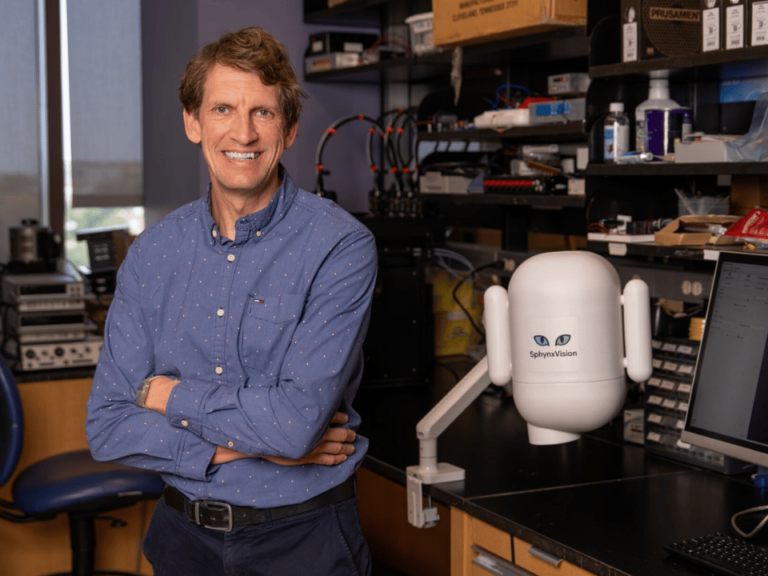
The Jayne Koskinas Ted Giovanis Foundation for Health and Policy awarded The Wistar Institute a $840,000 grant over three years, to support the Jayne Koskinas Ted Giovanis Breast Cancer Research Consortium at Wistar.
The award furthers the multidisciplinary research projects of two Wistar scientists, Frank Rauscher, the principal investigator of the award, and Qing Chen, whose integrated research targets breast cancer and specifically how cancer cells migrate from the primary tumor to form an often-deadly metastasis.
Rauscher, professor in Wistar’s Gene Expression and Regulation Program, studies the regulation of gene expression in cellular differentiation and homeostasis and how disruption of these mechanisms affects tumor initiation and metastatic progression.
Chen, assistant professor in Wistar’s Immunology, Microenvironment and Metastasis Program, focuses on the molecular mechanisms of brain metastasis originating from primary tumors like breast cancer.
Working in collaboration, the scientists will focus their breast cancer research at the mechanisms used by the tumor at the very onset of the metastatic process, and how the primary tumor burden promotes and activates metastasis to distant organs— specifically in the brain. They hope to understand and define the biochemical mechanisms specific to cancer cells that promote metastasis and to find druggable targets to block tumor spread.