By law, the Food and Drug Administration is required to determine whether a drug, device, biologic, or medical device is “safe and effective.” But the FDA determination does not control whether the Centers for Medicare & Medicaid Services will pay for it.
To satisfy CMS, medical products and services must be “reasonable and necessary,” meaning that it “meets, but does not exceed the patient’s medical need.” Simply stated, a drug, biologic, or device may satisfy the FDA’s criteria for approval, but still fail CMS’s independent statutory requirement that they be reasonable and necessary for the treatment of a specific patient or disease.
This distinction explains why the FDA’s accelerated approval of aducanumab (Aduhelm) for the treatment of Alzheimer’s disease in June 2021 did not control CMS’s independent decision whether to cover the drug.
CMS ultimately determined that aducanumab would only be covered by Medicare Part B under limited circumstances, such as FDA-approved randomized clinical trials, or in CMS-sponsored Coverage with Evidence registry studies.
What about Medicare Part D, which covers oral drugs? Although Medicare Part D plans are required by law to provide coverage for all antineoplastics, the same statutory requirement (i.e., drugs must be “reasonable and necessary”) still applies—meaning that the prescribed drugs may not “exceed the patient’s medical need.”
FDA’s Project Optimus, announced in 2021, is intended to eliminate or reduce excessive dosing of investigational drugs (i.e., prior to initial approval), implicitly acknowledging that dose optimization was generally not a consideration for oncology drugs.
For all these examples, we argue that CMS coverage of the excessive dosages is not ‘reasonable or necessary’—since the prescribed dose clearly ‘exceed[s] the patient’s medical need.’
As we have previously noted, multiple drugs have been approved by the FDA at dosages that appear to be excessive, including four drugs for which the recommended dosage has been proven to be excessive in randomized clinical trials (e.g., abiraterone, sotorasib, ribociclib, and nivolumab), as well as other drugs that are commonly prescribed at a lower dose than the FDA originally approved (e.g, pembrolizumab).
For all these examples, we argue that CMS coverage of the excessive dosages is not “reasonable or necessary”—since the prescribed dose clearly “exceed[s] the patient’s medical need.”
There are also dozens of other drugs for which prospective clinical trials of lower dosages are warranted, based on evidence that the labeled dose appears to be excessive.
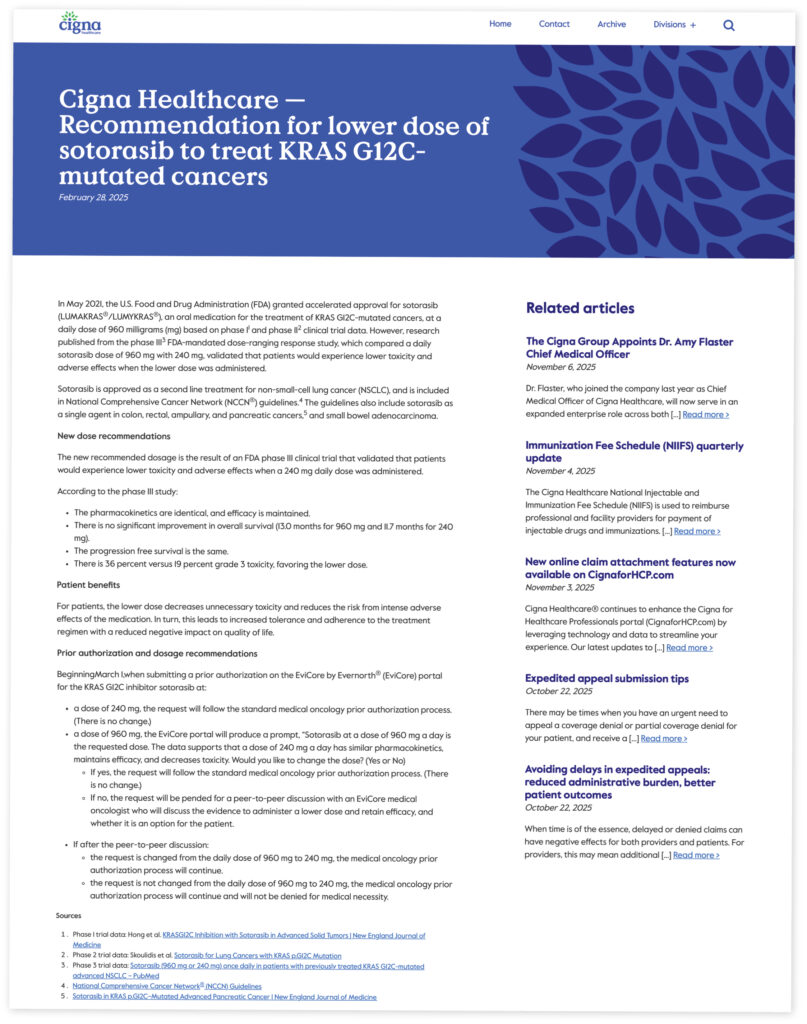
Private payers can use the same strategy to protect patients from excessive dosages. Of note, for sotorasib, a year ago Cigna announced that it believed the best evidence supported a dose of 240 mg daily, rather than the FDA-approved dose of 960 mg daily.
The press release states that physicians who wish to prescribe the higher dose would be required to go through Cigna’s peer-to-peer prior approval process, while the lower dose would go through Cigna’s standard prior approval process. Other payers should follow Cigna’s lead—for sotorasib and other drugs where there is strong evidence of excessive dosing.
By reducing excessive dosing, we will improve the quality of cancer care and reduce the risk and severity of side effects. That is our primary goal. However, reducing excessive dosing also has beneficial economic consequences for patients (who will have lower co-payments) and for the healthcare system as a whole.
The U.S. is struggling with the synergistic challenges of an aging population, rising national debt, and healthcare cost inflation.
Drug costs are one of the main drivers of the cost of cancer care, which are expected to exceed $25 trillion globally by 2050.
There are substantial opportunities to reduce these costs by avoiding prescribing of unnecessary and excessive dosages of effective drugs for the treatment of cancer.
In this context, we have organized a convening in March of this year, to be held at Georgetown Law School in Washington, DC on March 4-5. More information and registration is available online.
The meeting is entitled, “Novel Solutions to Address the Rising Cost of Oncology Drugs: Targeting the Demand Side.” At this meeting, we will focus on the distinction between “safe and effective” and “reasonable and necessary.”
The meeting will include a keynote lecture by Dr. Monica Bertagnolli, former director of NCI and NIH, and will include five panels focusing on the perspective of policymakers, government payers, private payers, physicians, and patients.
Our hope is that this convening will substantially advance the conversation about anticancer drug dosing, and the medical and financial benefits of administering the right drugs at the right dosage to every patient.