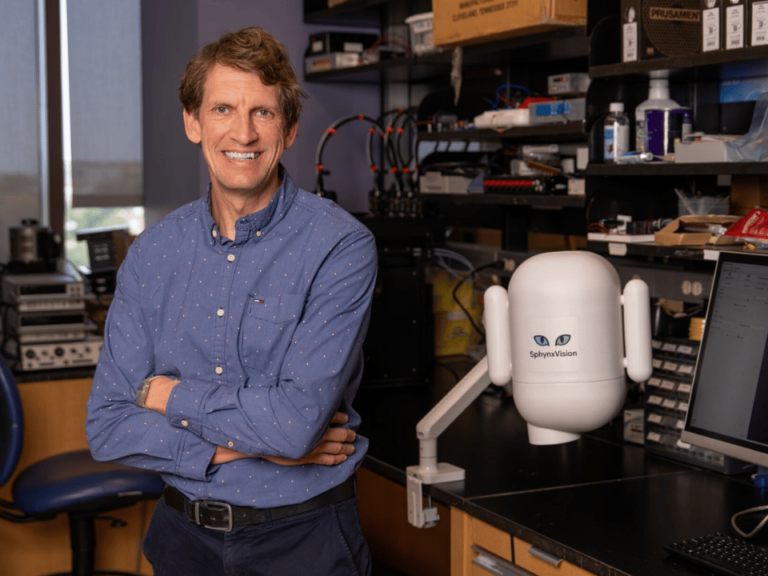
Imaging technique accurately detects ccRCC

Share on facebook
Share on twitter
Share on linkedin
Share on email
Share on print

A new study led by investigators from the UCLA Health Jonsson Comprehensive Cancer Center has demonstrated a new, non-invasive imaging technique can accurately detect clear-cell renal cell carcinoma, the most common form of kidney cancer.

To access this subscriber-only content please log in or subscribe.

If your institution has a site license, log in with IP-login or register for a sponsored account.*
*Not all site licenses are enrolled in sponsored accounts.

Login Subscribe
Table of Contents

YOU MAY BE INTERESTED IN

Mina Sedrak, director of the UCLA Center for Cancer and Aging and co-director of Cancer Control and Survivorship Research at the UCLA Health Jonsson Comprehensive Cancer Center, has received a five-year, $3.6 million grant from NIH to develop strategies to improve physical recovery and reduce frailty in older adults following hematopoietic cell transplantation, commonly known as a bone marrow or stem cell transplant.
Traditional pathological features used to classify aggressive prostate cancer—such as high-grade disease, cancer extending outside the prostate and cancer involving the seminal vesicles—after surgery do not predict who will benefit more from adding hormone therapy to postoperative radiation, according to a study led by investigators at the UCLA Health Jonsson Comprehensive Cancer Center. 
Cristina Puig-Saus, an associate professor of microbiology, immunology and molecular genetics and surgical oncology at the David Geffen School of Medicine at UCLA and an investigator at the UCLA Health Jonsson Comprehensive Cancer Center, and her research team have received a five-year, $3.9 million grant from NCI to develop drug-based strategies that could enhance cancer immunotherapy for patients with melanoma and potentially other types of cancer. 
Jason Chiang and Kyung Sung of the Department of Radiological Sciences at the David Geffen School of Medicine at UCLA and the UCLA Health Jonsson Comprehensive Cancer Center have received a $3.2 million, five-year grant from NCI to develop an artificial intelligence-enhanced imaging platform designed to improve yttrium-90 (Y90) radioembolization planning for patients with liver cancer.

Never miss an issue!

Get alerts for our award-winning coverage in your inbox.

Login