
Hait and Libutti in conversation; Rutgers Cancer Institute founder and its current director talk history

Share on facebook
Share on twitter
Share on linkedin
Share on email
Share on print
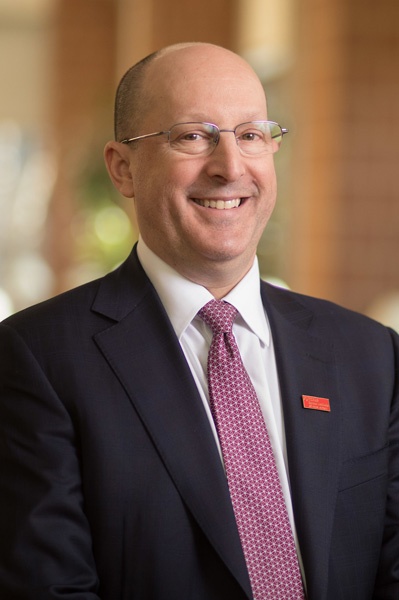
Steven K. Libutti, MD, FACS

Steven K. Libutti, MD, FACS

Director, Rutgers Cancer Institute of New Jersey
Senior vice president of oncology services, RWJBarnabas Health; Vice chancellor for cancer programs, Rutgers Biomedical and Health Sciences; Professor of surgery, Rutgers Robert Wood Johnson Medical School; Affiliated Distinguished Professor in Genetics, Rutgers School of Arts and Sciences.
William N. Hait, MD, PhD

William N. Hait, MD, PhD

Global Head, Johnson & Johnson External Innovation.

In 1993, when William Hait came to New Jersey to start work toward the NCI designation for Rutgers, the place had one office and three cubicles.

Four years later, in 1997, the Cancer Institute of New Jersey received the NCI Cancer Center designation, and on the next review cycle, in 2002, it received the Comprehensive Cancer Center designation.

The Cancer History Project invited Hait, the first director of Rutgers Cancer Institute of New Jersey to sit down for a conversation with Steven K. Libutti, the institution’s current director.

“That’s almost unprecedented today, to be able to achieve that, and so, that’s an amazing accomplishment,” Libutti said to Hait.

How did Hait get it done? 

“I was given some very sound advice from my colleagues at Yale. They said, ‘Your instinct will be to build the basic science programs first.’ They said, ‘Build the clinical programs first, because that’s what the center at first will be known for.’

“So, I tried my best to recruit outstanding clinical people, clinical researchers, master clinicians, people who could really be dedicated to giving incredibly high-level care to the people in New Jersey.”

Rutgers, now a part of a health system and a scientific consortium with Princeton University, recently started construction of a $750 million cancer hospital in collaboration with RWJBarnabas Health.


Table of Contents

YOU MAY BE INTERESTED IN

When our hematological malignancy testing pilot project began in Eldoret, Kenya, there seemed to be a mismatch in relation to progress in healthcare. The region, like much of sub-Saharan Africa, had been focusing on combatting infectious diseases such as HIV and malaria—which was much-needed—yet cancer care was under-resourced. 
Artificial intelligence is rapidly transforming biomedical research and healthcare. Large language models, foundation models, and AI agents are increasingly being deployed to assist with data interpretation, literature review, clinical decision support, and translational research. 
In modern oncology, important insights from clinical trials often emerge years after initial publication. As new therapies extend survival and transition more patients into long-term remissions, clinicians and researchers are increasingly looking beyond initial response rates to understand durability, long-term safety, and even the possibility of a cure. 

Never miss an issue!

Get alerts for our award-winning coverage in your inbox.

Login