Cancer research increasingly demands environments that mirror the biology it seeks to understand: Complex, adaptive and deeply interconnected. At Sylvester Comprehensive Cancer Center, part of the University of Miami Miller School of Medicine, collaboration is not treated as an optional cultural trait but as a structural requirement.
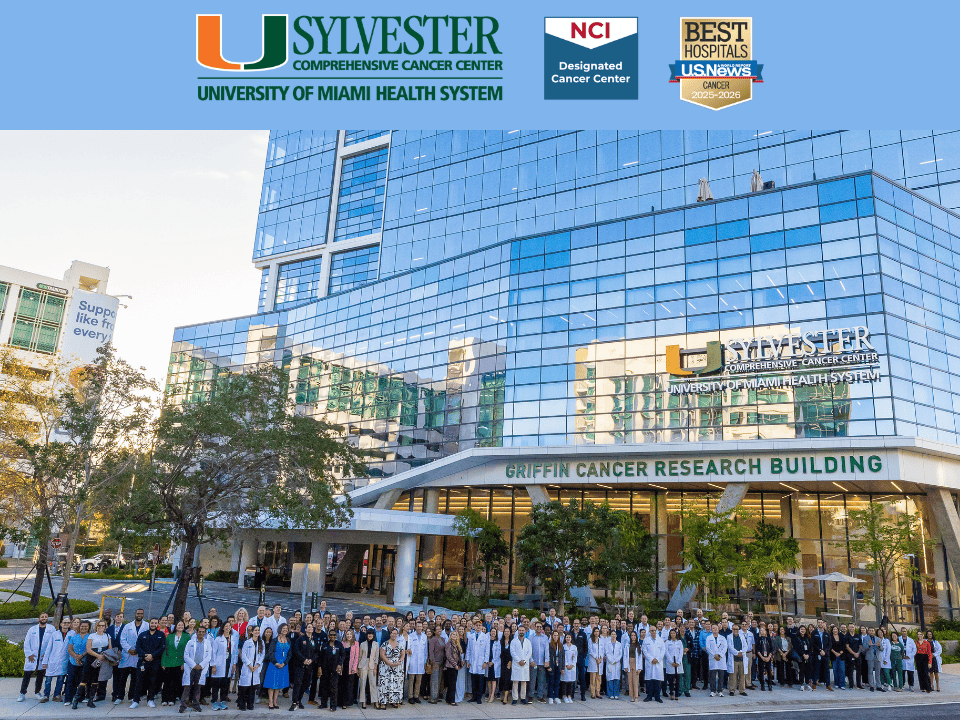
Collaboration is designed into the physical and scientific framework of Sylvester’s new 12-story Kenneth C. Griffin Cancer Research Building—a vision that started in 2018.
The 244,000-square-foot building has doubled Sylvester’s research space. It opened in fall 2025, organizing investigators into scientific neighborhoods, clustering laboratories by shared research themes rather than by department.
Three of the center’s cross-cutting themes were represented in the first phase: metabolism and cancer; infection and cancer; and cancer risk and outcomes. This model intentionally compresses the distance between basic discovery, translational validation, and clinical application. By design, oncologists, molecular biologists, population scientists, and computational researchers across career stages work in proximity, enabling continuous, bidirectional exchange across the translational spectrum.
The impact is practical as well as philosophical. Traditional siloed models often introduce latency—weeks or months between hypothesis generation, methodological input, and downstream application. In contrast, neighborhood-based research ecosystems function more like integrated circuits than linear pipelines, allowing rapid iteration and course correction as data evolves. The Griffin Cancer Research Building’s floors feature many of these scientific neighborhood teams.
“High-risk, aggressive cancers don’t give you the luxury of sequential thinking,” said Matthew Schlumbrecht, MD, MPH, physician-scientist and co-lead of Sylvester’s Gynecologic Oncology Site Disease Group. “For diseases with complex biology, you need molecular insights, clinical context, and trial design informing each other continuously. Physical proximity makes that integration routine rather than exceptional.”
That integration is central to accelerating translational cancer research. When laboratory discovery, clinical observation, and trial infrastructure coexist, research questions tend to sharpen earlier—and fail faster (when they should). The result is not simply speed, but precision.
For David Lombard, MD, PhD, co-leader of the Cancer Epigenetics Research Program at Sylvester, the Griffin Cancer Research Building creates an environment where discovery is accelerated through constant scientific exchange.
High-risk, aggressive cancers don’t give you the luxury of sequential thinking. For diseases with complex biology, you need molecular insights, clinical context and trial design informing each other continuously. Physical proximity makes that integration routine rather than exceptional.
Matthew Schlumbrecht
“Science advances fastest when you’re surrounded by people asking different questions but working toward the same goal,” Lombard said. “Conversations that might have taken months to happen occur organically—in the hallway, over coffee, after a seminar—and those moments often spark the ideas and new collaborations that move cancer research forward, to generate new cures.”
Importantly, the collaborative architecture extends beyond tumor biology, cancer epigenetics, and translational oncology to include population science, prevention, and outcomes research. This integration reflects a growing recognition that cancer progression and response are shaped as much by behavioral, environmental, and social determinants as by molecular drivers.
Patricia Moreno, PhD, a behavioral and population scientist and licensed clinical psychologist, said that embedding population research alongside laboratory and clinical teams is essential for translational relevance.
“When population scientists are part of the same research ecosystem, discoveries are more likely to translate into interventions that are scalable and responsive to real-world conditions,” Moreno said. “It closes the gap between mechanistic insight and population-level impact.”
The Griffin Cancer Research Building effectively serves as a proof of concept for team science at scale. By dissolving disciplinary boundaries and engineering intentional proximity, Sylvester has created a research environment that evolves alongside the science itself—one in which collaboration is not a downstream outcome but a primary design principle.
For cancer centers navigating the next era of discovery, the message is increasingly clear: Scientific excellence is no longer defined solely by individual expertise, but by the systems that allow expertise to converge, collide, and compound—turning collective intelligence into measurable translational gains.