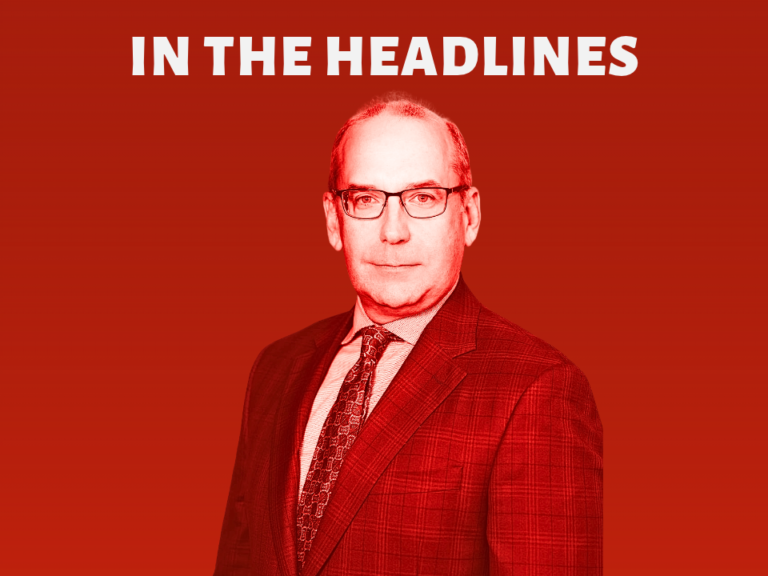
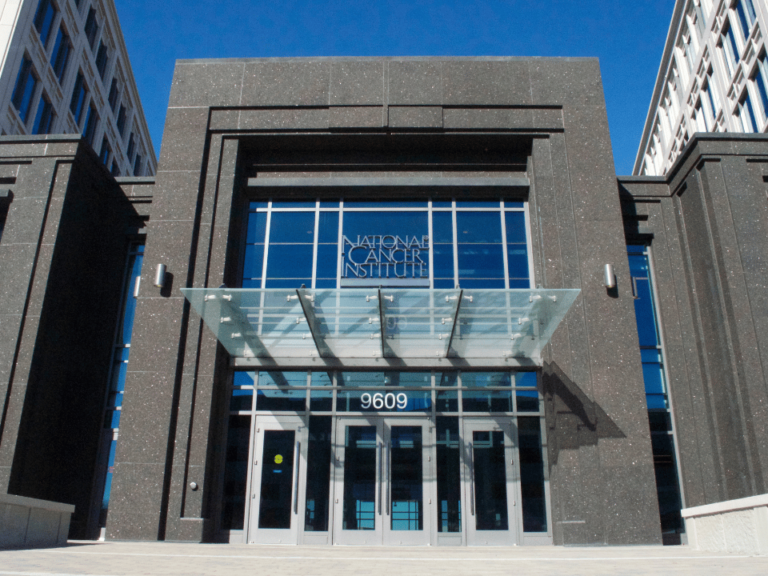
The Cancer Letter’s most recent cover story featured an in-depth Q&A with Anthony G Letai, director of the National Cancer Institute.
This episode is available on Spotify, Apple Podcasts, and Youtube.
In this week’s episode of The Cancer Letter Podcast, Paul Goldberg, editor and publisher of The Cancer Letter, and Jacquelyn Cobb, associate editor, shared the behind-the-scenes editorial decisionmaking behind the story.
“It might almost read a little bit of a boring story,” Jacquelyn said. “It’s not, but it’s very repetitive, it’s very in line with what he has been saying, and that is the point. That is the point—this repetition is what he’s trying for and what NCI is trying for and what the national cancer enterprise arguably needs, according to Letai, at this time.”
In this episode, listeners can hear an excerpt from The Cancer Letter’s interview with Letai. The full conversation is available as a video.
One major lingering concern from the oncology community is about the status of granted money getting out of NCI and to grantees.
“Really, I want to make it clear there are no real major speed bumps or impediments in our way to getting these grants out the door,” Letai said. “The major impediment really was the government shutdown. And I think it’s a credit to the NCI staff who’ve been doing an excellent job, given the many changes that have come their way, to keep business as usual, keep the grant money flowing out to the extramural programs. As is typical, as is usual, roughly 75% of the entire NCI budget is going to the extramural program, and Fiscal Year 2026 is going to follow exactly that pattern.”
According to the latest numbers NCI provided to The Cancer Letter, on March 17, 22 competing grants were awarded by the institute. By April 9, 167 grants were awarded.
This amounts to about 200 competing grants awarded per month or about 50 per week, though this is just a very small sample size, as NCI did not receive many competing awards to pay until late February, an NCI institute official said. The plan is for that pace to pick up significantly.
Additionally, 1,514 non-competing awards have been paid since mid-November 2025.
“It’s nice to remind people that there is an actual scientist at NCI, not a blogger like us. Not a podcaster, like us,” Paul said. “Who actually has a scientific vision, which is fantastic to have, and who is more like the past NCI directors than not. And if you’ve heard him say something that’s vaguely reassuring, it’s nice to have him repeat it because that way you know that you heard it correctly the first time.
“He’s got enormous influence in his job. And part of the influence is to be essentially the unlicensed psychiatrist and chief. That’s what is needed.
“Actually, that doesn’t make him any different from any other NCI director that we’ve ever known. Some have been better psychiatrists than others. But all have been unlicensed.”
This episode is sponsored by Johns Hopkins Kimmel Cancer Center. Learn more at hopkinscancer.org/#ai
Other stories mentioned in this podcast include:
- Letai: Perceptions aside, money is flowing and the cancer research infrastructure is sturdy NCI expects record-breaking spending on extramural research
- America needs a new blueprint for the National Cancer Program First step: Develop Version 2.0 of Paul Calabresi’s “Cancer at a Crossroads”
- California state-funded institute scraps selection process that put cancer projects at a disadvantage
- Protecting the cure: Why the future of radiation oncology must be precision-guided
This episode was transcribed using AI transcription services. It has been reviewed by our editorial staff, but the transcript may be imperfect.
The following is a transcript of this week’s In the Headlines, a weekly series on The Cancer Letter podcast:
Jacquelyn Cobb: This week on The Cancer Letter Podcast…
Paul Goldberg: It’s nice to remind people that there is an actual scientist at NCI, not a blogger like us. Not a podcaster…
Jacquelyn Cobb: Podcaster, yeah.
Paul Goldberg: … like us. Who actually has a scientific vision, which is fantastic to have.
Jacquelyn Cobb: Fantastic vision too. Gets me so excited.
Paul Goldberg: Yeah. And who is more like the past NCI directors than not. And if you’ve heard him say something that’s vaguely reassuring, it’s nice to have him repeat it because that way you know that you heard it correctly the first time.
You are listening to The Cancer Letter Podcast. The Cancer Letter is a weekly independent magazine covering oncology since 1973. I’m your host, Paul Goldberg, editor and publisher of The Cancer Letter.
Jacquelyn Cobb: And I’m your host, Jacquelyn Cobb, associate editor of The Cancer Letter. We’ll be bringing you the latest stories, groundbreaking research and critical conversations shaping oncology.
Paul Goldberg: So, let’s get going.
Jacquelyn Cobb: Good morning, Paul.
Paul Goldberg: Good morning, Jacquelyn. How are you?
Jacquelyn Cobb: Good.
Paul Goldberg: Well, look at that.
Jacquelyn Cobb: Yes, I was waiting.
Paul Goldberg: And they’re available on our merch, blah, blah.
Jacquelyn Cobb: Our merch website. I don’t even… they’re available on our regular website.
Paul Goldberg: The merch section of the website.
Jacquelyn Cobb: Yes.
Paul Goldberg: We should start making golf shirts.
Jacquelyn Cobb: Ooh, like polos?
Paul Goldberg: Polo shirts, golf shirts. I don’t know.
Jacquelyn Cobb: For those of you who can’t see the screen, we have our Cancer Letter mugs, because this will be really confusing if you can’t see what we’re talking about.
Paul Goldberg: Right. What in the world are these two people talking about? But that’s common in podcasting.
Jacquelyn Cobb: Apparently. Yeah, that is true, a lot of visual elements get missed.
Paul Goldberg: Right.
Jacquelyn Cobb: Well, I was going to wait until later, but this is a beautiful segue, Paul, to podcasting in general because, as our lovely producer, Imani, reminded us right before we started counting down here, Paul has not had a chance to wax poetic about our Webby nomination. So before we dive in, I would love to give you the floor, Paul.
Paul Goldberg: Yeah. I’m just totally delighted to see this, because we just basically started the podcast because everybody else had one or… I don’t know why we started the podcast, because we should have. It’s how people learn, how people take their information. Plus, I always thought that you can discuss kind of the newsroom banter is something that has gone virtual. I mean, I kind of missed the days in the newsroom where people sat around and smoked. I didn’t, but I passively smoked. And talked about, “Oh, yeah, remember when”… That kind of stuff. I miss that terribly. And I think it’s gone to podcasting to some extent, where people drink their coffee and talk about the day when God knows what happened.
Jacquelyn Cobb: Yeah. Literally, it’s the same type of energy. I love that. That’s a good point. And even I think about when I’m cooking breakfast and Kevin’s at work or whatever, I put on a podcast and I feel like that is actually what probably would’ve been happening in the office a lot of the times, if you got there and you were making your coffee and stuff like that. There you go, Paul.
Paul Goldberg: Yeah. What’s really interesting also is that it edges into commentary, when it actually sometimes is not. But maybe it is, I don’t know. It’s not just what happened, but it’s also how you think of it. And just by bringing that out, it becomes a, by definition, a news analysis. And I will give $20 to the first person who explains to me what is the difference between commentary and news analysis.
Jacquelyn Cobb: Is there a difference? This is my lack of journal [inaudible 00:03:02].
Paul Goldberg: I don’t either. I don’t know. If you look at the rubrics, we have the slide-
Jacquelyn Cobb: Oh, we have a separate commentary, huh?
Paul Goldberg: I know. I know.
Jacquelyn Cobb: I don’t think I’ve ever really… Have I ever used it? I don’t know if I have.
Paul Goldberg: Oh, you’ve written them or I’ve [inaudible 00:03:17] some of what you’ve written. So when you opine.
Jacquelyn Cobb: [inaudible 00:03:20]. When you opine, yeah. That’s how I always think of news analysis, because I’m thinking even about Claire’s dietary guideline story was a news analysis. Now I’m like, should it have been a commentary?
Paul Goldberg: Good question. One never knows the right answer.
Jacquelyn Cobb: Yeah, it’s exactly [inaudible 00:03:41].
Paul Goldberg: Which is why I’m putting up this princely sum of $20.
Jacquelyn Cobb: Sounds good. Tomorrow is the last day to vote for the Webbies. And so we’re up there. Please submit your vote. And I think I said this last week, but please make sure to validate your vote in your email. It seems like a small bureaucratic thing, but your vote doesn’t count without it. So yeah, our last pitch.
Paul Goldberg: Yeah. Which is, it’s still the most important thing is that we were nominated. I was just amazed to be nominated, as I’ve said before. But the final step is people voting for the nominees. And there we’ve got a bit of a problem because some of our competing entries in this category are big players like PBS, and they can get a lot more votes than we can. Even with a much larger Cancer Letter than anybody imagines. I mean, our readership is between 150,000 and 200,000 unique users per month, but that’s still bupkis, as we say in French, compared to NPR and PBS and all these other people that compete with us.
Jacquelyn Cobb: Which is honestly, I feel like speaks to why we are so amazed and happy and enthusiastic. And sort of the conversation around this nomination for us specifically is for Ologies, to me, Ologies is like The Office or something. It’s celebrity level. And so just to be next to them, I feel like has been really exciting. And also just it’s inspired some ambition in me. It’s like this first year we are up against them, and let’s up our game, let’s get out there, let’s do it, and come back next year for a win or something. I don’t know. I’m revved up.
Paul Goldberg: Oh, we are definitely doing pretty well with podcasting. Kind of surprising, but-
Jacquelyn Cobb: Exactly.
Paul Goldberg: … doing as well as we are. Well, you’re just learning. Well, turns out we just did it.
Jacquelyn Cobb: Yeah. I mean, it’s so many transferable skills, too, from journalism. And we have such a rich, rich, rich network of sources, I feel like, is such a huge part of it. And that’s, I think, what comes across in the podcast too, is we have such an in-depth, unique, niche topic coverage area.
Paul Goldberg: So vote for us.
Jacquelyn Cobb: Yes. To wrap that all up. Yes, please vote for us. And the link is in the description. And yes, my last final reminder, check your email, validate the vote.
Paul Goldberg: And then there’s, I was just actually thinking out loud about this, what we probably ought to do, and it’s inevitable that we will, is start the kind of podcasting that is more of a kind of a long-form storytelling podcasting, like tell the story of that only we remember. We are, kind of weirdly, the institutional memory of academic oncology, and with it, really a lot of oncology, so all pieces of it. And we’ve all covered some stories that really need to be told and told and told again.
Jacquelyn Cobb: Yeah, absolutely. It’s so funny you say that, Paul. It must have been my first year at the Cancer Letter, because I was in DC and I was at a conference, and someone from NCI Communications came over to me and they were like, “Your coverage, the Cancer Letter’s coverage of PRAGMATICA”… You remember PRAGMATICA-LUNG?
Paul Goldberg: Yeah.
Jacquelyn Cobb: “We at the NCI used your coverage as primary sources, because it was so hard to cover.” And we were able to do it because we talked to everybody and we got an understanding of what was actually happening. And so it’s funny you say that, because I definitely… And again, don’t know for sure because this is my only journalism job, but it seems to me that that’s very unique in journalism where we’re sort of this… And actually you just reminded me of what I was going to say earlier about the origin of the Cancer Letter podcast, is that we did have a podcast before last year, but it was the Cancer History Project podcast. And it was rooted, exactly like you’re saying, in sort of this historical documenting of this field that is so interesting and so niche and that nobody else is going to do. And so it’s kind of beautiful and organic that it’s come out of that, and now it might return in some more produced way potentially, but we’ll see. We’re talking too much.
Paul Goldberg: Yeah. I think actually we’ve done this… I’ve done grand rounds at a bunch of places over with some of my stories, and I think that that kind of a thing where a reporter walks through a story longitudinally is worth doing, and that’s not only through Cancer History Project.
Jacquelyn Cobb: Yeah, absolutely. As it’s happening now.
Paul Goldberg: Yeah. And in fact, as we go to the next part of this podcast and I stop rambling, if I stop rambling, we will talk about the Calabrese report, which is a perfect example of the kind of story that needs to be told [inaudible 00:09:30] because it’s so relevant.
[ADVERTISEMENT]: Managing and interpreting the billions of data points generated by genome sequencing and other cancer research has been a barrier to progress against cancer. But today, it’s part of the solution as more than 50 years of advances in computer processing power intersects with more than 50 years of cancer research. Learn more about Johns Hopkins Kimmel Cancer Center’s AI initiatives and how they’re helping physicians see cancer sooner and drive outcomes with unmatched speed and clarity at http://hopkinscancer.org/#ai
Jacquelyn Cobb: Yes. Okay. So we have a whole section dedicated to this, as you said. So, let me go do my job of going through the headlines, but I’ll be pretty brief because… Well, you’ll see why. So the cover last week was a conversation with the Cancer Letter, one of our classics, but it was with Anthony Letai, the director of the National Cancer Institute. Really cool story. We’re going to talk about that in a little bit more depth and you’ll be able to hear directly from that interview as well in this podcast. But the overall gist is that it might almost read a little bit of a boring story. It’s not, but it’s very repetitive, it’s very in line with what he has been saying, and that is the point. That is the point is this repetition is what he’s trying for and what NCI is trying for and what the National Cancer Enterprise arguably needs according to Letai at this time. So we’ll dive into that.
Our story two was a guest editorial by Robert A. Wynn. I’m just going to honestly pause and just let Paul talk about that, because I feel like I’m going to butcher it, and Paul gives me chills every time he talks about it. So I’m just going to pause and let him do that.
Paul Goldberg: Yeah. Rob Wynn gave grand rounds at Yale. And I was invited as well to Paul Calabrese. It was actually a Paul Calabrese lecture, and I was invited to just be there. And I came, of course. Because I knew Paul Calabrese, I knew his family, and we haven’t been in touch in a long time, so it was really kind of lovely to just say, “Well, I’ll be in New York anyway, so why not just keep going to Yale and see it?” And also Roy Herbst is about to go off to the wilds of New Hampshire to a place called Dartmouth.
Jacquelyn Cobb: Does Dartmouth really count as the wilds of New Hampshire? I’m not sure.
Paul Goldberg: No. So I just thought, “Heck, that sounds really wonderful.” And it really turned out to be. But the part that was also really interesting is this report. As I was talking to Rob before we met up in New Haven, I happened to have a copy of this report and there’s this picture of Rob holding up the report. But I mean, what’s so cool about it is that this is a report by an NCAB subcommittee chaired by Paul Calabrese, then of Brown University Cancer Center. It’s called Cancer at a Crossroads, and cancer is always at a crossroads, I mean, face it. But it gives out kind of a blueprint about how to sustain a vision for cancer research, and sustaining a vision is really important, especially today. But I could have said that last year as well, or two years ago, five years ago. It doesn’t really matter. But sustaining that vision is always an important thing and it’s also what needs to happen.
And I’ve been talking about this to France, including Dr. Wynn, about, well, we really need to come up with a people’s agenda, a public agenda for cancer research. It should, of course, incorporate rigorous science and built on it, but demand it. And that is not happening yet. If anybody can lead this, it’s raw. And really, between him, Odis Brawley and me and a few others, we’ve all kind of understand that this needs to happen. We all understand that part. But it’s one thing to understand that, it’s another thing to lead it. And I think everybody there is willing to jump in and roll up the sleeves and figure out what the next step is.
My vision on this thing is completely anachronistic. Has nothing to do with oncology, zero. It’s about the human rights monitoring and in the Eastern block a long time ago. So when members of the public go up and say, “Hey, let’s live up by certain rules,” or, “Let’s establish certain rules and let’s monitor what’s actually happening,” you present this level of moral authority that changes the world. And that’s literally the subject of my first book and my second book, that have nothing to do with oncology again.
But what I’m thinking is that we need … And Rob totally buys into that as somebody has to set up a Calabrese-like commission, except not a part of NCAB, not a part of anything. Now, this predates the doubling of the NCI budget, the NIH budget.
Jacquelyn Cobb: Wow.
Paul Goldberg: And that is the blueprint that was used to double it. And then things got a little out of hand and kind of the loss of vision occurred and some ambitions came into play. It’s a long conversation, similar to one that we should probably do a piece about, because I covered that from the beginning and throughout, including that loss of focus and some very, very nasty stuff that occurred as a result. But what we need to do is have it not subverted, have it actually move forward and be a public vision. And so that’s my spiel for this.
And I’m just delighted that Rob essentially issued this challenge and said, “Let’s do it.” He is the right person to lead it. And if I’m allowed to be a part of it, I’ll be a part of it. It just means I’d get recused from covering it.
Jacquelyn Cobb: Yeah.
Paul Goldberg: Again.
Jacquelyn Cobb: Which is definitely worth it. Especially reading this story was so… It’s just a beautiful story outside of everything that you just said. It’s just, it’s moving. And I think what got me, again, I don’t have sort of this contextual background as much, but what got to me was just, I might butcher it, but basically Wynn talks about what Paul said in that report that you just held up, 32 years ago. And I mean, I don’t want to read the whole thing because it’s a little long, but it’s basically six major issues that will prevent our ability to “prevail” in our war on cancer.
And the six issues are, it literally reads like it was written today. Literally. And just to give you a sneak peek, because again, I’m not going to read all of them, but current healthcare reform proposals are devastating to the war on cancer by denying resources for research in quality cancer care. That’s number one.
Paul Goldberg: Yeah. But he’s talking about the Clinton health reform.
Jacquelyn Cobb: I mean, I know it’s not the same, but it’s like we literally wrote a story about the president’s budget proposal last week. It’s just so weird. It’s such a weird… Oh, God, yeah. So I’m at risk of sort of just ending up reading the whole thing, so I’m not going to. But definitely going to [inaudible 00:18:06].
Paul Goldberg: If you ever or anybody else who might be listening, if you ever want to read it, we have it. And I went out and had it scanned in. It’s a government document, it’s not copyright protected, and we have published it. I think what we need to do is roll it out one more time with a new forward with precisely that. And in fact, someone that’s writing it, that someone being Odis Brawley, who’s the co-editor of the Cancer History Project, so he is going to write a new forward precisely on this.
Jacquelyn Cobb: This is great news to me as editor of The Cancer Letter. I’m very excited to hear this.
Paul Goldberg: Yeah. I just-
Jacquelyn Cobb: It’s an editorial meeting.
Paul Goldberg: Yeah, we just had an editorial meeting. Which just goes back to what we were talking about-
Jacquelyn Cobb: It’s all there.
Paul Goldberg: About the newsroom blather.
Jacquelyn Cobb: Yes, exactly.
Paul Goldberg: And coffee.
Jacquelyn Cobb: Exactly.
Paul Goldberg: No cigarettes.
Jacquelyn Cobb: No cigarettes, not anymore. Especially… we can’t do that at an oncology trade publication.
Paul Goldberg: No.
Jacquelyn Cobb: Yeah. Okay. So again, just please go read that story. Incredible. Gives me chills every time. And then yeah, a little bit of a winding podcast today, but I’ll just wrap up going through the headlines. We had a really cool story. And honestly, Paul, if you want to touch on this, this has also sort of originated with you and Sarah, but a California state funded institute called the California Institute for Regenerative Medicine. They’re in charge of billions of dollars in research funding every year in California. And they, a few years ago, had a bureaucratic process change basically happen, or they chose to do that because of a wild increase in the volume of applications. But in doing so, they inadvertently were excluding cancer research projects sort of at this preliminary, again, exclusion stage. They weren’t even really getting reviewed.
So now the news in last week’s issue is about that sort of history and the fact that they scrapped that selection process that was putting cancer projects at a disadvantage. And cancer researchers are now sort of reapplying to this program that is, again, a pretty big chunk of cancer research funding.
And then finally, there was a pretty… I love this editorial. I thought it was really interesting. It’s a little niche, even within our niche coverage, but it was about proton beam therapy, radiation therapy. Again, I have a little bit of an understanding of oncology and treatment and stuff from my brief education with this, but I never understood radiation therapy. I never got really any sort of exposure to that. So this is always new to me and interesting.
But basically the gist is that the proton therapy doesn’t have to exit the body, it can stop before it goes all the way through, which is just hugely helpful for other organs in the body. And it’s also more precise. But if you have a beam of radiation going into your body, it saves heart muscles, it spares lifesaving organs. And as people are living longer with cancer, not doing damage to your heart when you’re maybe in your younger years is definitely important as people are aging and surviving with cancer. So, very interesting story.
Also, a really, really dense brief section last week, just as a heads-up. So, if you’re perusing the issue, definitely pay attention to that as well. So, what were you going to say, Paul?
Paul Goldberg: Yeah, no, it’s the California story. What’s really interesting with that is it began as a guest editorial, because Steven Foreman of City of Hope suggested that we cover it. And I said, “Would you like to do that as a guest editorial, because you’re affected by this and your opinion matters?” And then he did, and that kind of got the story on our radar. And then we followed up, Sarah followed up on it as a reported story, and called everybody and got everybody to explain to her what’s actually going on. And as a result, we have essentially something that begins as a guest editorial and then ends up being essentially a reported piece. So it’s kind of, since that’s our late motif, it’s going from opinion to reportage and back.
Jacquelyn Cobb: And back. I was wondering if you’re going to go there. Yes, back and here we are. That story was really interesting. I’m glad that we got that reported piece because some of the quotes were really, really strong. I feel like they… Even as I said that out loud, I was like, “Wow, it sounds a little bureaucratic. It sounds a little”… But hearing from the people that it’s affecting, I feel like definitely humanized it and was really like, oh, yeah, this is… It grounded in reality a little bit for me because it’s… Yeah.
Paul Goldberg: All of that plus you have essentially two leading state agencies that fund cancer research. One of them is secret in Texas and the other is this California regenerative thing. And it’s important to see, to learn from mistakes of these places, and learn how other states could do it better or how they can do it better. So it’s really a huge story. And CPRIT has always been a huge story for us.
Jacquelyn Cobb: Yeah, absolutely. I mean, especially right now, considering that… I mean, we don’t want to say that federal funding is uncertain. That’s really not necessarily fair anymore. But we are still, I think, raw from last year. And the narratives and the uncertainty and the turbulence surrounding sort of federal funding, I feel like it’s always been, like you’re saying, that CPRIT and state funding models have been an important alternative or an important augment to federal funding. But yeah, importance is just sort of narrow in on that occasionally.
Paul Goldberg: Yeah. And it’s always very difficult to peer review these things, and that’s where it’s especially useful to find out. In this case, they were really dealing with a prescreen.
Jacquelyn Cobb: Yeah. Literally, it’s called a preference. Yeah, go ahead.
Paul Goldberg: Because they have a limited number of reviewers. They’re limited to a dozen. So how do you do all this? So peer review is a problem. And CPRIT solved it in a very different way.
Jacquelyn Cobb: How did they solve it? I don’t know.
Paul Goldberg: This was put together by Al Gilman, the whole sort of system of peer review, where he used reviewers from other states. Texans do not take part in it.
Jacquelyn Cobb: Wow. Interesting.
Paul Goldberg: It’s huge too. It’s just huge.
Jacquelyn Cobb: Is the 12 limit in California… This is now me just being curious, but is the 12 person limit in California for… I guess where is the root of that? Why is that?
Paul Goldberg: I’ve read it in the story. I didn’t know why. I edited the story. But I think it is an interesting story if indeed any state wants to move forward with something similar. And I think we did a story about that. Tennessee was thinking about setting its own CPRIT, which would be… They wouldn’t even have to change the acronym.
Jacquelyn Cobb: Perfect.
Paul Goldberg: But I don’t think that’s viable. But if it is, I’d love to hear from somebody who will tell me it’s viable.
Jacquelyn Cobb: Absolutely.
Paul Goldberg: So please, my email address is…
Jacquelyn Cobb: It’s on the website.
Paul Goldberg: Please let us know where it is now. But it would be very interesting to see states get into it and also to see states implement really good peer review, because everything is as good as the peer review.
Jacquelyn Cobb: 100%. Yeah.
Paul Goldberg: It’s the definition. Otherwise, you’re just burning money and giving money to friends.
Jacquelyn Cobb: Yeah. That’s why no Texans do it, it’s like trying to avoid conflicts of interest?
Paul Goldberg: Yeah, like across state rivalries and God knows. But yeah, it was brilliantly put together by Gilman and then it misfired a few times, and that’s where we came in.
Jacquelyn Cobb: [inaudible 00:27:14].
Paul Goldberg: So that was a while ago. It’s not misfiring now.
Jacquelyn Cobb: Yeah. I love covering CPRIT. It’s been quite straightforward for me and generally quite positive. So before my time, I misfired.
Paul Goldberg: Yeah. No, it’s a ton of money.
Jacquelyn Cobb: Yeah, absolutely. Very important. Okay. Well, kind of a unconventional episode today, but I finished going through the headlines and we’ve kind of paused and gone through all of the stories. Wait, oh, my God.
Paul Goldberg: You forgot the main thing. This is like Passover at my house, we get to the main point 40 minutes late and talking over each other.
Jacquelyn Cobb: Okay. You go. It’s your main story. I did the original sort of the overview, but please share what you’d like to about Letai.
Paul Goldberg: Yeah. So we caught up with Tony Letai on his six-month anniversary almost at the time, now it’s a little past that, at NCI. So now he knows where the water fountains are, he knows, as he put it, where the functioning toilets are, and it’s all really good. And we really talked mostly about what he has learned in the past six months, what his scientific vision is, and that is a really worthwhile thing to listen.
But also a lot of it was repetitive, but actually don’t knock repetitive. When everybody is really panicking, which this field was as recently as six, seven, eight months ago, and every now and then there’s another panic attack, including even now really, it’s nice to hear a reassuring voice that there’s actually a scientist who’s in charge in those places.
Jacquelyn Cobb: Well, it’s also nice that it’s a reassuring voice from someone who is in a leadership position.
He gets it and he’s got it.
Paul Goldberg: He’s got it. He’s got it. We talked about this a little bit after the president’s budget request came out, and the president’s budget request gives NCI $9 million more. It’s a really interesting table. Everybody gets a cut. Some people get cut out of existence, some institutes and centers. And NCI gets a plus 9 million, which is budget dust, but still plus 9 million is-
Jacquelyn Cobb: It’s not a cut.
Paul Goldberg: It’s not a cut.
Jacquelyn Cobb: It’s like a weird signal of, “You’re good.”
Paul Goldberg: Yeah. And again, the president’s budget request is just that—a request. The budgets have been put together by congress, and by way of comparison last year, NIH got a 40% cut in the president’s budget request. And all of the vision that pretty much was congress went the other way. No, thank you very… So NCI is probably doing a little bit better than others. And it’s also very interesting to see how you can have… We were talking about the doubling. The doubling of an age budget occurred after the Calabrese report. And it was really focused on NCI. But NIH director, Harold Varmas, convinced congress and others, and others did too, other groups, that you really need to… You can’t just focus on NCI. All ships should rise at the same time. Which is an interesting idea because in the world of science that exists now, the genomic world, it’s very hard to earmark, because intellectually that’s a difficult thing to do. Where does one disease begin and the other end? So this is an interesting underlying principle, but here, they seem to be doing that, which is-
Jacquelyn Cobb: [inaudible 00:32:04] scribbling that down. I thought that was a really cool point.
Paul Goldberg: Yeah. It’s a strange point, but it’s an interesting point. And I think it’s going to be a point that we will be revisiting.
Jacquelyn Cobb: Yeah. I really feel that’s a multi… I’m not going to go… This is just my sort of I could go off on a tangent about this, but I definitely think that that’s a multidisciplinary… I think many fields are sort of facing that same, what is boundary? Are our boundaries that we drew correct? And how do we create improved outcomes and do what our goals are, while considering that maybe we got to refine a little bit as science improves? So I really love that topic.
Paul Goldberg: Yeah. But there’s also a couple of bombs in there in the president’s budget request. There’s the 15% indirect costs cap, which would put a lot of people out of business. But congress has to act on it. And if last budget is an indication, they will say no again. And then there’s also this multi-year funding, which they’re supposed to go to 100% multi-year funding under that request. But again-
Jacquelyn Cobb: Well, that’s a weird one because Congress has… Oh, I guess, no, I’m mixing up the years, my bad. Because fiscal year 26, NIH, or is it just NCI, I think NIH has a cap on what percentage of projects that they can do with full forward funding. And I mean, I’m sort of just going based on what I’ve heard. This isn’t necessarily a… Anyway. I get the sense that Letai and NCI are preparing for this transition to completely multi-year [sic] funding. And as he said to NCAB members in the past, that the issue with forward funding is the transition. So they’re doing their best to sort of prepare for that if that is what congress wants or if congress supports what the administration is asking for. Because that one’s a little dicier. The cap on indirect cost feels like congress is just like, nah, that’s just not… But the forward funding… I mean, again, if we’re going based on last year, but forward funding is a little bit more uncertain.
And even Letai said again to the NCAB members a little while ago, that that’s still up in the air from OMB.
Paul Goldberg: Well, going back to sort of the reason for this, it’s not because of his six months at NCI, although that didn’t hurt, but really I wanted to catch up with him before ASCO and ACR meetings. He’s going off to ACR now, I guess.
Jacquelyn Cobb: Yeah, probably on the plane.
Paul Goldberg: I don’t know. But he’s going off. And it’s nice to remind people that there is an actual scientist at NCI, not a blogger like us. Not a podcaster…
Jacquelyn Cobb: Podcaster, yeah.
Paul Goldberg: … like us. Who actually has a scientific vision, which is fantastic to have.
Jacquelyn Cobb: Fantastic vision too. Gets me so excited.
Paul Goldberg: Yeah. And who is more like the past NCI directors than not. And if you’ve heard him say something that’s vaguely reassuring, it’s nice to have him repeat it because that way you know that you heard it correctly the first time.
Jacquelyn Cobb: Yep.
Paul Goldberg: Yeah. So, he’s really all about the science of the thing. And he’s got a job to do, so he can’t say, I like this and not that. There’s Congress for some of these things and there’s the president. But he’s got enormous influence in his job. And part of the influence is to be essentially the unlicensed psychiatrist and chief.
Jacquelyn Cobb: That’s true. I’m laughing, but that’s really quite true. It literally is.
Paul Goldberg: That’s what’s needed, yeah.
Jacquelyn Cobb: Yeah.
Paul Goldberg: Actually that doesn’t make him any different from any other NCI director that we’ve ever known. Some have been better psychiatrists than others. But all have been unlicensed.
Jacquelyn Cobb: Yeah, that’s going to be the huge milestone is when NCI actually is a psychiatrist as a literal doctor of psychiatry.
Paul Goldberg: Wrong institute, but they’re just…
Jacquelyn Cobb: It’s not needed, yeah. And here’s a snippet from the interview with Letai, so listeners can just hear it directly from him.
Anthony Letai: First, with regard to non-competing grants, that is grants that are in their later years of funding, we’ve paid out, I would say probably over a thousand of those. There’s no halt in NCI funding. With regard to new research project grants, there’s no question that we are behind the rate that we were last year if you take the year as a whole. But I am surprised that that comes as a surprise to people, because we had a government shutdown, and that is the main issue that is delaying our paying out of new grants.
What people might not have noticed before, but this is nothing new, is once we at the NCI, once we complete our scientific review and sort of give a stamp of approval to a grant, there’s still roughly about 90 days of some back and forth and administrative work that needs to be performed in order for an actual check to be written. So there’s sort of the approval. I mean, people are familiar with just in time information, but there’s additional back and forths between us and the contracting institution, as well as between us and NIH and ultimately HHS.
The numbers that you see online, a very important point is that a lot of those numbers are from publicly available repositories, like NIH Reporter, that are just not up to date at all. And I do wish that was better up to date. And I understand people seeing that and thinking that’s a sum total. But at this point we have here at the NCI, we have… I’m just going to refer to some information that with regard to funds that are actually out the door. Our competing RPGs is close to 150. There’s additional number that will soon be over 200, I would guess in the next week, as some clear approval at the NIH level and so forth.
And we anticipate, now that the machine is going, now that we could start up and the machine is going, we’d anticipate approving like two to 300 new research project grants every month. And don’t see a difficulty in completing paying out our extramural budget by the end of the fiscal year, which ends at the end of September. This is despite challenges of it’s a new system. We are operating on a new system, so things are always going to be a little bit bulky at the beginning of that system.
But really, I want to make it clear there are no real major speed bumps or impediments in our way to getting these grants out the door. The major impediment really was the government shutdown. And I think it’s a credit to the NCI staff who’ve been doing an excellent job, given the many changes that have come their way, to keep business as usual, keep the grant money flowing out to the extramural programs. As is typical, as is usual, roughly 75% of the entire NCI budget is going to the extramural program, and fiscal year 2026 is going to follow exactly that pattern.
Paul Goldberg: Well, thank you. This was a lot of fun.
Jacquelyn Cobb: Thank you, Paul. This was lovely. I’m glad to be back with you on the pod. This was great. And I’m sure I will see you soon.
Paul Goldberg: See you soon. Bye.