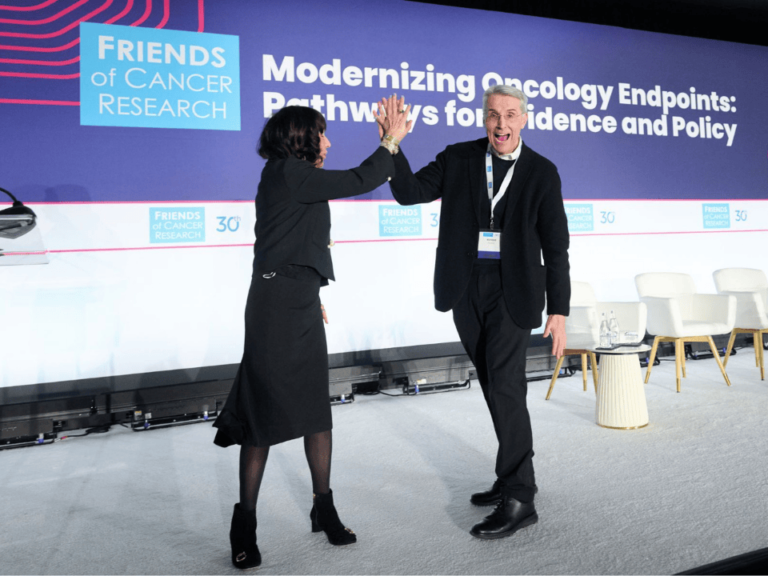
Richard Pazdur, founding director of FDA’s Oncology Center of Excellence and long-time FDA visionary, has accepted the top job at FDA’s Center for Drug Evaluation and Research following George F. Tidmarsh’s dramatic ouster from the position.
This episode is available on Spotify and Apple Podcasts.
“This is big. Because, you know, the whole field of oncology over the past 25 years—and [Pazdur has] run the oncology division and decided which drugs would get on the market, which drugs won’t get on the market. Everybody is speaking ‘Pazdurese,’” said Paul Goldberg, editor and publisher of The Cancer Letter. “Even if you don’t like Pazdur, you are speaking Pazdurese if you’re doing oncology. And he’s shaped it.
“I don’t think anybody has had more impact on this field than he has,” Paul said. “So, now, here he is, and I suspect there’s some people who are unhappy, but I think there’s, what I’m sensing is a lot of dancing in the streets.”
In this episode of The Cancer Letter Podcast, Paul, Jacquelyn Cobb, associate editor of The Cancer Letter, and Claire Marie Porter, reporter, talk about the details of Tidmarsh’s departure and how Pazdur’s leadership may change FDA.
Tidmarsh resigned from his position Nov. 2 following a lawsuit by a former associate and a probe into what an HHS spokesperson described as “serious concerns about his personal conduct.”
“FDA is important to the industry,” Paul said. “The industry makes money by having a solid FDA, where people are competent, where decisions are made in a way that is at least explainable.”
Solid FDA leadership is central to the success of the field of oncology.
“This is just as important as the fact that you know, the administration’s plans to change over NIH and really gut it has been stopped,” Paul said. “This is as important as the fact that Tony [Anthony] Letai is now the NCI director.
Stories mentioned in this podcast include:
- The Directors: Ruben Mesa and Kunle Odunsi on how immigration and diversity accelerate discovery
- CDER Director Tidmarsh quits amid inspector general probe of his “personal conduct” Cancer advocates express concern about comments that signal trouble for accelerated approval
- How George Tidmarsh crossed the FDA-industry Rubicon
- How next generation sequencing is powering the shift to more accessible—and comprehensive—cancer care
- City of Hope’s leadership in lung cancer: Precision, innovation, and a vision for cure
This episode was transcribed using AI transcription services. It has been reviewed by our editorial staff, but the transcript may be imperfect.
The following is a transcript of this week’s In the Headlines, a weekly series on The Cancer Letter podcast:
Jacquelyn Cobb: This week on The Cancer Letter podcast …
Paul Goldberg: Many words I said at ODAC, Oncologic Drugs Advisory Committee meetings, are filled with not blather at all. It’s actually erudite discussion of data, policy, what have you. And you can see opinions being shaped, opinions being made, being forged and expressed, and recommendations being made. So that’s very different from this kind of blather, and blather and transparency are not the same thing. These guys are getting a little bit confused, as far as I’m concerned. I don’t understand half of what they’re saying, and that’s usually a bad sign because I’ve been covering FDA for a very long time, and generally, if I don’t understand something, when I was younger, I used to think it was me. Now I think it’s just blather.
You are listening to The Cancer Letter podcast. The Cancer Letter is a weekly independent magazine covering oncology since 1973. I’m your host, Paul Goldberg, editor and publisher of The Cancer Letter.
Jacquelyn Cobb: And I’m your host, Jacquelyn Cobb, associate editor of The Cancer Letter. We’ll be bringing you the latest stories, groundbreaking research and critical conversations shaping oncology.
Paul Goldberg: So let’s get going.
Jacquelyn Cobb: Hello, Paul. I’m gonna not say how are you today, just to give the listeners a quick update. we have a normal In The Headlines episode coming in about 10 minutes, I would guess. But first we have somewhat breaking news that we just really need to talk about that came out yesterday. So the, the big news is that Richard psr, director of the FDA’s Oncology Center of Excellence has taken the job as FDA’s director of the Center for Drug Evaluation and Research. So CDER.
And that there’s a lot to talk about. Here he is taking over for Dr. Tidmarsh. and he, yeah. Let’s, let’s get into it. Paul, why don’t you, because I didn’t report..
Paul Goldberg: He’s not taking over for Dr. Tidmarsh. He’s taking over from Dr. Tidmarsh.
Jacquelyn Cobb: True, true, true, true!
Paul Goldberg: So we have had a news outbreak.
Jacquelyn Cobb: Yes.
Paul Goldberg: So, so now we’re pivoting and it’s, it’s gonna be great. So, yes. Yeah. Let’s talk about Dr. Pazdur.
Jacquelyn Cobb: Yeah. Can you tell me what this means for, for, for the CDER side of FDA?
Paul Goldberg: Well, I think for the entire FDA first, right?
Jacquelyn Cobb: Sure.
Paul Goldberg: Because FDA has been in a state of, how you say, chaos. That’s the right word. People leaving—and they don’t really want them to leave because right now they have a thousand positions that they can fill. It’s just that, does anybody really want to go to an agency that looks rudderless? Let’s call it by its proper name. And the thing with Dr. Tidmarsh is that he really didn’t just, you gotta listen to the, what’s coming with the other episode about his ouster, his downfall, whatever you want to call it.
Jacquelyn Cobb: Yes.
Paul Goldberg: He was an outsider who was kind of wearing his outsiderness on his sleeve. Pazdur is the exact opposite. He is an insider with a vision, with a sense of what he wants from the agency.
And if you’re asking me as an observer of FDA for more than three decades the thing with Pazdur is, he’s had the same vision for quite some time, which is: Reorganize the agency based on disease groups, because to quote Dr. Pazdur, nobody gets ill with “small molecule” or “biologics.” People get diseases, not modalities. And besides, I could never really understand what in the world, what is the difference between biologic, and this drug, a small molecule—who cares! And that is—
Jacquelyn Cobb: Yeah.
Paul Goldberg: You know, I mean, people can answer that question. I just think it’s an idiotic answer.
Jacquelyn Cobb: Yeah.
Paul Goldberg: People get sick with, you know, diseases, heart disease, cancer, what have you, but they don’t really get small molecule. And again, I’m stealing from Pazdur, but he is, you know, he’s the kind of guy who’s been playing 3D chess in his head for a long time, and yeah, he can, he can actually, he sees how things can come together.
Jacquelyn Cobb: Yeah. Move around.
Paul Goldberg: He’s got the mind for that. And there are lots of people who believe in what he’s saying. And frankly, I think he is making a really fascinating choice now seeing him at CDER, and I think he’s gonna stay at the Oncology Center of Excellence as well. So he is gonna be there as well as—but yeah. Can we just go to his vision for another moment?
Jacquelyn Cobb: Please.
Paul Goldberg: So the drugs part of ODAR and drugs, part of CDER, the part that he’s taking over, really just does the largest number, but really a portion still not all of cancer drugs and cancer modalities.
So some of them treatment modalities, some of them are gonna be in CBER. So the question is—he’s not head of CBER. The question is, is FDA going to be ready to do what PSR wants to do? And that means taking, you know, some of the CBER stuff and moving it over fit into a physical center. And that’s been a fight.
Jacquelyn Cobb: Really.
Paul Goldberg: So, yeah. People you know, need, people don’t move these fiefdoms, they don’t change. But, but the idea that they got him means a lot.
Jacquelyn Cobb: Yeah.
Paul Goldberg: Means a lot because you don’t just. I suppose he can just walk out if he’s had enough at some point.
Jacquelyn Cobb: Yeah, true.
Paul Goldberg: I suspect he really is going to succeed at this. My money—I’m willing to bet you as much as $5 that this is really good and it’s going to cause complete change over in how drugs and biologics and so forth are dealt with. And by the way, there’s also, some of it is also devices, because devices are really important in oncology.
Jacquelyn Cobb: Yeah.
Paul Goldberg: So people don’t get drug, you know, small molecule, they, and get sick with small molecule or biologic, but they also don’t get sick of with devices.
Jacquelyn Cobb: Yeah. Well, I get sick FROM devices, though. No, <laugh>.
Paul Goldberg: Yeah.
Jacquelyn Cobb: yeah, I mean.
Paul Goldberg: Good. Yeah. I corrected, you corrected me. Even somebody should keep the score.
Jacquelyn Cobb: Yeah. I mean, I don’t wanna—Yeah, I know. Seriously, right? We can have a little tally.
Paul Goldberg: Yeah, yeah, yeah.
Jacquelyn Cobb: No, I think I, I don’t wanna drag this out too long. I think there’s a little delay.
Paul Goldberg: I have got time.
Jacquelyn Cobb: No, but I, I think I just you know, I haven’t been covering Tidmarsh, that’s really been you and Claire, and you know, it’s, this is breaking news. We haven’t done like deep reporting on it yet, but, you know, we know Pazdur pretty well, you know, as a, as well as reporters can, you know, and I think from my very outsider standpoint I’m really excited.
I, there’s really no one in oncology that I respect more than Pazdur. And I think that considering, like you said, FDA is so rudderless, even though it’s a little jarring to think of Pazdur, you know, not just being Oncology Center of excellence, God, you know, like—
Paul Goldberg: The word he hates is “Cancer Czar.” And—
Jacquelyn Cobb: I’m sorry, I know I almost said it.
Paul Goldberg: I’m sorry, Dr. Pazdur, if you’re listening. I’m the one who coined it and I’m really, really sorry.
Jacquelyn Cobb: Yes, yes. I, I didn’t say it. But yeah, I mean, he’s, he’s just such a figure in, in FDA and oncology more broadly. And while I do have a little bit of nerves at the idea of him splitting his time just because I enjoy him working at meetings and stuff. Like you said, if anybody is gonna take on more responsibility and have a vision for FDA and, you know, bring in positive change in this time of chaos—or let’s just say change, let’s just say tumultuous change, perhaps—it’s him,
Paul Goldberg: It’s gonna—yeah. But it’s gonna, it’s gonna get less stable. That’s my prediction, before it gets more stable.
Jacquelyn Cobb: Yeah.
Paul Goldberg: Because his counterpart, Vinay Prasad, if you look at his entire sort of body of work, his, all of his literature, he is digging under the things that Pazdur has been building. So is this going to cause a battle of Titans? If that does, then my money again, this is another $5 bet, is on Pazdur because…
Jacquelyn Cobb: Oh my gosh, I’m about to… Well, I don’t wanna make these bets, though.
Paul Goldberg: But you haven’t, you haven’t bet against it. So whatever. I’m just, it’s a symbolic bet. Yeah. We’ll just donate money to… what?
Jacquelyn Cobb: To each other.
Paul Goldberg: To the beer fund.
Jacquelyn Cobb: There you go. That works. I’m in, I’m in.
Paul Goldberg: Yeah. So just as important as the fact that you know, the administration’s plans to change over NIH and really gut it has been stopped. This is as important as the fact that Tony Letai is now the NCI director.
Jacquelyn Cobb: Yeah.
Paul Goldberg: This is big because, you know, the whole field of oncology over the past 25 years that he’s run the oncology division and changed the drugs and decided which drugs would get on the market, which drugs won’t get on the market. Everybody is speaking “Pazdurese.” Even if you don’t like Pazdur, you are speaking Pazdurese if you’re doing oncology. And he’s shaped it.
Jacquelyn Cobb: Yeah.
Paul Goldberg: So I don’t think anybody has had more impact on this field than he has. So now here he is, and I suspect there’s some people who are unhappy, but I think there’s, what I’m sensing is a lot of dancing in the streets.
Jacquelyn Cobb: Awesome. Awesome. Well listen on for the podcast that Claire and Paul recorded, it will come in right now and you’ll get more information about Tidmarsh and his ouster which is very relevant to Pazdur’s being named. So, yeah.
Paul Goldberg: We’ve got, basically it’s all upside down and
Jacquelyn Cobb: Topsy-turvy, yeah.
Paul Goldberg: Yeah. But upside meaning that part two comes up before part one. Yes. So, I guess one thing you could do is just play this podcast backwards.
Jacquelyn Cobb: Get some, get some Devil speaking in the background there.
Paul Goldberg: And now we return to our previously scheduled program.
So Claire, did you have a great weekend?
Claire Marie Porter: Hi, I did. I had a really good weekend. I went to a documentary premiere for my friends, and I’ve just been holing up inside, rainy and cold. So it was cozy, though. What about you?
Paul Goldberg: No, I went to Ci4CC, which is the Cancer Center’s Informatics Society meeting, which was in Miami Beach, and it was a lot of fun. I love that meeting because very few people, a lot, I mean, on the ground. I have no idea how many people queued into this thing because they’re techie people. They don’t need to be there in person. But yeah, it was just really nice to go and see a bunch of friends and just wander out and look at some art deco buildings again and they don’t change. Well, they get a little better painted, and I got home. That’s the part that’s great. I was able to get back on Sunday. Yeah, I got lucky. Anyway, well, so what happened? We had a very busy week last week.
Claire Marie Porter: Very busy week. Yeah, I mean, you were editing at the airport with me, live. But yeah, I’ll do the honors and give us the rundown, like Jacquelyn usually does. Story one was the directors last week with Ruben Mesa and Kunle Odunsi on the internationalism of the oncology community. And then the next two stories were about CDER director George Tidmarsh’s ouster and the events that preceded it. So the first was reported by Paul and myself and the second was a guest editorial written by Dr. Sekeres. It’s called How George Tidmarsh crossed the FDA Rubicon. Super interesting. It’s our top trending story at the moment. It’s definitely worth a read.
We had another guest editorial on Next Gen sequencing by Kathy Davy from Thermo Fisher, and we had a sponsored article by City of Hope on lung cancer. As usual, it was a very packed cancer policy section, which has become our catch-all for all the news and policy changes that we would like to write about, but can’t write about and can’t get into an issue, but end up being really strong stories at the same time.
But yeah, the big news that we want to talk about that happened over the weekend last weekend, so October 31st through the 2nd was that FDA CDER director, George Tidmarsh, was put on leave on Friday to be investigated for his “personal conduct.” And then according to multiple interviews, Tidmarsh didn’t see this coming Sunday morning. Confirmed by an HHS spokesperson, he resigned. Sunday was also the same day that Aurinia Pharmaceuticals filed a lawsuit against Tidmarsh for signaling out the company due to a personal vendetta. So I mean, we reached out to HHS and received the same response that everyone did, which was that Secretary Kennedy expects the highest ethical standards from all individuals serving under his leadership.
Earlier that week, Tidmarsh had made an appearance at BIO, which is Biotechnology Innovation Organization, interviewing with John Crowley. And at that fireside chat, he said some things that were pretty alarming, and those comments are the basis of [inaudible 00:05:09]. So I mean, going into this reporting, I was like, well, Occam’s Razor, he resigned the same day that a lawsuit was filed. So clearly that’s the reason he resigned or was ousted or whatever we want to call it. But it did seem, as we dug a little deeper, that there was a lot more than what met the eye.
And I will say it was not easy to get a recording or transcript of that chat. I called and emailed every press person associated with BIO and no one had a recording or was able to give me one, which was … this was essentially FDA’s top drug regulator dishing. Paul over the weekend, then, I guess you used your reporting wiles and got us a recording, which turned into a larger story for us. So what was most surprising to you about this recording or this chat?
Paul Goldberg: It was kind of fun. I went out into the street and there was this huge wind gust, and the wind gust brought me the recording of the BIO gathering.
Claire Marie Porter: I love when that happens.
Paul Goldberg: I know, it’s really great. Well, the thing, let’s go back to your stuff, your part of the story. I mean, we shared the entire story, but you were doing all of the alleged personal vendetta part of it, and these are two separate issues. Actually, it could even be three separate, it could be more than three separate issues. Because we don’t know whether he resigned because of the, well, we know he resigned because of the investigation, but were they investigating? Is it the same thing that was in the lawsuit? We don’t know. Probably, but probably isn’t good enough. And as far as the fireside chat, that’s completely separate. That, we know
The fireside chat, we abstracted it in the story, but we also published the entire thing because just to make sure that everybody sees it, that it’s not being quoted out of context. The context is all there. One of the takeaways for me is that whenever they put you in an armchair and say, “Dr. Horseface,” or whoever, “Mr. Goldberg,” you are in the fireside chat, and then you get very comfortable. You get lulled into complacency by the sound of your own voice. And then you say a lot of really crazy stuff. And I may have done this. If I have, I would not know that. So my modest proposal is that FDA start to regulate those comfortable chairs, as dangerous, high-risk devices. You could end up sitting down in this chair, getting up and you don’t have a job anymore. To me, the fireside chat was the most interesting bit. So do you want to drone on or please interrupt me, but can we talk a little bit about the other bit if …
Claire Marie Porter: Well …
Paul Goldberg: What happened?
Claire Marie Porter: Yeah, sure. Yeah, we should. I mean, I will say, and we wrote about this a bit when we first reported on Tidmarsh becoming CDER director, that his relationship with Makary and Bhattacharya and Prasad, these relationships arose from this COVID-era solidarity. So I think what is most surprising to me about all of this, and I think we use the word breeziness a lot, was just the breeziness, the maybe unseriousness or the lack of weightiness in some of these contexts. If you’ve listened to FDA’s direct podcasts, and I don’t know if FDA has had podcasts before, but just the fact that there is one is a little bit odd to me, and maybe you can speak to that. And I know all of these guys were pals prior, and Tidmarsh has talked about that extensively, crashing on people’s couches. And I think what’s interesting, this word transparency has been thrown around a lot.
Obviously the spokesperson used that language again, and I think this podcast and this fireside chat style is all under the guise of transparency, but it ends up having the opposite effect, at least on me, where my takeaway is if this is how these top agency heads are speaking in their official capacity, what is it like behind the scenes? It feels almost more like oversharing, I would say, than transparency. So that was something that surprised me about all of this, and it’s a lot to sift through. But going back to the lawsuit, I mean, it’s public. We linked to it in our story. You can get into it. It’s pages and pages of emails that Tidmarsh had sent to Kevin Tang, who is the current chair of the board of Aurinia Pharmaceuticals, essentially according to the complaint, threatening revenge on him for various ousters from other companies that Tidmarsh had worked for, other drug makers.
A lot of threatening language in those emails. And I guess this all was kicked off by an early September LinkedIn post that Tidmarsh had made about Aurinia’s drug for lupus, just singling it out and criticizing it and eventually, ultimately took that post down and declared that he did not post it in his official capacity, but on a personal note. So their stock drops, Aurinia Pharmaceuticals’ stock drops, and that was the basis of the lawsuit. So I think those are the most interesting parts. I think making personal comments about the safety of a drug on your social media account rather than through official FDA pathways shows maybe a lack of judgment, to be nice, but it’s also not surprising. A lot of these guys will go directly to the masses and not through traditional pathways. But I mean, what are your thoughts on that? Is there anything else, really, to talk about?
Paul Goldberg: Yeah, I mean, FDA used to speak always in two different ways.
One of the ways is well-honed lawyered policy way, and that is what counts. And I miss those days when there was more of that. So you have somebody write some text, somebody fix the thing and then keep on going, and then they think of the implications and God knows. It was not a human language, but you know what? It was language you could act on. At the same time, FDA would show up and talk at various gatherings like Friends of Cancer Research, FDA officials, including CDER directors and CBER directors and what-have-you. Certainly the cancer division, Rick Pazdur is there. A lot of medical reviewers are there and they can talk. Or at ASCO, they do the same. But that’s not the same as policy language.
It’s like developing things, thinking things out, hashing things out. And my God, many words I said at ODAC, Oncologic Drugs Advisory Committee meetings, are filled with not blather at all. It’s actually erudite discussion of data, policy, what have you. And you can see opinions being shaped, opinions being made, being forged and expressed, and recommendations being made. So that’s very different from this kind of blather, and blather and transparency are not the same thing. These guys are getting a little bit confused, as far as I’m concerned. I don’t understand half of what they’re saying, and that’s usually a bad sign because I’ve been covering FDA for a very long time, and generally, if I don’t understand something, when I was younger, I used to think it was me. Now I think it’s just blather. Which is why look at the Mikkael Sekeres editorial. I wanted to bounce it over to him and he was kind enough to do it. And just to say, “Well, this is how I understand the blather at that fireside chat,” or dumpster fire, as we called it.
And Mikkael is a writer. He can use many words and use them well, but he uses them well. So I still do not understand what Tidmarsh said. I do kind of understand that he did say that the FDA is looking for a way to go beyond, make the accelerated approval standards different, go after overall survival. And this is interesting because that’s what Vinay Prasad, his counterpart, who’s also the chief medical officer of FDA is saying. And I never really thought it was a Tidmarsh point, that it was one of his ideas, but it is the entire Prasad idea. And that Prasad now has all of these data from inside FDA, and he’s been publishing on this when he was outside FDA, and now he’s going to say, “Aha.”
Now why did Tidmarsh announce it? I have no idea why he announced it. Is it because he was trying to rat out somebody whom he didn’t particularly get along with? Sources say that that is the case, that he did not get along with him, but still doesn’t explain why he did it. It could be several explanations. We don’t know them. We don’t really necessarily need them. And also, what does Tidmarsh’s ouster tell us about what is happening next at FDA? Is Prasad next? Is he going to be re-fired and rehired again? I don’t know. Is Makary strong enough to stick it out? I don’t know. Rumor has it that Kennedy is not pleased right now, which is interesting to see where it all goes. But yeah, blather is not the same thing as transparency, said I, blathering, sitting in a comfortable chair. So if I’m making an idiot of myself, please tell me.
Claire Marie Porter: Well, at least you … yeah.
Paul Goldberg: Am I making an idiot?
Claire Marie Porter: Least you’re calling it what it is.
Paul Goldberg: Yeah.
Claire Marie Porter: Yeah.
Paul Goldberg: So that is the story.
Claire Marie Porter: That’s the story, yeah, and a lot of contradictions and I don’t know if we’ll ever really have the answer to what exactly happened, but it’s not good. None of it points to being good things.
Paul Goldberg: Maybe we will have an answer to that. I think we’ll probably have an answer to that in a matter of a few weeks, because either these guys are sticking around or allowed to stick around, or they are … told to spend more time with their families. But I can’t imagine that anybody is satisfied right now with what FDA is doing. I guess I’ve also, once again, really talked around the point, but didn’t get to the point. FDA is important to the industry. The industry makes money by having a solid FDA, where people are competent, where decisions are made in a way that is at least explainable. And one of the things that I heard Tidmarsh say that actually scared me the most, well, in addition to this, the idea that here is he and Vinay Prasad and God knows who else mucking around with accelerated approval.
But the other bit was the voucher program. Tidmarsh was talking about calling investigators, an investigator, on this rare disease situation. And CDER director calling an investigator to find out what’s really going on? I mean, there’s process. And what message does that send to the industry? It sends the message that, “Hey, all you have to do is just convince the CDER director.” I don’t know if that’s a good thing. No, let me rephrase that. Let me rephrase it. I cannot say, “I do not know it’s a good thing.” Whether it’s a good, it actually stinks. Thank you.
Claire Marie Porter: Tidmarsh himself, or described himself, as a student of the history of the FDA. I think that was on his Welcome to the FDA podcast. And it just begs the question, does he know better? Does he know better? I don’t know.
Paul Goldberg: Well, the guy we got to critique his fireside chat blather was Mikkael Sekeres, who actually wrote a book about, he was not just a student, but he wrote a book about FDA. He is a former ODAC chair. He is a writer. And I would say, I would go with what Mikkael says over what Dr. Tidmarsh says. It’s really strange and it’s not good. It’s rotten. And the question is, where’s it going? And the industry, I think, wants it to go in the direction of stability because you can make money with stability. In chaos, you can make money, but you have to go through very different … strategies.
Claire Marie Porter: Yeah, indeed.
Paul Goldberg: This is a terrific time to be a journalist.
Claire Marie Porter: It’s a great time to be a journalist, stories unfolding. I mean, I guess the one downside of stability is that we have less to report on.
Paul Goldberg: Oh, no …
Claire Marie Porter: Not wishing for instability.
Paul Goldberg: You can report on unstable, you can report on chaos. You just have to be stable as you-
Claire Marie Porter: Okay, yeah.
Paul Goldberg: Report on chaos. That’s the challenge.
Claire Marie Porter: No, that’s what I’m saying. I’m saying we benefit from chaos, journalists.
Paul Goldberg: Oh, yeah.
Claire Marie Porter: We’re the only ones.
Paul Goldberg: We’re the only ones.
Claire Marie Porter: Right. We should probably wrap this up.
Paul Goldberg: We should, before we say something really stupid. This is becoming a fireside chat.
Claire Marie Porter: It’s becoming a fireside chat. Yeah. My chair is becoming too comfortable and too cozy.
Paul Goldberg: Are you lulled into complacency by the sound of your own voice?
Claire Marie Porter: Well, thank you for listening. Thank you for talking, and we’ll see you next week.
Jacquelyn Cobb: Thank you for joining us on The Cancer Letter Podcast, where we explore the stories shaping the future of oncology. For more in-depth reporting and analysis, visit us at cancerletter.com with over 200 site license subscriptions, you may already have access through your workplace. If you found this episode valuable, don’t forget to subscribe, rate and share. Together, we’ll keep the conversation going.
Paul Goldberg: Until next time, stay informed, stay engaged, and thank you for listening.