New Orleans. Late 1970s, give or take.
Two young biostatisticians, in town for the annual meeting of the Eastern North American Region of the International Biometric Society (ENAR), walk out of a restaurant and are sauntering about the French Quarter.
One of the two, Richard M. Simon, a clinical trials design expert at NCI, confesses to the other, Stephen L. George, then of St. Jude Children’s Research Hospital, that he is a fan of country music.
“He showed me a card indicating that he was a Willie Nelson fan club member,” George, now professor emeritus of biostatistics & bioinformatics at Duke University School of Medicine, said to The Cancer Letter. “Then he confessed that he actually was fonder of the music of Waylon Jennings!”
By the same token, Simon, who died at age 80 on May 9, was a fan of Thomas Bayes and a believer in the limited applicability of at least some principles described by the 18th century philosopher and statistician to the design of modern clinical trials.
During one memorable meeting of the FDA Oncologic Drugs Advisory Committee, circa 2000, with this reporter completely awake, indeed captivated, in the audience, Simon entertained and enlightened his fellow ODAC members with a lecture cleverly titled “Ayesian Tatistics,” which he defined as “Bayesian Statistics without BS.”
I didn’t write that story, but clearly, the lecture made an impression.
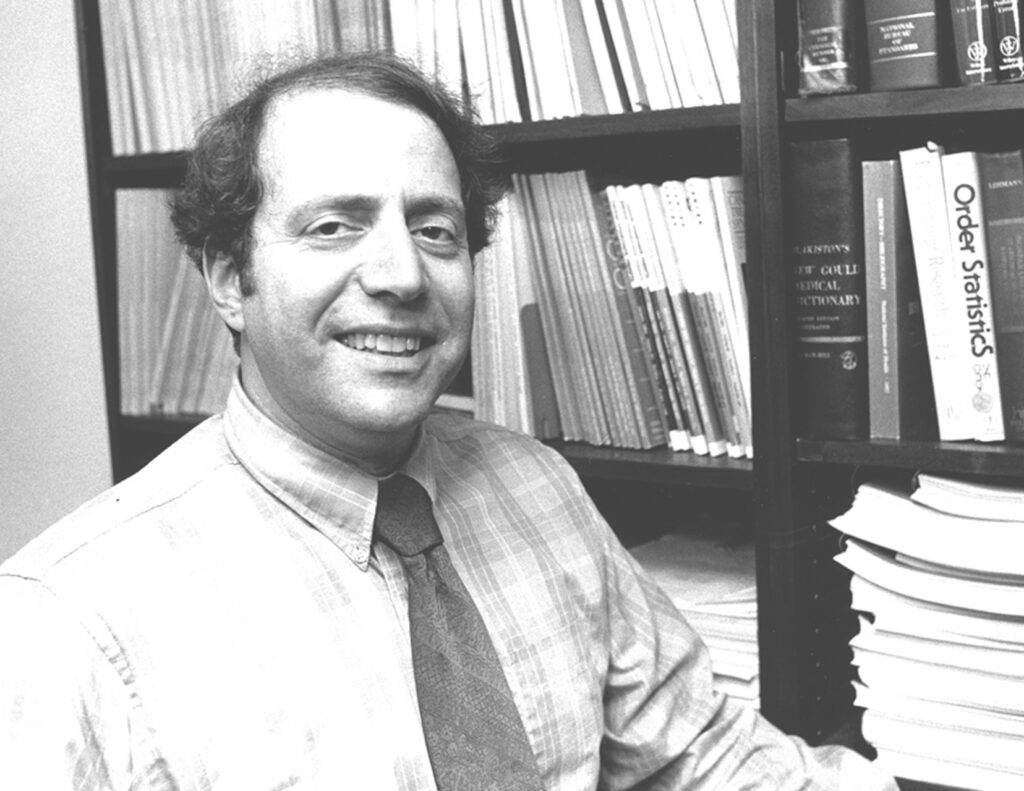
Simon joined NCI in 1974 and retired in 2017.
“Decades ago, we created the Biometric Research Branch in the Cancer Therapy Evaluation Program—this for two reasons. The first was the central importance of biostatistics to clinical trials. The second had to do with Rich himself,” said Robert E. Wittes, former director of the Cancer Therapy Evaluation Program, former director of the Division of Cancer Treatment and Diagnosis, and former physician-in-chief of Memorial Sloan Kettering Cancer Center.
“Making him chief of the new branch acknowledged his leadership qualities and made him one of the key decision-makers in the program,” Wittes said to The Cancer Letter.
“Aside from his technical excellence as a statistician, I greatly valued the keen insight that he brought to all discussions where strategies were worked out and key decisions were made in the clinical trials and new drug development arenas. He wasted few words, quickly got to the point, and expressed views that were always worth careful consideration, whatever the subject,” Wittes said.
James Doroshow, director of the NCI Division of Cancer Treatment and Diagnosis, said he learned enormously from Simon’s expertise.
“Every time we met for our regular one-on-one sessions, Rich would bring me his latest paper or book to make sure that my understanding of the forefront of biostatistics was up-to-date,” Doroshow said to The Cancer Letter. “It was a great education that lasted over a decade.”
In a 2012 letter of support recommending Simon for the American Statistical Association Karl Peace Award, University of Washington biostatistician Thomas R. Fleming estimated that Simon had more first-author publications—over 100 at that time—than any biostatistician.
“As head of the [NCI] Molecular Statistics and Bioinformatics Section, he has had profound impact in bringing scientific insight and rigor to a research area of seemingly unlimited potential to impact treatment and prevention of cancer, and yet with unparalleled challenges due to high dimensionality of available data,” Fleming wrote in 2012.
Simon did receive the 2013 Peace Award “for outstanding statistical contributions for the betterment of society”—along with the 2017 Marvin Zelen Leadership Award from Harvard University, and the 2012 National Federal Government Award for Excellence in Technology Transfer. He was awarded the Snedecor prize for best publication in biometry in 1985 for the Gail-Simon test for qualitative treatment by subset interaction.
Altogether, Simon’s name figures on more than 748 published papers (with an h-score of 143: 143 publications with at least 143 citations each). He is also the author of the “Design and analysis of clinical trials” chapter in all 12 editions of DeVita, Hellmann and Rosenberg’s reference book “Cancer: Principles and Practice of Oncology.”
“He had an enviable gift in identifying major problems in clinical research, translating them into statistical problems, and developing practical and accessible solutions. He also had an enviable gift in writing,” Max Parmar, professor and director of the MRC Clinical Trials Unit at UCL, Institute of Clinical Trials and Methodology in London, said to The Cancer Letter. “These gifts are perhaps seen most clearly in the excellent single author papers he has written—a number of which I would consider to be statistical classics in the full sense of those words. There is no doubt in my mind that he was one of the giants in the field of medical statistics and clinical trials. However, I will perhaps remember him most for his kindness and humor.”
Staying relevant
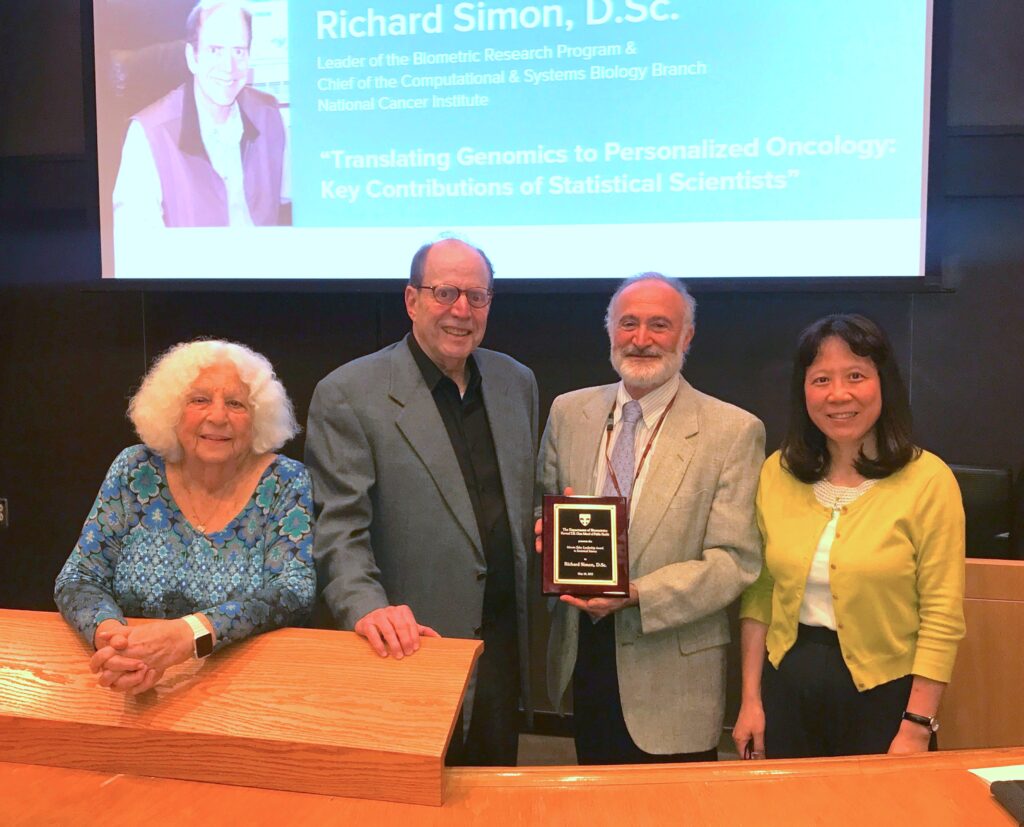
Left to right: Thelma Zelen, Richard Simon, Richard Gelber, and Xihong Lin. Source: Richard Gelber
Simon kept up with the times and the changing science of cancer clinical trials.
For example, his “Ayesian Tatistics” lecture at ODAC was intended to set the stage for discussion of active control trials, cross-study comparisons, and interpretation of a noninferiority trial of an oral 5-fluorouracil formulation.
Arguing about 5-FU seems like a discussion stemming from the Bronze Age, compared with his later interest in design and analysis of studies using high dimensional genomic data and the use of genomics in clinical trial design.
“As I followed his career as we approached the turn of the century, I wondered whether Rich could continue his momentum for groundbreaking research,” University of Washington’s Fleming wrote in 2012. “He certainly did, becoming a pioneer in the area of statistical genomics through his efforts to bridge the fields of quantitative statistics, biology and genome sciences.”
Simon believed that a successful biostatistician must have in-depth knowledge of the subject matter and integral involvement in applied research, said Larry Rubinstein, a mathematical statistician in the Biostatistics Branch of the Biometric Research Program of NCI/DCTD.
In an email announcing Simon’s death to his NCI colleagues, Rubinstein wrote:
Dr. Simon’s numerous and seminal methodologic biostatistics contributions include the Norton-Simon model of tumor growth, which informed curative chemotherapeutic late intensification in pediatric leukemia, Pocock-Simon adaptive stratification, Lan-Simon-Halperin futility monitoring, the Gail-Simon test for qualitative treatment by subset interaction (awarded the Snedecor prize for best publication in biometry in 1985), the optimal 2-stage design, which quickly became the most used phase II trial design in oncology, the accelerated titration design to reduce under treatment in phase I trials, and early papers on the design of therapeutic equivalence trials.
He was internationally regarded as an expert in the evaluation of prognostic and predictive classifiers.
Dr. Simon was recognized as one of the foremost international experts in the design and analysis of studies using high dimensional genomic data and the use of genomics in clinical trial design. He was the lead author of the book “Design and Analysis of DNA Microarray Investigations,” with other members of the Biometric Research Program, and the author of the book “Genomic Clinical Trials and Predictive Medicine.”
He established a post-doctoral training program in statistical genomics and bioinformatics, which has continued for approximately 20 years.
He designed, developed, and maintained a suite of DNA microarray data analysis tools, including BRB-ArrayTools, implemented to be rigorous and yet accessible to early career computational biologists with little statistical sophistication.
BRB-ArrayTools amassed over 26,000 registered users in approximately 65 countries, has been cited in over 3,000 publications, is licensed from NIH by approximately 30 companies.
“During the last 20 years before his retirement, Rich developed the BRB-Array Tools, and this gave a lot of help to wet lab scientists who have no programming experience,” said Yingdong Zhao, chief of the Computational and Systems Biology Branch at NCI.
“With it, they can analyze their data by themselves. So, it has thousands of subscribers and the tool has been cited by over 3,000 papers.”
“Today is a gift”
On his desk at NCI, Simon kept a plaque with an arguably Bayesian saying attributed to Eleanor Roosevelt: “Yesterday is history, tomorrow is a mystery, today is a gift. That’s why we call it ‘The Present.’”
When NCI and FDA officials were politicizing biomarker research, Simon was quietly advancing the science of clinical trials that utilize biomarkers.
“Professionally, I was always impressed with his ability to find elegant solutions to important practical problems,” Duke’s George said. “There was no development of ‘methodology for methodology’s sake,’ and I can think of no area in the methodology of clinical trials that has not been influenced substantially by Rich’s work.
“In addition, Rich was willing to learn new skills in areas beyond his original training. With his increasing interest in the use of high-dimensional biomarker data in cancer research, he pursued laboratory training in genomics and cell biology at Cold Spring Harbor and NIH to bolster his understanding at a fundamental level. His subsequent work on the use of genomics in developing predictive markers that can guide the design of clinical trials had a major influence on the direction of clinical cancer research,” George said.
There is no doubt in my mind that he was one of the giants in the field of medical statistics and clinical trials. However, I will perhaps remember him most for his kindness and humor.
Max Parmar
Simon believed that statisticians must bear the burden of making themselves understood by non-statisticians, said Lisa M. McShane, associate director, of the NCI Division of Cancer Treatment and Diagnosis and head of the Biometric Research Program.
“He was always ahead of the curve in terms of understanding what the new statistical challenges were and what new statistical methods would be needed to address them, for example genomics,” McShane said to The Cancer Letter. “He was a groundbreaker for recognizing the needs for new statistical methodology. He was an excellent writer. He could explain concepts in a very easily understandable way, particularly to non-statisticians.
“He also valued statisticians learning about the applied subject,” McShane said. “He took classes in some assay methodologies, so that he would better understand them. I was taught even by my PhD advisor that you need to understand where the data are coming from to guide you for analyses.
“The importance of ability to communicate statistical concepts and converse effectively with non-statisticians is a principle that we continue to uphold in the program. We want to make sure that our program members aren’t sounding like they are speaking Greek to non-statisticians.”
Rubinstein offers an example of a Rich Simon teaching moment:
I remember a talk he gave to clinicians a long time ago.
He said that there’s the temptation to try to avoid randomization and just look at patients who were treated and distinguish between the ones who complied with the treatment and those who didn’t, to see if the treatment worked.
So, he said, “Here’s an example.”
We took one of the arms from a trial that was actually randomized, and we looked at the compliers versus the non-compliers. And sure enough, the compliers did quite a lot better. And then he paused for a moment, and he said, “The important thing about this example, though, is that that treatment was the placebo arm.”
So, he said, “This is just one of the ways that you can get caught up and misled by trying to rely on a non-randomized comparison.”
Janet Wittes, a prominent biostatistician and, most recently, founder of Statistics Collaborative, a consulting firm, said Simon was a pleasure to work with.
“I trace so much of how I think about clinical data to Rich’s insights,” Wittes said. “He was ever curious, dependably inventive, intellectually playful, and fun to be with. He enriched biostatistics, clinical trials, and those around him.”
Susan Ellenberg, now emerita professor of biostatistics, medical ethics and health policy at the University of Pennsylvania Perelman School of Medicine, became aware of Simon early in her career “while working as a clinical trials statistician for a now-long-defunct cancer cooperative group.”
“I was so impressed—he identified ways that the design and analysis of cancer trials could be improved, developed the relevant methodology and wrote so clearly that even a non-statistician could understand his proposed methods,” Ellenberg said. “Although I was happy in the position I had, when he advertised a staff fellow position, I applied and was selected.
“He was a wonderful mentor—he gave me the confidence I didn’t yet have to go beyond analyzing the data that were emerging from my assigned studies to thinking about new approaches to cancer clinical trials. And he became a good friend as well.”
The echoes of Ayesian Tatistics
In 2000, as a believer in the scientific process and peer review, Simon acknowledged to me that he was worried that FDA would use his Ayesian Tatistics lecture—and the precedent set by declining to approve the oral 5-FU drug UFT—as a basis for a heavy-handed dogma governing clinical trials.
He often suggested to us to find issues in real data, and try to solve them using a very simple approach, rather than a too complicated one. If it’s too complex, it won’t be practical.
Yingdong Zhao
“It may be useful to have guidelines for the design and conduct of active control trials in order to clarify the situations where such designs are appropriate, to foster appropriate analyses and to provide guidance to FDA staff in review of applications,” Simon said to me at the time (The Cancer Letter, July 21, 2000).
“Such guidelines are best developed by a joint committee of FDA staff and external clinical and biostatistical scientists,” Simon said. “Internal development by FDA staff alone does not provide an adequate context to ensure that the proposals are based on peer-reviewed clinical trials methodology.”
This was an important statement to get on record at the time. FDA was constantly under attack for promulgating home-grown rules that NCI and the industry viewed as out of touch with mainstream oncology.
In another ODAC lecture, Simon tried to draw a distinction between informative subset analyses and the highly suspect practice of data-dredging (The Cancer Letter, Jan. 30, 2009). The discussion focused on drugs that target the KRAS mutation.
Said Simon:
We’ve had this sort of conventional wisdom: never trust subset analysis unless the overall results are positive, and that has sort of protected us against data dredging.
That is actually sort of an irrational rule of thumb in terms of what we’re really talking about, and we don’t need that to protect us against data dredging.
We need to distinguish data dredging from the kind of KRAS situation we were seeing today. But if we continue to use this rule of thumb, never look at a trial unless it’s met its [overall endpoint], that leads to clearly erroneous conclusions.
And so, that rule of thumb really needs to be sort of given up, and we need to independently make sure we’re not talking about a data dredging situation.
We need to distinguish the kind of prospective-retrospective design and the conditions for doing it that were presented this morning by the FDA. [The FDA conditions] are very useful, and we need to not lump those kinds of analyses together with the sort of typical data dredging analyses.
It needs to have enough patients, both in the test positive and the test negative subsets, to be interpretable, and you have to have a test that is analytically validated on archived tissue.
But I can conceive of situations where you could do an analysis—even though the trial was big enough and the proportion positivities were appropriate and you had arranged for archived tissue, and you could actually do, to me, just as believable analysis if information arose during the course of the trial from external sources as if you had set it up from the start that way.
That may not be the typical situation, but I don’t think because it wasn’t done completely prospectively that that precludes being able to reach reliable conclusions—if other things are right.
It was alluded to this morning that this term kept popping up, stratified, randomized stratified by the prospective—by the predictive biomarker, meaning that if, by stratified, we mean that the randomization is balanced by the predictive biomarker, that is not, to me, a viable objection.
That is not, to me, an essential. You can do a perfectly valid randomization test without prospective stratification and all of the prospective stratification—if you know the predictive biomarker in advance, then prospective stratification is valuable because it assures that you will have tissue and assays for all of the patients who go into the trial.
But it doesn’t really do anything to improve the validity of the analysis. All it improves is the balance between the number allocated to treatment versus the number allocated to control for, say, the test positive patients. It doesn’t improve the balance of those with regard to unknown covariates.
So, there is, I think, a lot of confusion about the supposed benefits of prospective stratification, at least as it applies to sort of providing a basis for inference. I think key issues are sample size, multiplicity control [and] having a focused analysis.
The inevitability of error
“I was one of the first batch of postdocs Rich recruited back in 1998, when he funded the bioinformatics group,” NCI’s Zhao said to The Cancer Letter.
“He was an incredible mentor. He gave us a lot of help and guidance during our research, and it really shaped our thinking in tackling scientific problems,” Zhao said. “He often suggested to us to find issues in real data, and try to solve them using a very simple approach, rather than a too complicated one.
“If it’s too complex, it won’t be practical. He could explain complex statistic concepts in plain language, making him an excellent communicator to biologists.”
Boris Freidlin, chief of the Biostatistics Branch at NCI, recalls one catastrophe from circa 1996, his early days at the Institute:
Rich was a great mentor, he introduced me to the clinical trials, to biostatistics. I was his research assistant—that’s how I ended up here.
He was extremely patient and encouraging. I remember one situation: I was working with him as research assistant on developing a predictive classifier using biomarker data from a randomized trial. I was doing the programming, and we were preparing to present it to top leaders at NCI.
Bob Wittes was there, Bruce Chabner [then director of the Division of Cancer Treatment] was there.
During the presentation, it turned out that I randomly mislabeled the treatment assignments, so the classifier was predicting random noise for all intents and purposes.
I was essentially presenting total garbage to people who were several levels above Rich, and I am sure this was embarrassing for Rich.
Yet, Rich calmed me down and talked me off the ledge. He said, “It happens to everybody. We wouldn’t even have the NCI if everything was simple.”
“I had a chance to get to know Rich for the first time when I visited the NCI in 1990 for two months to do some research with him on the need for more than one randomized trial,” Parmar said. “I was relatively fresh out of a PhD and did not realize quite how lucky I was—of which more below.
“Rich was very hospitable and put me up at his house while I gained my U.S. legs. His boys were very young then and I remember wrestling with them in the evenings and saying to Rich that I was glad I was not wrestling him,” Parmar said. “Working with him I realized that he was super knowledgeable and smart with a very wry sense of humor.
“He was very kind to me as my grasp of trials and research was in its infancy, suggesting and proposing ideas in his own quiet but clear way to ensure that I did not flounder too much,” Parmar said. “We were able to publish a paper together which he helped me craft—one of which I remain proud.
“The confidence of youth meant that I did not realize what a major figure he was while working with him—which was probably just as well, I think.”
An argument can be made that a mathematician’s precision influenced Simon’s non-professional interests. When his sons were young, he studied the strategy of soccer and started to coach.
I have had the honor to work with many colleagues over the years. Rich falls into the rarified intersection of two sets—‘intellectual giant’ and ‘true mensch.’
Barry Kramer
Later in life, he took up ballroom dancing. Music—such as being a card-carrying Willie Nelson fan—is mathematical as well, as is the sport of horseracing, another of Simon’s passions.
Jeffrey Abrams, former head of CTEP, argues that Simon’s life-long obsession with horseback riding was less about mathematics.
“Rich was a major leader at NCI throughout his long tenure and educated so many of us in clinical and basic research,” Abrams said. “But I will remember him most for our mutual enjoyment of horseback riding which belied all statistical logic as he often recounted finding himself stuck in the mud looking up.”
“I had the good fortune to hear a lecture on clinical trial design by Rich in my first year of oncology training,” said Barry Kramer, former director of the NCI Division of Cancer Prevention. “At the time, I was armed only with the frighteningly garbled understanding of biostatistics with which I graduated medical school.
“His talk provided me with insights on study design, but also inspired me to seek additional statistical training if I ever hoped to become the physician-scientist I aspired to be.
“Years later, I attended Rich’s retirement party celebrating his NCI career. Both his towering accomplishments and the fondness harbored by his many colleagues were evident. Over all of those intervening decades, Rich inspired me in a broad range of areas including trial design, biomarker evaluation, subset analyses, and scientific humility.
“I have had the honor to work with many colleagues over the years. Rich falls into the rarified intersection of two sets—‘intellectual giant’ and ‘true mensch.’”
Simon is survived by partner Sharon Sterling, sons Jonathon Simon, associate professor in the Stanford Physics Department, and Noah Simon, associate professor in the University of Washington Biostatistics Department, a grandchild, and a sister.