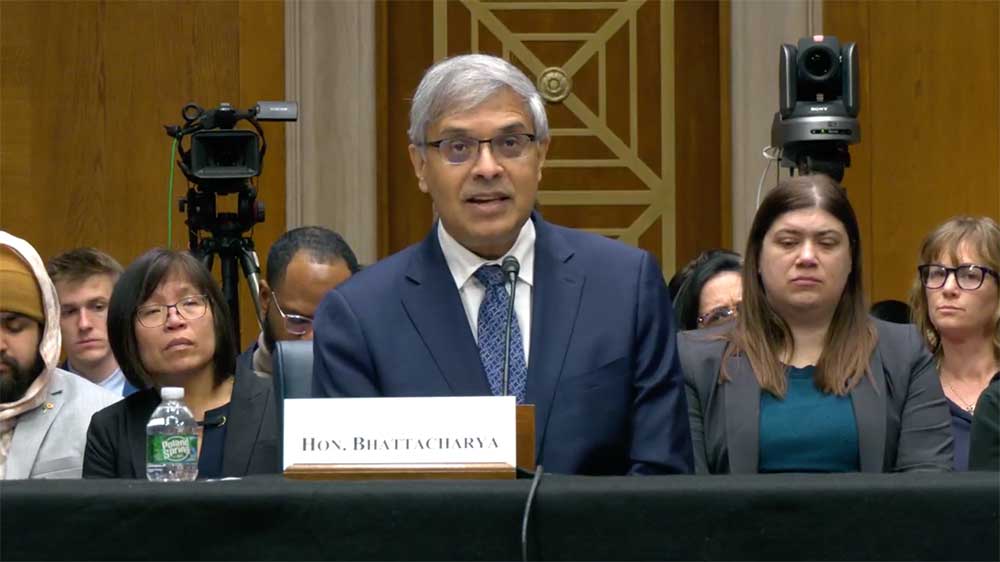
Pressed by Sen. Bernie Sanders (I-VT), NIH Director Jay Bhattacharya acknowledged that he is not aware of any study pointing to a causal link between vaccines and autism.
“I have not seen a study that suggests any single vaccine causes autism,” Bhattacharya said at a hearing of the Senate Health, Education, Labor and Pensions Committee.
Bhattacharya said that HHS Secretary Robert F. Kennedy Jr. believes vaccines should be used to control measles. “I’ve also heard Secretary Kennedy say that publicly,” he said.
Regarding the perception that Kennedy is anti-vaccine, Bhattacharya said: “I’ve seen him caricatured quite unfairly.”
Kennedy has long argued that there may be a causal link between vaccines and autism. He has also stated that childhood vaccines aren’t tested for safety. This is incorrect, mainstream scientific experts say.
Last year, Kennedy fielded questions from the same HELP committee and said “if the data is there, I will absolutely [discredit the link between autism and vaccines],” (The Cancer Letter, Jan. 31, 2025).
The following exchange occurred during Bhattacharya testimony before the HELP Committee on Feb. 3.
Bernie Sanders: Dr. Bhattacharya, according to the American Medical Association, which represents over 270,000 doctors “an abundance of evidence from decades of scientific studies shows no link between vaccines and autism.”
That includes over a dozen rigorous scientific studies involving hundreds of thousands of children. Last week you said, “the caricature” of Secretary Kennedy you’ve seen “in the press is just totally unfair.” You have seen him change his mind, you’ve said, when you’ve sent evidence to him.
So, my question is: Have you shown Secretary Kennedy the existing evidence that shows that vaccines do not cause autism? What steps are you taking to make sure our nation’s health policy is guided by scientists and not conspiracy theorists?
Jay Bhattacharya: Thank you for that question, Senator. I’m absolutely convinced that, for instance, the measles epidemic that we’re seeing currently is best solved by parents vaccinating their children for measles. I’ve said that publicly and I’ve said that privately.
BS: Please say it again, loudly and clearly, so parents all over this country can hear you.
JB: I think the best way to address the measles epidemic in this country is by vaccinating your children for measles. I’ve also heard Secretary Kennedy say that publicly. As you said in that quote, I’ve seen him caricatured quite unfairly. I think the key to me is that we have to address the deep distrust that has developed over the last several years by the public…
BS: I’m sorry to interrupt you, I don’t have a lot of time. You’re right, there is deep mistrust.
Do you think that deep mistrust now has something to do when you have an organization like the American Medical Association telling us that vaccines do not cause autism, but you have a secretary of HHS who says the very opposite. Do you think that causes concern and mistrust among parents?
JB: In 2024, there was a study published in the Journal of the American Medical Association that said that only about 40% of patients still trust their doctors. As somebody who went to medical school myself, that’s absolutely shocking. That’s before Secretary Kennedy took office. We have to address mistrust, but it has to be a bipartisan effort.
BS: Let me ask you a simple question. Tell the American people. I appreciate your thoughts on measles. Do vaccines cause autism? Tell that to the American people. Yes? No?
JB: I do not believe that the measles vaccines causes autism.
BS: Uh-uh, I didn’t ask measles. Do vaccines cause autism?
JB: I have not seen a study that suggests any single vaccine causes autism.