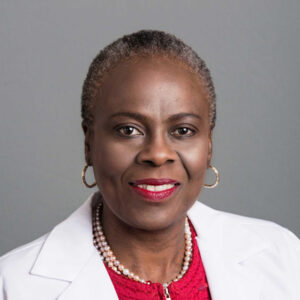
When Olufunmilayo I. “Funmi” Olopade was born, the most common Nigerian career aspirations were pastor or teacher. Olopade’s father, a pastor, thought differently. He wanted his children to be scientists, economists, and doctors.
As the fifth of six children, Olopade was her parents’ “one last chance to find a doctor in the family,” she said.
“Our community really prays a lot, our community wants good outcomes and when you have nothing, the only thing you have is God,” Olopade said. “And in my culture, in Yoruba culture, we believe in a lot of natural phenomena, but my father was exposed to science early because the missionaries took him to school at a very old age. Then if he would pray and then bad things still happened, he said maybe I should hedge my bet on science.”
Olopade listened to her father and, with her mother’s support, she graduated from the University of Ibadan in 1980.
The bet has paid off in the long run for Olopade, who is now the director for the Center for Clinical Cancer Genetics and Global Health at the University of Chicago. She co-founded the center in 1992.
Olopade recently shared stories of her upbringing in a recent conversation with Robert A. Winn, director and Lipman Chair in Oncology at VCU Massey Comprehensive Cancer Center and guest editor for The Cancer Letter for Black History Month, highlighting some of the giants in the field of cancer research.
Since 2022, The Cancer Letter has celebrated Black History Month with a series of interviews with giants in the field of cancer research.
Listen to this week’s conversation between Olopade and Winn on the Cancer History Project Podcast, available on Spotify, Apple Podcasts, and YouTube.
Olopade has won numerous awards and honors in her distinguished career, including a MacArthur Foundation Fellowship, otherwise known as the “Genius Grant.” Her 2005 MacArthur Foundation Fellowship came from her study translating findings on the molecular genetics of breast cancer in African and African-American women into innovative clinical practices in the United States and abroad.
This topic began to arise in Olopade as soon as she arrived in the United States and began working at the John H. Stroger, Jr. Hospital of Cook County in Chicago.
“I came to Chicago in a cold, wintry weather, landed at Cook County Hospital, and I saw a lot of Black folks, and those Black folks were just like the people I left behind in Nigeria,” Olopade said. “That’s why I was like, genetics is strong, no matter where you go.”
When Olopade was admitted into the University of Chicago in 1987, genetics was a controversial topic. But as an avid medical textbook reader, Olopade discovered the work of geneticist pioneer Janet Davison Rowley, MD, the Blum-Riese Distinguished Service Professor of Medicine and of Molecular Genetics and Cell Biology at the University of Chicago Medical Center. Rowley’s discovery proving that cancer was a genetic disease inspired Olopade to go into genetics.
Olopade also credits Harvey M. Golomb, MD, former chair of the Department of Medicine at the University of Chicago, for welcoming her into the field of genetics.
“Let’s just say the stars were aligned,” Olopade said. “I didn’t know what I was doing, but I kept putting one foot in front of the other, and from the minute I met Harvey Golomb, who really became a great mentor, and he asked me to go work in Janet’s lab, I was set. Because between Harvey Golomb and Janet Rowley, I couldn’t but just love genetics.”
Her breakthrough in research can be credited to a move to Chicago’s South Side to avoid traffic between dropping her children off at childcare and commuting to the University of Chicago. Golomb suggested a move to Hyde Park and a lightbulb went off.
“I said, ‘Hyde Park? But they told me, don’t live on the South Side,’” Olopade said. “That was the game changer, because Chicago is so racially segregated and you’re new in the city, and they tell you where to live. And the minute I discovered Hyde Park, and the University of Chicago, and my neighbors, that’s why I do work that impacts the community because these are my neighbors.”
When Olopade helped co-found the Center for Clinical Cancer Genetics and Global Health at UChicago, she realized her clientele was largely African-American women from her home on the South Side of Chicago. She noticed that although African-American women suffered breast cancer less frequently than white women, the disease was developing at younger ages. While this was common knowledge, Olopade asked the question: Why was no one studying the amount of young Black women diagnosed with triple negative breast cancer? This drew her back to her home country of Nigeria.
“When you do genetics, you’re going to understand that the genetic basis of every cancer, or everything we do, starts in Africa,” Olopade said. “You have to begin to appreciate the diversity that makes Chicago a great city because every single patient who came through my clinic was unique and different.”
In the late 1990s, on a trip to Nigeria with her husband, Olopade began to research breast cancer in Nigeria and compared it to what she had seen on the South Side of Chicago. Likewise, Olopade also went to Brazil to do the same research.
What Olopade reasoned was the early-onset tumors seen in so many young Black women from the South Side of Chicago to Nigeria, might be more so related to genetic factors rather than environmental or lifestyle.
“Every time I see a Black woman, I was like, she’s my long-lost cousin. I went to Brazil, and I was like, this person looks like my long-lost cousin,” Olopade said. “We may have been divided by the slave trade and the waters, but the culture of being happy, thinking about your spiritual beings, thinking about your ancestors, has stayed with us.”
Just like Olopade was once inspired by the work of those before her, Olopade’s research has inspired others to look at the links in genetics. In her conversation with Winn, Olopade encouraged others to look for inspiration outside of just the sciences, like she was by former First Lady Michelle and President Barack Obama, or Chicago Bulls legend Michael Jordan, or even her neighbors on the South Side of Chicago.
“Look at how many people are in science now that were not even allowed to be part of a scientific community,” Olopade said. “What I’m saying is the community can influence you, and I’m hopeful that not only NIH supports our research, foundations support research, we have now people from our communities that are wealthy. They’re telling the stories. We just need to make sure that they can see role models in their own communities.”
Read the transcript on the Cancer History Project, and listen to the full episode on Spotify, Apple Podcasts, and YouTube.