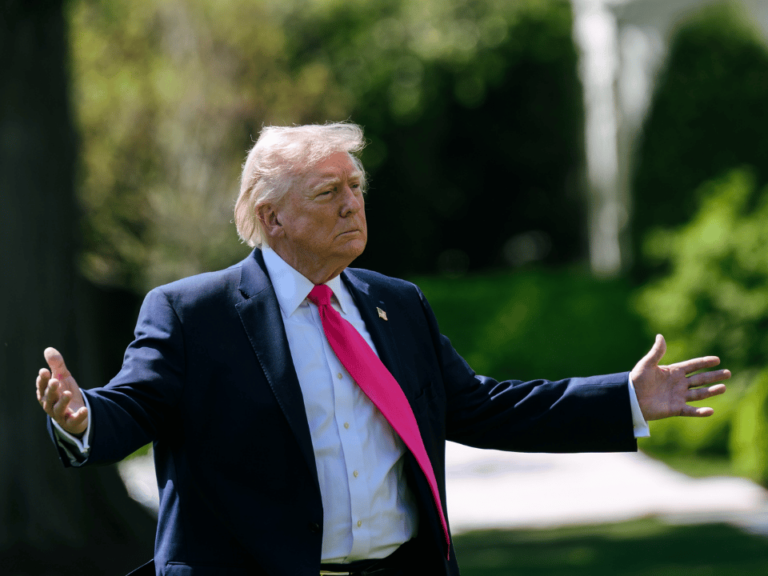
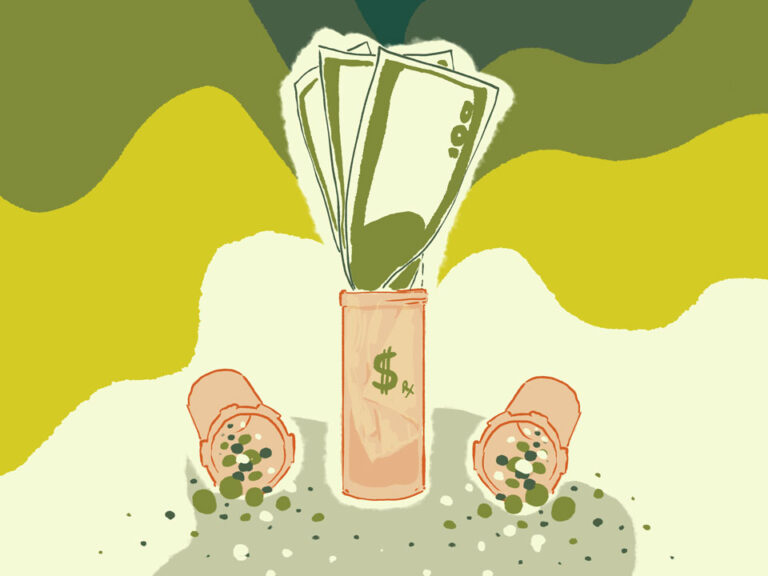
On July 21, President Donald Trump announced his latest set of sweeping tariffs on the pharmaceutical industry: a 200% levy on imported generic drugs by the year 2029.
This episode is available on Spotify, Apple Podcasts, and Youtube.
Trump imposed tariffs on branded drugs in April, which were met with concern about increased drug costs and decreased U.S. competitiveness in the global drug development market. However, a more dire concern—a familiar one—is arising now that tariffs are extended to generics: Shortages.
At the time of the announcement, Jacquelyn Cobb, associate editor with The Cancer Letter, wrote a story about the news with expert commentary from Marta Wosińska, a healthcare economist and senior fellow at the Brookings Institution Center on Health Policy. In this episode of The Cancer Letter Podcast, Jacquelyn speaks with Wosińska to drill deeper into the potential implications of Trump’s new tariffs on generic oncology drugs.
In the conversation, Wosińska explains how tariffs will likely not be able to achieve the goals Trump hopes.
“This is yet another wrinkle in a really unstable system,” Wosińska said. “And whether or not tariffs are playing into this—and tariffs could potentially make things more challenging, you know. Onshoring is not necessarily going to solve our problem, because we have already a lot of domestic manufacturing, and it’s really not a domestic versus foreign problem.”
The problem is much more complicated, and shortages—particularly of generic drugs like platinum-based chemotherapies—are a persistent, crippling, and sometimes deadly problem in oncology.
“What we do have is a very fragile system that’s not reliable,” Wosińska said. “So, you know, setting tariffs aside, we have a broken system and we have to repair that system.”
Stories mentioned in this podcast include:
This episode was transcribed using transcription services. It has been reviewed by our editorial staff, but the transcript may be imperfect.
The following is a transcript of this week’s In the Headlines, a weekly series on The Cancer Letter Podcast:
Jacquelyn Cobb: This week on the Cancer Letter Podcast.
Marta Wosińska: If you have a drug where 100% of it is affected by a tariff, even though this is a generic and you could cut it by another version, there is no other version. All of them are affected by the tariff. You don’t really have a choice. The price can go up; right?
But there are certain pockets and certain payers where prices cannot go up by more than the level of inflation. Medicaid is really sort of the starting point. So, the more of an exposure to Medicaid you might have as a manufacturer, you will have to pay a rebate above the level of inflation. The level of inflation right now is 4%; right? So, you’re basically paying 96%, you’ll have to pay back to Medicaid.
Paul Goldberg: You’re listening to the Cancer Letter Podcast. The Cancer Letter is a weekly independent magazine covering oncology since 1973. I’m your host, Paul Goldberg, editor and publisher of The Cancer Letter.
Jacquelyn Cobb: And I’m your host, Jacquelyn Cobb, associate editor of The Cancer Letter. We’ll be bringing you the latest stories, groundbreaking research, and critical conversations shaping oncology.
Paul Goldberg: So let’s get going.
Jacquelyn Cobb: Welcome, Dr. Wosińska. Thank you so much for taking the time to speak with me today. A few weeks ago, I leaned heavily on your presentation and your work for a story about Trump’s new plan to impose steep tariffs on generic prescription drugs.
Marta Wosińska: Yeah.
Jacquelyn Cobb: And in the past, I’ve covered your expert commentaries on drug shortages in oncology specifically. But in that last story, I really only talked to you about—or I didn’t even really talk to you, you gave really wonderful resources to journalists right after that happened—but that was from sort of a broader stance. And you so graciously offered to kind of drill into the oncology piece for us on this podcast. So, thank you for being here with me today.
And if we can start with just a general overview, kind of what you gave the journalists a couple of weeks ago, that I received: Just sort of a general overview of what the news is and what Trump has done recently and what his goals are.
Marta Wosińska: First of all, thank you for the invitation. I’m happy to be here.
I think it’s really important to understand how oncology drugs are different from other drugs. So, this is really great, to do this deep dive.
So, let me first set the stage here. The Trump administration has been very much interested in using tariffs to accomplish multiple goals across all sorts of sectors. For pharmaceuticals, there have been several goals. Some of them are tied to where the drug is made. There’s been a concern that a lot of our drugs are made outside of the United States and that [tariffs] might actually drive onshoring, or that it might protect existing U.S. manufacturers.
For branded drugs, there’s sort of been another layer to it, which is to really participate in and sign the MFN [Most Favored Nation] deals with the administration. So, in a sense, the tariffs were less about—I mean the Trump administration wants to lower drug pricing; right? So, putting 100% tariff on a branded product seems like the complete opposite of it, but the tariff is so large that it really leaves the manufacturer no choice but to come to the table and do whatever they can to avoid that tariff.
And so, that’s the premise. You know, you could be pushing really high tariffs to basically drive onshoring, because that’s one way out. And another way is to do it to accomplish other goals such as, you know, signing MFN deals.
And the tariffs that had been announced earlier this year try to go both ways: One is to drive some level of onshoring, and if there are onshoring plans in place, then the tariff goes down to 20%. And then, if you have an MFN deal, then it can go down to zero. But there are trade deals already in existence with other countries, like the EU has, I believe, 15%, which means that you don’t even have to onshore—you can just pay the 15%, which is something that a branded manufacturer can very much absorb. So, this is something that they can sort of live with—a 15%, 25% hit, because their margins are large.
So, when the Trump administration was considering how to handle generics, they initially backed off and they said generics and biosimilars are not going to be affected. But recently, President Trump made an announcement. Other than his post on Truth Social, I am not aware of any additional detail about putting on tariffs. So, he announced that he would put tariffs starting two years from now, of 100% on generic drugs and 200% after that, unless they onshore. That’s all the detail we have.
Jacquelyn Cobb: I will just say, when I was reporting on that, I was a little bit nervous writing a whole story when all we had was the Truth Social post. So, the one thing we do have at least is confirmation from the White House that this is official policy. But yes, no other details and no report, a little bit weird of a situation there. But we do know that it’s official policy, at least for now. So, thank you for the overview. Can we drill a little bit into the oncology sort of specific side of things now?
Marta Wosińska: Absolutely.
So, you know, the big question is how is this going to impact availability and prices of oncology drugs; right? And there are a number of moving parts here, and I have a lot more certainty over some than others.
And so, I’ll try to walk through how this might play out.
A lot of the drugs that we get in the United States, we mostly use solid oral dose products, tablets and capsules. Just massive amounts of it. In a report that I that I did last year using IQVIA data, I estimated that we consume something like 187 billion tablets and capsules a year. It’s a massive number. And I would say almost two-thirds of it, well over 60% of it, comes from India. Also some from Europe, a little bit from China. It’s very heavily coming from from India.
Jacquelyn Cobb: My gosh, what an image.
Marta Wosińska: Because so much of these tablets are coming from outside of the United States, a 100% tariff definitely is going to show up; right?
So, a big swath of the market for certain drugs, probably 100% of what’s available, might be affected by the tariff. And then the question is: What happens next? And that is going to a bit depend on the kind of setting and the payers that are in the market.
So, you know, if you have a drug where 100% of it is affected by a tariff, even though this is a generic and you could cut it by another version, there is no other version. All of them are affected by the tariff. You don’t really have a choice. The price can go up; right?
But there are certain pockets and certain payers where prices cannot go up by more than the level of inflation. Medicaid is really sort of the starting point. So, the more of an exposure to Medicaid you might have as a manufacturer, you will have to pay a rebate above the level of inflation. The level of inflation right now is 4%; right? So, you’re basically paying 96%, you’ll have to pay back to Medicaid.
Medicaid exposure very much varies by drug. And also another important piece, and this becomes even more important for cancer drugs, is that the Medicaid inflation rebate translates into the 340B discount. So, the same applies if there’s a 340B hospital and is using this drug, they’re going to get that discount as well.
So, the question is going to be can a manufacturer with 20% Medicaid market share absorb basically having to—they’re going to have a major loss on any units that are being sold to Medicaid. They cannot decide not to sell to Medicaid; right? So, you know, how much they can is all going to depend on what level of margin they already have; right? So, you know, there might be situations, depending on the market share, that they could still, with a small margin, make it and not go under.
But the larger your exposure to these programs, the more likely it is that you’ll actually decide, I can’t make money in the U.S. market, I’m going to exit the U.S. market. And so, I think that’s been the major concern.
And one initial pushback around tariffs is that it takes five years to build a new facility. Here, you’re only given two years. And the question is: Are you sending a strong enough signal to manufacturers that you should be in the U.S.? And remember, a domestic manufacturer is going to face the same type of pressure in terms of pricing. So, if you already have a facility in the U.S. and you’re trying to ramp up production, you cannot increase your price; right? You’re subject to the same rules.
So, in a normal market, you know, the price of the competitive product goes up, and the price of the domestic product will go up, incentivizing further the domestic production; right?
Here, you’re going to have a problem with that. It’s going to be limited, and you would have to have new players coming in on the market. But again, they don’t necessarily have capacity.
This is why it’s a major concern, especially on drugs that are heavily imported, is that the margins are so small that they will have a really hard time absorbing. And unlike in Europe—some of them are coming from Europe, so maybe they’ll be paying the 15% rate. India is not part of any deal. There, the tariff would actually be very high, unless they strike some sort of a deal, which is not in the books. So, it could be a 100% tariff applied to a very large share of the market. So, that’s the general dynamic, especially for the solid oral dose products.
Cancer drugs are a little bit different.
On the kind of negative side, you have the 340B program. Cancer drugs are outpatient drugs; right? And more than half of hospitals are 340B hospitals, and a very large share of cancer hospitals are 340B; right? So, it’s not even half the sales for a manufacturer. Easily 70% of sales could be going through a 340B program.
So, now, if you are a foreign manufacturer, and these manufacturers tend to have, I don’t know, 10% margin. Single-digit margins. If you get slapped with a 100% tariff, you go under really quickly; right?
So, that’s the bad news. So, this is sort of the repeat. And then also, GPOs sign multi-year contracts where they say, “You’ll have to pay this price, and if you can’t deliver there are penalties.” So, that also complicates things.
The potentially encouraging piece is, unlike solid oral dose products, a lot of the sterile injectable drugs are made in the United States. So, the big question and the big unknown is how much capacity is there for making these kinds of drugs in the United States? And there’s definitely some. The question is, is there enough?
And that piece I can’t answer. So, you have Pfizer and Hospira; right? A big player in this space. You have Hickma, another manufacturer. Fresenius Kabi plays a role here as well. I believe Teva no longer is in play. They used to have a big facility that made cytotoxic drugs in Irvine, California, but I believe that that shut down. Nonetheless, there are players. So, to the extent that, Intas was a big player in India. If they are out of the market, would Pfizer and those other players have enough capacity to just be able to absorb it?
If they do, then we really don’t have a problem. And goal accomplished; right? And we actually now are getting it from the United States. The problem we run into is if there isn’t enough capacity. Because if they have to build capacity, that’s where we run into a wall. That’s where we run into the expense of building this and the uncertainty of whether we’re going to hang on to this market and the timelines that are involved, and the fact that I can’t actually increase my profit because of the 340B space.
As soon as we run into a capacity constraint, that’s where things become a challenge. So, the big question is: Of the manufacturers that are in the United States, do they have capacity?
Jacquelyn Cobb: Okay. And we don’t know that? How does one learn that?
Marta Wosińska: We don’t know. We can talk about this.
One of the challenges in this market is that the way contracts are set is that GPOs sign contracts with manufacturers where they say, “You will provide it at this price whenever we want [product from you], but we’re not going to sign a long-term contract with you.” It’s basically like, “We agree to this price, but we might buy nothing from you.”
And you know, it’s very easy. You can actually commit to buying from Pfizer, and they can make sure that there’s the capacity for you, and they’ll tell you in advance, “You sign a contract with me, I will make sure the capacity is there.” In a sense, that’s what Civica [Rx] does. You basically commit to a certain amount of product that you’re going to buy over a period of time, and they actually have a buffer that comes along with it in case there was some sort of a supply disruption.
But it’s a contract like a contract like you sign everywhere else, right? You usually sign up in advance and say, I’m going to have this for this amount of time and you’re going to guarantee that the product is going to be available. So, it’s very much a conversation that hospital systems, that GPOs can have with those manufacturers to say, “Would you have this capacity for me? Could you set this aside?”
So, it’s doable, and it’s knowable.
Jacquelyn Cobb: With this situation where there is some domestic capacity and we’re just not exactly sure how much. What about the incentive structure? You said Pfizer, if they have sort of this unknown capacity, why would they go to generics when they also have capacity for branded drugs? I might be misunderstanding that. But, if they’re going to make more money in branded drugs, why would they, you know, increase capacity in the generic drug space where they have demand but still not a lot of profit margins from what I understand.
And then the other thing was the APIs, but maybe we’ll come back to that. I feel like what I just asked is probably enough for one question.
Marta Wosińska: So, when we talk about capacity, there’s sort of a couple of things to consider. One is that it has to be very specific capacity. So, you know, Pfizer might have multiple plants, but they can only make cancer drugs on certain lines. So, capacity, especially for cancer drugs, cytotoxic drugs, they tend to be made on dedicated lines. So, that’s the space to consider.
Generally, branded and generic drugs are not made on the same facilities, so the competition might not be as strong. Initially, I think one cancer drug competes against another cancer drug that might be generic. But again, they really do compete for capacity; right? So, they can only make so many, you know, can only run the line so for so many hours in the day, and you have to switch between products, and this is actually where higher volume drugs tend to win, because the downtime between products—you have to clean, you have to do all sorts of changes and validation and so on. It’s much easier for you to just run one product in really large batches.
Ultimately, I think the more pressure that the administration is pushing on the branded products to actually onshore, I’m not sure that this is a question about maybe how Pfizer would allocate product, although there is that question. But also the question around contract manufacturing facilities, some of which do make generic drugs. And for them, you know, they’re definitely going to get probably a much higher margin for from a branded manufacturer that tries to escape the tariffs from China, India, Singapore, and so on. So, the the capacity is getting squeezed both because of branded products and generic products potentially trying to fit the same set of lines.
Jacquelyn Cobb: Very interesting. I think we’ve sort of talked around this a little bit, but you know, obviously, the concern in oncology is drug shortages; right? You mentioned the fact that the for generic oncology drugs, it’s not necessarily that they’re all made offshore. But the API, from what I understand, is pretty much all from outside the United States or largely from outside the United States. Is that correct?
Marta Wosińska: So, I don’t know for cancer drugs specifically. I actually don’t know that. What what I can tell you is that the level of API and exposure that the U.S. has specifically to China is very much mischaracterized. It is true that a lot of antibiotics are made in China, no doubt about it. The Chinese really control the not even far upstream supply chains, but they very much make if not the API then the precursor to that; right? Because they really have a monopoly on all the fermentation steps.
But I think the reliance on China for API has been overstated. And people say 80%, which isn’t true. It’s about 25% of volume. It varies by therapeutic class, again, antibiotics probably on the extreme. Where we have a lot of reliance on China is not on the API, but on the key starting materials and some of the kind of chemicals that feed into the drugs. And that is very true. We have tremendous reliance on China for those for those sort of precursors and the ingredients that go into API. So, I think that’s really important to distinguish. But I can’t really tell you specifically for cancer drugs where the API really gets made.
Jacquelyn Cobb: That makes total sense. We have plenty of questions to cover.
The next thing, and this is sort of outside of oncology, but if you can bring it into oncology—why have generics been exempt from tariffs so far? I probably should have asked this earlier, but I got carried away with some of the fun detailed questions.
Marta Wosińska: So, again yeah, I might have touched on it a little bit, is the risk of shortages. They really don’t have the kind of a margin that would either let them absorb you know, so let’s say a 100% tariff is really like putting somebody against the wall no matter what, even with a branded manufacturer. A 25% tariff on a drug that sells for, you know, $10,000 might only cost a $100 to make. You have massive, like 99%, margins. You can absorb 25%. For a generic, it’s going to be single digits.
So, you know, you’re not going to be able to absorb anything. But also the large margin allows you to say, “Okay, let’s say that I build this. Over time I can recover. I actually have capital available and I am able to pay this off.” And for a generic, not only is the margin too low to absorb it, but also you really don’t really have any incentive to make major capital investments.
So, it sort of comes on both sides. And because of this, there’s been a fear of shortages. So, it will be really interesting to see how this plays out. Again, when you look at tariffs for branded products, the idea was not so much just onshoring, but also the MFN deals. There’s no such thing. There is no such “Let’s lower the drug prices at the same time” for generics. We already pay less for generics than Europeans do. So, you don’t have this kind of a dynamic playing into it.
So, I guess we’ll see where we go from here. Maybe but I mean, one thing to look for is the level of exemptions that might come into play; right? Even with section 232 branded tariffs, there are a lot of exemptions in there already. So, for example, orphan drugs are exempt, which really takes a lot of different drugs out of the space. So, they don’t have to worry about that.
And then also, the tariffs from countries that have negotiated multilateral tariff agreements that also apply. So, I guess we would have to wait and see whether it’s really going to be 100%.
Jacquelyn Cobb: From my perspective, at The Cancer Letter, we’ve covered really horrific drug shortages, especially of these generic, specifically the platinum drugs, I feel like are the ones… that’s what I’ve covered at least. There’s been others, but it feels like this recurring issue.
It’s this unsolved problem, these unsteady or unreliable supply chains. And it’s just a little disheartening to have now another challenge thrown into that world of generics that might also affect availability.
Marta Wosińska: Yeah, that’s right. Supply chains.
Jacquelyn Cobb: So, yes, we’ll have to wait and see. I’ll try to be more optimistic than how I’m sounding right now. One of our last questions is: What will the impact be on oncology if this policy were to remain in effect? I think you maybe just answered that basically saying we can’t know exactly for sure, but just in case there’s anything else you want to say on that question before we move on.
Marta Wosińska: I think what I would like to say is to go back to what you were just talking about, meaning that this is yet another wrinkle in a really unstable system. And whether or not tariffs are playing into this—and tariffs could potentially make things more challenging, you know. Onshoring is not necessarily going to solve our problem, because we have already a lot of domestic manufacturing, and it’s really not a domestic versus foreign problem.
What we do have is a very fragile system that’s not reliable. This is a very, very unprofitable business for manufacturers to be in. They really don’t have strong incentives to be investing in quality systems. They really have a hard time differentiating themselves on reliability because frankly, hospitals really pay attention to price and not whether they get reliable supply. You know, they want to be first in line at the potential risk of shortage, but they don’t want to sort of in advance saying, “I’m actually going to commit to a long-term contract to make sure that I really do get the product.” So, you know, setting tariffs aside, we have a broken system and we have to repair that system. And so, you know, I am very much hoping that Senate finance will come back to the legislation that they had proposed a couple of years ago. And, you know, we need to think about how to how to fix the real… But that’s a different conversation.
Jacquelyn Cobb: Yes. That’s a conversation I would really like to have more deeply with you in the near future, if you have time.
Thank you so much for being with me, Dr. Wosińska.
Marta Wosińska: Sounds great. Thank you for having me. Take care.
Jacquelyn Cobb: Thank you for joining us on the Cancer Letter Podcast, where we explore the stories shaping the future of oncology. For more in-depth reporting and analysis, visit us at cancerletter.com. With over 200 site license subscriptions, you may already have access through your workplace. If you found this episode valuable, don’t forget to subscribe, rate, and share. Together, we’ll keep the conversation going.
Paul Goldberg: Until next time, stay informed, stay engaged, and thank you for listening.