One of the greatest challenges in cancer immunotherapy is finding the rare immune cells, called tumor-reactive T cells, whose job it is to recognize and eliminate tumor cells.
The immune cells collected from a tumor are specific for other targets the patient may have encountered in the past—viruses like flu, COVID, or other pathogens unrelated to the tumor—with very few that are tumor-specific. Yet those rare cells often hold the key to whether immunotherapy will work.
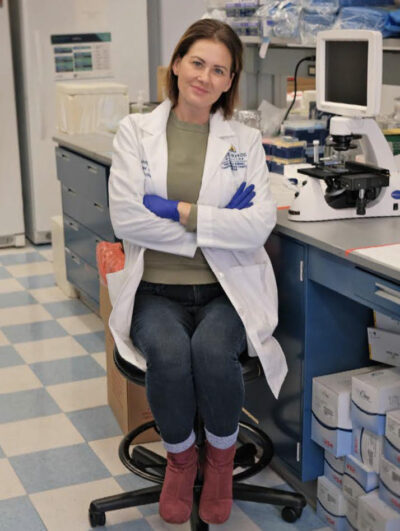
“To identify predictors of response to immunotherapy, we need to be able to study the immune cells that recognize tumors,” Kellie Smith, Ph.D., Bloomberg Kimmel Institute for Cancer Immunotherapy researcher said.
So she and her team developed a powerful new tool, called MANAscore, to identify these critical, but elusive tumor-reactive immune cells.
The idea grew out of years of time-consuming and costly research that yielded only small glimpses of tumor-specific immune cells. The findings, however limited, were revealed through sophisticated research strategies, but Dr. Smith was determined to find a better approach.
“It was very expensive. It took a really long time, and it used a lot of patient samples, and we were still only able to find these cells in three patients,” said Dr. Smith.
Using the tools of AI, Dr. Smith and team were able to sort through immense data sets and condense terabytes of complex data into a model built on just three well-known genes: CD39, CXCL13, and the IL-7 receptor.
MANAscore’s genius is in its simplicity. The three-gene panel works better than other models that require 200 genes or more, making MANAscore a practical way to routinely test for tumor-reactive immune cells, including on archival tissue samples already collected from patients. Early study results show that the frequency of these three-gene–positive cells correlate strongly with how well patients respond to immune checkpoint inhibitors.
These three key genes help reveal how T cells respond to cancer, marking cells that recognize the tumor, but are worn down, yet still targetable by therapy. They also draw in other immune cells to build strong local hubs of immune activity, and those that help T cells survive and remember the cancer for lasting protection. Together, they show which T cells are most engaged and, even in tiny numbers, capable of initiating an immune response.
The team is now validating MANAscore by looking back at pre-treatment biopsies from patients whose outcomes are already known and then moving forward to test the model prospectively as new patients begin treatment. They are also using the tool to explore how tumor-reactive T cells interact with their cellular “neighbors,” including regulatory T cells that may suppress the immune response. Insights from these studies could point to new treatment strategies.
Dr. Smith says this is where the power of AI shines, making the overwhelmingly complex understandable and clinically useful in record time.
To identify predictors of response to immunotherapy, we need to be able to study the immune cells that recognize tumors.
Kellie Smith
“Our model allows us to skip a time-consuming and expensive process to identify the cells targeted by immunotherapy,” she explains. “It will help us learn what distinguishes patients who will respond from those who will not.”
MANAscore is still a research tool, but Dr. Smith believes it may be ready for clinical use to guide the treatment of patients within the next two years.
She says, “by applying MANAscore to a single biopsy slide, we may soon be able to quickly predict which patients are most likely to benefit from immunotherapy.”
Progress can’t come soon enough for patients, including one woman who goes by REBB. She received immunotherapy for her pancreatic cancer, and lost her daughter Valerie to breast cancer.
“I am passionate about research, and the idea that we can move so much faster using AI is extremely exciting,” says REBB, who describes feeling so weak before beginning treatment that she needed a wheelchair for any prolonged distance. She believes her life was saved by Kimmel Cancer Center research and an immunotherapy clinical trial. “Almost immediately, I started feeling better. My immune system was destroying the cancer. By April, I was running through the airport, and by December 2022, I was cancer-free. I want this for all cancer patients.”