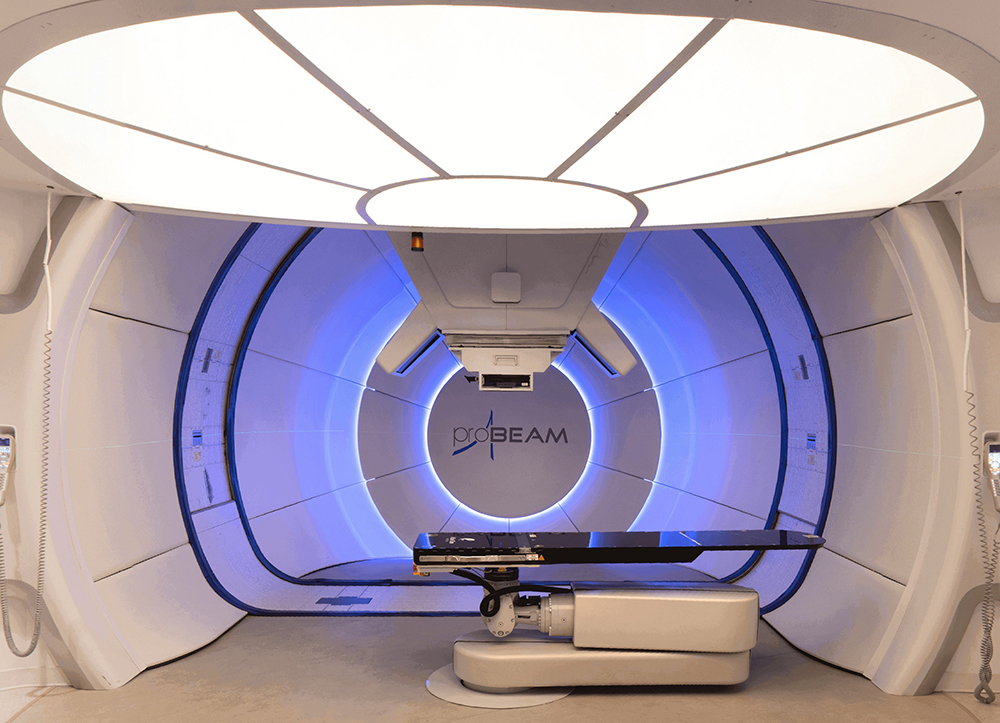
Radiation therapy has been a cornerstone of cancer care since 1896. For more than a century, the central challenge has remained unchanged: How to eradicate tumors while preserving the normal tissues that allow patients not only to survive, but to thrive after treatment.
As systemic therapies and surgical techniques have evolved, radiation oncology appropriately has faced increasing pressure to deliver a cure with fewer long-term consequences.
That pressure has catalyzed one of the most meaningful technological advances in modern oncology: proton therapy. Particularly with pencil beam scanning, proton therapy leverages the physical principle of the Bragg peak, allowing radiation dose to stop at a defined depth rather than passing entirely through the body as photons do.
Proton therapy leverages the physical principle of the Bragg peak, allowing radiation dose to stop at a defined depth rather than passing entirely through the body as photons do. The practical implication is profound: Reduced exit dose and less unintended radiation to the heart, lungs, spinal cord, esophagus, and other vital structures.
The practical implication is profound: Reduced exit dose and less unintended radiation to the heart, lungs, spinal cord, esophagus, and other vital structures.1
This physical advantage would matter little without clinical validation. Fortunately, the evidence base continues to mature. A randomized trial published in The Lancet in December 2025 demonstrated improved survival and reduced toxicity in patients with oropharyngeal head-and-neck cancer treated with proton therapy compared with photon therapy.2
Patients receiving protons for these cancers experienced lower rates of feeding tube dependence, less xerostomia, improved swallowing function, and better overall quality-of-life metrics. These findings suggest that dosimetric advantages are translating into meaningful patient-centered outcomes.
Breast cancer also provides a compelling example. For patients requiring comprehensive nodal irradiation, particularly those with left-sided disease, the heart lies perilously close to the radiation field. Radiation-induced heart disease is a well-documented late effect, with even small increases in mean heart irradiation dose associated with measurable increases in major coronary events.4
In this context, reducing cardiac irradiation exposure is not merely a technical improvement; it is a survivorship imperative.
The ongoing RadComp trial represents the most rigorous effort to answer this question to date. RadComp is a large, multicenter, randomized phase III comparative effectiveness trial evaluating proton versus photon therapy in patients with non-metastatic breast cancer requiring comprehensive nodal radiation.3
Importantly, its design mirrors the longitudinal structure of landmark public health studies. Patients are being followed for major cardiac events, loco-regional tumor control, and long-term survival for over a decade or more.
Early patient-reported outcomes presented at ASTRO 2025 demonstrated excellent quality of life across both treatment arms, with signals favoring proton therapy in certain symptom domains, including shortness of breath. Patients treated with protons were also more likely to indicate they would choose the same treatment again. While these early endpoints are encouraging, the most consequential data remain ahead: adjudicated major cardiac events, late toxicities, and long-term disease control, with these outcomes expected between 2028 and 2032.
It is here that the analogy to another landmark trial, the Framingham Heart Study, becomes particularly instructive. Framingham did not revolutionize cardiology overnight. Rather, through sustained longitudinal observation, it identified risk factors—hypertension, cholesterol, and smoking—that reshaped preventive medicine for generations.5
If the forthcoming data demonstrate meaningful reductions in major cardiac events without compromising cancer control, the implications will extend far beyond radiation oncology. They will reshape how we define the cure itself.
RadComp seeks to apply that same longitudinal rigor to radiation oncology. Instead of focusing solely on acute toxicity or short-term tumor response, it asks whether reducing radiation dose to the heart today will translate into fewer cardiac events years from now. If confirmed, such findings would fundamentally alter how we define value in breast cancer radiation therapy.
Beyond primary treatment, proton therapy is expanding options in complex scenarios where conventional radiation has historically been constrained. A recent publication in Radiotherapy & Oncology discusses promising outcomes for proton therapy in reirradiation of recurrent breast cancer, where cumulative dose to organs such as the heart, lungs, brachial plexus, spinal cord, and esophagus often precluded additional treatment.6
For selected patients, proton therapy reopens doors for potential cures that were once closed.
As access increases—according to the National Association for Proton Therapy (NAPT): 47 proton centers now operate in the United States, compared with only five before 20107—the responsibility to refine patient selection grows equally urgent. In 2024, the NAPT, the Proton Collaborative Group, and PTCOG–North America convened a research forum to define priorities for the next generation of particle therapy trials.8
The consensus emphasized equity-focused enrollment, standardized quality assurance, integration of patient-reported outcomes, and endpoints that capture late toxicities and functional preservation.
Innovation in delivery techniques continues to accelerate this progress, including:
- FLASH proton therapy, delivering ultra-high dose rates in milliseconds, is under active clinical investigation following early feasibility data published in JAMA Oncology in 2023.9
- Proton stereotactic body radiation therapy (SBRT) allows ultra-conformal treatments delivered over five or fewer sessions, optimizing both convenience and tumor control.
- Spatially fractionated radiation therapy (SFRT) introduces lattice-style dosing that may enhance immunologic synergy in bulky or resistant tumors.
Each of these innovations reflects a broader philosophical shift in oncology. The goal is no longer solely the eradication of disease, but the preservation of organ function, productivity, and long-term quality of life.
Proton therapy is not universally indicated, nor should it be. However, for pediatric patients, individuals requiring reirradiation, and patients with challenging to treat tumors at higher risks of toxicities, including cardiac or pulmonary toxicities, with traditional radiation, the capacity of proton therapy to reduce collateral damage may prove decisive.
Cancer survivorship is measured in decades. The trials we design today, like RadComp, must, therefore, be powered not just for tumor control, but for long-term cardiovascular and functional outcomes.
If the forthcoming data demonstrate meaningful reductions in major cardiac events without compromising cancer control, the implications will extend far beyond radiation oncology. They will reshape how we define the cure itself.
References
- Paganetti H. Proton beam therapy. Phys Med Biol. 2012;57(11):R99-R117.
- Frank SJ, et al. Proton vs photon therapy for oropharyngeal cancer: randomized trial. Lancet. 2025;[Epub ahead of print].
- Darby SC, Ewertz M, McGale P, et al. Risk of ischemic heart disease in women after radiotherapy for breast cancer. N Engl J Med. 2013;368(11):987-998. doi:10.1056/NEJMoa1209825
- Bekelman JE, Lu H, Pugh S, et al. Pragmatic randomized trial of proton vs photon therapy for breast cancer – the RadComp trial. J Clin Oncol. 2020;38(15_suppl):TPS603.
- Dawber TR, Meadors GF, Moore FE Jr. Epidemiological approaches to heart disease: the Framingham Study. Am J Public Health Nations Health. 1951;41(3):279-286.
- Choi JI, et al. Proton therapy for breast cancer reirradiation. Int J Radiotherapy & Oncology. 2025;[In press].
- National Association for Proton Therapy. Proton therapy center census. 2025.
- Proceedings of the 2024 NAPT–PCG–PTCOG North America Proton Therapy Research Forum. Int J Radiat Oncol Biol Phys. 2025;[In press].
- Bourhis J, Montay-Gruel P, Gonçalves Jorge P, et al. Clinical translation of FLASH radiotherapy. JAMA Oncol. 2023;9(1):1-2.