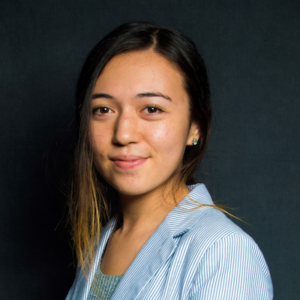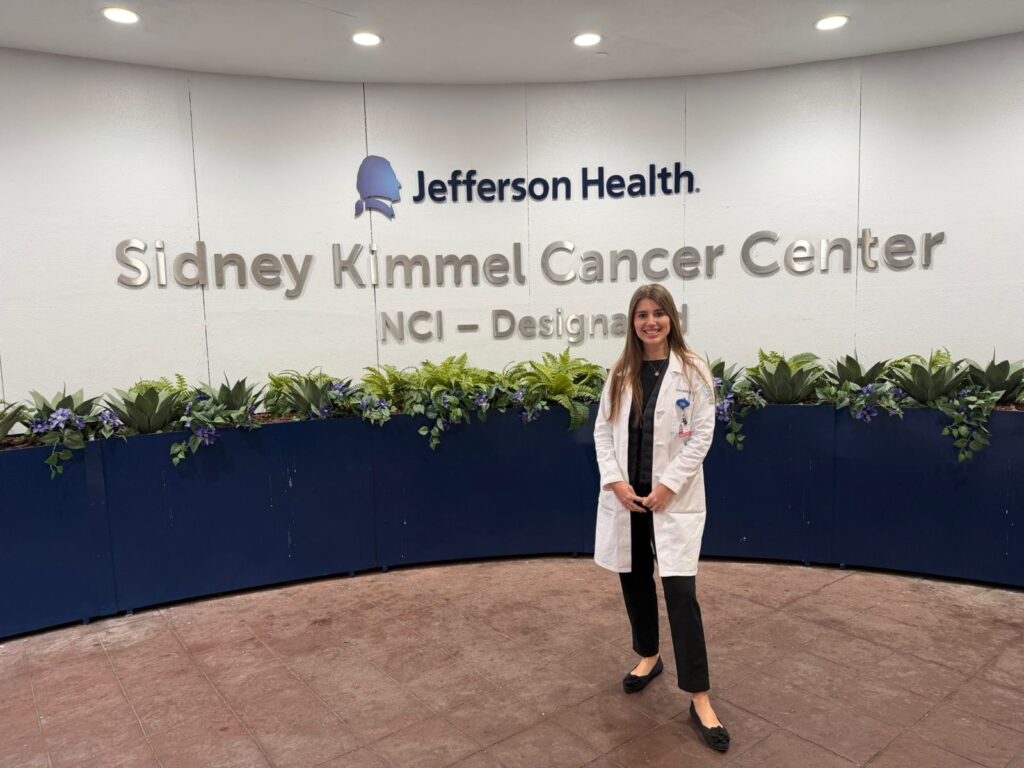
It took Yuliia Lozko nearly three days to travel to Sidney Kimmel Comprehensive Cancer Center at Jefferson Health in Philadelphia.
The Ukrainian oncologist, on her way to begin a six-week observership sponsored by the Union of Councils for Soviet Jews, departed from Kyiv in mid-February and a comedy of errors ensued—it took two flight delays, two cancellations, and a zig-zag journey from Poland to Germany to San Francisco before she finally landed in Philly.
Compared to the typical stresses of her day-to-day life as an radiation oncologist at the National Cancer Institute of Ukraine, these hiccups merited a laugh and a shrug, said Lozko.
Since Russia launched its full-scale invasion of Ukraine four years ago, Lozko has been treating patients under wartime conditions. She has become accustomed to the constant threat of missiles, the regular rolling blackouts in her city, and limited access to heat, even as the country experienced this past “coldest winter” of the war.
“I would describe it as four years of constant stress and bombing,” Lozko said to The Cancer Letter. “At the beginning [of the war], we would have said, ‘Yeah, it’s going to finish in a month. We really hope until the end of the year.’ Now, it’s been four years, and we face the reality that it’s not that easy and it’s not that fast.”
As the years dragged on, the shock settled and a new, disturbing reality calcified in its place. Business as usual was flanked by obstacles and interruptions arising at any moment—from water outages to low drug supplies to missile attacks while patients are already open on the operating table.
“To be honest, [the challenges are] consistent and it’s not getting any easier,” Lozko continued. “Some days it’s getting only harder, but not easier, for sure.
“It’s been four years, but I’m still scared of all those explosions, bombing, and air raids. Some people got used to that. I still can’t. I don’t know if it’s good or bad, but it is what it is.”
Lozko and her colleagues penned a guest editorial in The Cancer Letter during the first year of the war, which was marked by a staggering number of healthcare facilities damaged or destroyed beyond repair and a mad dash to evacuate pediatric cancer patients out of the country (The Cancer Letter, Oct. 21, 2022).
Our people are more afraid of cancer than of war.
Yuliia Lozko
About 6.9 million Ukrainians are refugees abroad while 3.7 million are internally displaced within the country.
At the time, Lozko and her colleagues also warned about the risk of “de-skilling,” particularly for Ukrainian physicians that have fled abroad, and the threat it may pose to the country’s medical institutions.
“Some people have left the country because they have small kids, because they feel unsafe,” Lozko said. “This is totally understandable and nobody judges them for that, but we do have this trouble.”
Radiation oncology has seen these dips: The number of radiation oncologists, radiation therapists, and medical physicists in Ukraine have decreased by 7.8%, 10%, and 7.3% respectively from 2021 to 2022, according to survey data of 25 RT centers in Ukraine collected by the Grigoriev Institute for Medical Radiology, Kharkiv. The total number of patients treated with external beam radiotherapy decreased by 11% and brachytherapy by 21%.
These concerns have marshalled a series of observerships and training positions abroad as one solution to combat the issue.
In August 2022, Lozko embarked on a nine-month observership at Stanford Cancer Center, organized by the Help Ukraine Group. She was in the middle of her residency then, which switched to online remote classes due to the war. The observership acted as a wartime replacement for that in-persontraining.
“How can I learn how to be a great radiation oncologist online?” Lozko said. “How is that possible? Also, the [length] of residency is very different [in Ukraine]. It’s much shorter than in the U.S. And then, if it’s online, that’s just nothing.”
This time, Lozko returned stateside for a second observership at Sidney Kimmel Comprehensive Cancer Center. She was joined by another radiation oncologist, Vadym Vasiura, who works at the Clinical Center of Oncology, Hematology, and Palliative Care in Cherkasy, also in Central Ukraine.
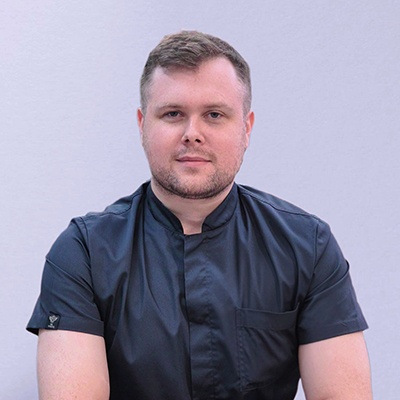
Two other oncologists—Oleksandra Pryhkodko, a clinical oncologist at the Kyiv City Clinical Oncology Center, and Alina Syrota, department head of the Modern Oncology Outpatient Chemotherapy Unit at Chernihiv Medical Center—will be observing at Sidney Kimmel at Johns Hopkins Medicine.
“This is not just sitting and watching,” Paul Goldberg, president of UCSJ, said to The Cancer Letter. “An observership is also making contacts. It’s also being able to call a doc at Jefferson or Hopkins and say, ‘Hey, what do I do with this patient? How do I dose?’ That can be career changing.”
Goldberg is the editor and publisher of The Cancer Letter. Goldberg served as a source for this story, but was not involved in its reporting or writing.
Since Lozko arrived at Jefferson Health, she has participated in tumor boards and mini rotations. She has observed a hyperthermic intraperitoneal chemotherapy procedure and brachytherapy sessions for prostate and gynecological cancers, and explored the MR-LINAC machine—equipment that her home hospital in Ukraine does not have.
“Radiation oncology is a field that has changes every single month because it goes together with technologies, with AI. We have to be up to date,” Lozko said. “Now, government and international collaborators have helped us a lot with equipment, so most of the hospitals in Ukraine have new LINAC. Our skills need to be upgraded as well.”
Ukraine is making upgrades despite the war, purchasing 21 linear accelerators for high-precision radiation therapy in 2023-2024.
It’s a very big update. Of course I want to see how they do it in the U.S., where they have used linear accelerators for many years.
Vadym Vasiura
“Ukraine has upgraded its radiation oncology equipment, even during the war,” said Goldberg. “A huge, huge, huge investment. Now they’re using linear accelerator machines. They’re hard to maintain, they’re hard to work with, plus a lot of the docs end up getting drafted and going to the frontlines, so it’s kind of difficult for them to really learn how to use this equipment and how to perfect it. And sometimes, it’s really hard to even maintain it and get parts.”
Vasiura said that his hospital installed a new machine this past summer.
“It’s a very big update,” Vasiura said to The Cancer Letter. “Of course I want to see how they do it in the U.S., where they have used linear accelerators for many years…Before that we had old cobalt machines, a very old method of treatment. So, we are happy to treat with new linear accelerators, a more accurate treatment.”
Ukraine has had one of the lowest numbers of megavoltage RT machines per capita in Europe. The renovations have been an ongoing project for more than a decade (The Cancer Letter, Aug. 5, 2022).
Practicing back home
Lozko’s three-day commute to the U.S. helped her escape the tail-end of a particularly brutal winter in Kyiv—where heat and electricityhas been spotty.
“This winter is awful, actually,” said Lozko. “With that kind of temperature, then imagine, plus missile attacks.”
Russia has attacked power stations and transmission lines, causing strain on the grid. Operators have had to ration electricity via rolling blackouts.
The hospital, critical infrastructure, has priority access. But this past winter, Lozko’s apartment lost heat for about five days. Many days, she only had four hours of electricity.
Many of her patients were much less fortunate.
“Before I came to Jefferson, I asked some patients, ‘How are you doing? How is everything?’” Lozko recalled. “They said: ‘Yeah, everything’s fine. Symptoms are fine. It’s just at home, it’s like plus five degrees celsius and freezing cold.’ People get sick, they just stop coming because elevators are not working. I do have lots of elderly patients that cannot get out of their buildings. So, there’s no power, no heating.”
There were times the hospital had to resort to a generator. Some services were able to continue, but radiation therapy came to a halt.
“Linear accelerators need a lot of power,” Lozko said. “We had to tell patients, ‘Sorry, we’re not treating today because the machine is not working.’”
Water shortages have resulted in similar disruptions, Lozko said, because the machines’ cooling systems need water.
These physical limitations seem to be the biggest obstacles to delivering care to patients, rather than the threat of missiles and active air raid alarms, according to Lozko. She says very few cancel.
“If they can, most people will show up,” Lozko said. “They say, ‘I don’t care. I want to be treated for cancer. I’m not afraid to be killed by a missile. I’m afraid of being killed by cancer. So, I want my cancer out.’
“One time there was an attack and I was afraid,” Lozko said. “[When I finally] drove to work, my patient was already there. They were like, ‘I don’t care. Explosions or not, I’m coming.’ So, I cannot say that most people would cancel. No.
You cannot put your life on a pause forever. You have to live.
Yuliia Lozko
“Someone in Ukraine once said: ‘Our people are more afraid of cancer than of war.’”
After four years of war, air raid alarms have become part of the soundtrack of everyday life.
“I get these questions from some international people asking, ‘How can you go to restaurants or do some concerts when it’s war?’” Lozko said.
“Even oncologists, we try to basically live the same life, meaning you go to the gym, you try a new sport,” Lozkov continued. “If it’s nice weather, you have a walk with your dog in the park, you plan to go on a vacation for a weekend somewhere in Ukraine.
“That’s the only way we can do it, actually. You cannot put your life on a pause forever. You have to live.”
Disclosure: Paul Goldberg, editor and publisher of The Cancer Letter, is president of UCSJ. Goldberg served as a source for this story, but was not involved in its reporting or writing.